A cooling tower life cycle assessment evaluates the environmental impact of a cooling tower from raw material extraction through manufacturing, transportation, operation, maintenance, and end-of-life disposal. Using a standardized LCA methodology, engineers measure embodied carbon, operational carbon, water consumption, and lifetime emissions across the entire cradle to grave lifecycle.
A comprehensive assessment helps facility owners compare cooling tower designs, identify environmental hotspots, improve sustainability performance, support ESG reporting, and make data-driven decisions that reduce environmental impacts and long-term operating costs.
Understanding Cooling Tower Life Cycle Assessment
A cooling tower life cycle assessment provides an environmental accounting framework based on ISO 14040 and ISO 14044 standards. This cradle-to-grave analysis measures a product’s complete environmental footprint.
Industrial cooling systems require lifecycle evaluation because they have long operating lives and a high energy influence on the entire facility. They also demand massive water consumption, require material-intensive construction, and need ongoing maintenance.
Defining the Scope of a Cooling Tower LCA
Scope boundaries determine the accuracy and usefulness of the evaluation. Engineers must define exactly what stages and metrics the assessment includes.
A true cradle-to-grave boundary covers raw material extraction, manufacturing, transportation, installation, operations, maintenance, and end-of-life treatment. The assessment measures impacts using a specific functional unit, such as per MW of cooling capacity, per Refrigeration Ton (RT), or per year of cooling delivered.
Life Cycle Stages of a Cooling Tower
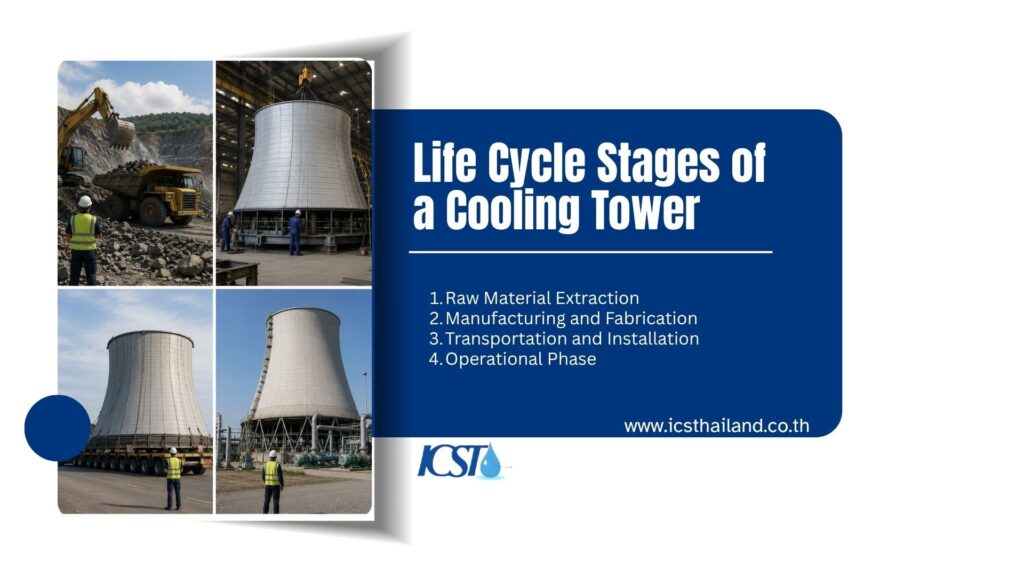
A cooling tower life cycle assessment involves analyzing five distinct phases. Each stage contributes differently to the total environmental footprint.
Stage 1: Raw Material Extraction
Cooling towers use steel, fiberglass, PVC, and HDPE materials. Before listing impacts, understand that material sourcing determines embodied carbon baseline.
- Mining of metals like steel increases CO₂ emissions
- Polymer production consumes fossil fuels
- Material processing requires high energy input
Stage 2: Manufacturing and Fabrication
Factories produce FRP panels, fabricate fans, assemble structural parts, and manufacture fill media. Major impact sources include factory electricity use, process emissions, and material waste generation.
Stage 3: Transportation and Installation
Logistics teams ship components globally and locally. In Thailand, this involves importing equipment through major ports, navigating regional distribution networks, and using heavy crane operations for site installation. Shipping emissions and local transport activities add measurable carbon to the project.
Stage 4: Operational Phase
The operational phase completely dominates the lifecycle footprint. Facilities generate massive carbon footprints by powering fan motors, running pump energy, and operating water treatment systems.
Water consumption impacts include evaporation losses, blowdown losses, drift losses, and high makeup water demand. Chemical usage adds further impacts through biocides, scale inhibitors, corrosion inhibitors, and water treatment chemicals.
Embodied Carbon vs Operational Carbon
Many procurement teams misunderstand the sources of cooling tower emissions. Distinguishing between the carbon built into the equipment and the carbon generated by using it remains crucial.
Embodied carbon includes all greenhouse gases emitted during material extraction, manufacturing, transportation, and installation. Operational carbon includes the electricity consumption, water treatment, and pumping energy required during long-term operation.
Operational carbon represents the much larger source of lifetime emissions. Because industrial cooling systems operate continuously for decades, energy-efficient designs quickly offset higher initial material impacts.
Environmental Impact Categories Measured in LCA
An LCA methodology measures several specific environmental indicators. These metrics help engineers quantify exactly how a system affects the planet.
Engineers track greenhouse gas emissions as CO₂ equivalent to determine the carbon footprint and climate change impact. They measure energy consumption by analyzing primary energy demand and fossil fuel dependence.
The water footprint reveals blue water consumption and regional water scarcity impacts. Assessments also track resource depletion and pollution indicators like acidification and eutrophication.
Cooling Tower Materials and Their Environmental Impact
When conducting a cooling tower life cycle assessment, material selection is a critical factor that directly affects lifecycle emissions.
Before reviewing the table, understand that while some materials may have a higher initial carbon footprint, their durability can significantly reduce long-term environmental impact.
Environmental Comparison of Cooling Tower Construction Materials
| Material | Embodied Carbon | Durability | Maintenance Demand | Recyclability |
| FRP (Fiberglass) | Medium | High | Low | Moderate |
| Galvanized Steel | High | Moderate | Moderate | High |
| Stainless Steel | High | Very High | Low | High |
| Concrete | High | Very High | Low | Moderate |
| HDPE Components | Low-Medium | High | Low | Moderate |
Operational Factors That Drive Lifetime Emissions
While embodied carbon is a key factor, operational emissions often have a greater environmental impact over a cooling tower’s lifespan. Facility operators can achieve significant long-term environmental savings through small adjustments to daily operations.
Key operational factors include:
- Fan Energy Consumption: This is heavily influenced by motor efficiency, Variable Frequency Drive (VFD) operation, and optimal fan selection.
- Water Management: Optimizing cycles of concentration, reducing makeup water demand, and minimizing blowdown are crucial for efficiency.
- Maintenance Practices: Regular cleaning and timely fill replacement are essential to prevent performance degradation over time.
- Local Climate Conditions: Thailand’s high wet-bulb temperatures and humidity require cooling systems to work harder, leading to increased resource consumption.
LCA Comparison of Cooling Tower Technologies
A cooling tower life cycle assessment reveals that different technologies address distinct environmental challenges. Facility owners must match the technology to their specific sustainability goals.
- Open-circuit cooling towers offer high energy efficiency but require significant water consumption.
- Closed-circuit cooling towers save water but increase equipment impacts and energy demands.
- Hybrid cooling towers reduce water use significantly but require a larger capital footprint and higher embodied carbon.
- Dry cooling systems eliminate water consumption entirely but force fans to consume much more electricity.
Strategies to Reduce Cooling Tower Lifetime Emissions
Engineers use cooling tower life cycle assessment (LCA) data to identify environmental hotspots and implement targeted improvements. Focusing on high-impact areas delivers the best return on investment for sustainability initiatives.
Targeting the most wasteful processes lowers both environmental impact and operating costs. The most useful improvement strategies include:
- Design Improvements: Install high-efficiency fans, VFD controls, and improved fill media to reduce electricity demand.
- Water Efficiency Improvements: Optimize cycles of concentration and install water reuse systems to reduce makeup water requirements.
- Material Selection Improvements: Specify recycled materials and low-carbon materials to lower initial equipment impacts.
- Digital Monitoring Improvements: Implement IoT monitoring and predictive maintenance to ensure the tower always operates at peak efficiency.
How ICS Thailand Supports Sustainable Cooling Tower Projects
Achieving sustainability goals for your cooling tower life cycle assessment requires partnering with experts who understand regional challenges and engineering best practices. International Cooling Solutions (Thailand) provides the technical expertise to optimize industrial cooling systems.
ICST delivers energy-efficient cooling tower design, lifecycle planning, and sustainability consulting tailored for the Asian market.
We help facilities execute water optimization strategies, perform high-efficiency retrofit projects, and drive long-term asset performance improvement to minimize environmental impacts.
Summary
A cooling tower life cycle assessment gives facility owners a complete, transparent picture of environmental performance. Evaluating the system from cradle to grave proves that operational carbon drastically exceeds embodied carbon over long service lives.
Using a rigorous LCA methodology helps organizations minimize water consumption, reduce lifetime emissions, make better ESG decisions, and lower long-term operating costs.
Frequently Asked Questions
What is a cooling tower life cycle assessment?
A cooling tower LCA evaluates environmental impact from raw material extraction to disposal. It measures carbon emissions, energy use, and water consumption across the entire system lifespan. Engineers use this method to compare designs and improve sustainability performance in industrial cooling systems.
What does cradle-to-grave mean in cooling tower LCA?
Cradle-to-grave includes all lifecycle stages such as raw material extraction, manufacturing, transportation, operation, maintenance, and end-of-life disposal. This approach ensures full environmental accountability instead of focusing only on installation or purchase cost.
Which stage creates the most emissions?
Operational phase creates the highest emissions due to continuous electricity use in fans, pumps, and water treatment systems. This stage often dominates total lifecycle impact because cooling towers operate for many years.
How can emissions be reduced?
Emissions reduce through efficient motors, VFD systems, improved water management, and better material selection. Regular maintenance and smart monitoring systems also improve efficiency and reduce long-term environmental impact.
Why is LCA important for ESG reporting?
LCA provides measurable environmental data required for ESG frameworks such as GRI and TCFD. It helps organizations report carbon emissions, water usage, and sustainability performance accurately and transparently.