Cooling tower water treatment is the ongoing process of controlling water chemistry to prevent scale, corrosion, fouling, and microbiological growth in recirculating cooling systems. Effective water quality management combines source-water testing, chemical treatment, filtration, blowdown control, cleaning, and automation.
Because evaporation concentrates dissolved solids, a well-designed treatment program protects heat-transfer efficiency, extends equipment life, and supports scale prevention while reducing water and energy waste in industrial facilities across Thailand.
What Is Cooling Tower Water Treatment?
Cooling tower water treatment is the practice of managing the chemistry and biology of recirculating cooling water. The goal is to protect equipment and maintain reliable cooling performance.
Makeup water enters the system to replace what evaporates and drains away. As the tower runs, evaporation removes pure water and leaves dissolved minerals behind. Those minerals build up over time.
Contaminants also enter from three sources. Airborne dust and debris fall into the open basin. Makeup water carries dissolved solids from the source. The operating environment adds organic matter and microbes.
Treatment needs vary widely. A tower fed by hard, high-alkalinity water needs a very different program than one fed by soft or treated water.
How Water Chemistry Changes Inside a Cooling Tower
Understanding these changes helps operators set correct control limits. Each parameter shifts as water cycles through the tower, and small changes can trigger big problems.
- Evaporation: Removes pure water and leaves minerals behind, driving up concentration.
- Dissolved solids: Rise steadily as cycles increase, raising scaling and corrosion risk.
- Conductivity: Reflects total dissolved mineral content and guides blowdown control.
- pH: Drifts higher as alkalinity concentrates, which favors scale formation.
- Alkalinity: Increases scaling tendency when combined with hardness.
- Hardness: Supplies calcium and magnesium that form scale on hot surfaces.
- Suspended solids: Accumulate from air and makeup water and cause fouling.
Why Cooling Tower Water Quality Matters
Water quality controls more than cleanliness. It directly affects operating cost and system reliability, which is why water quality management sits at the center of every program.
- Heat-transfer efficiency: Clean surfaces move heat freely, cutting energy use.
- Equipment reliability: Balanced chemistry protects pumps, pipes, and heat exchangers.
- Maintenance: Controlled water lowers downtime and reduces cleaning frequency.
- Water consumption: Smart chemistry lets you run more cycles and waste less water.
- Chemical consumption: Stable conditions reduce overdosing and chemical cost.
- System lifespan: Proper treatment adds years of service to major components.
What Problems Does Cooling Tower Water Treatment Prevent?
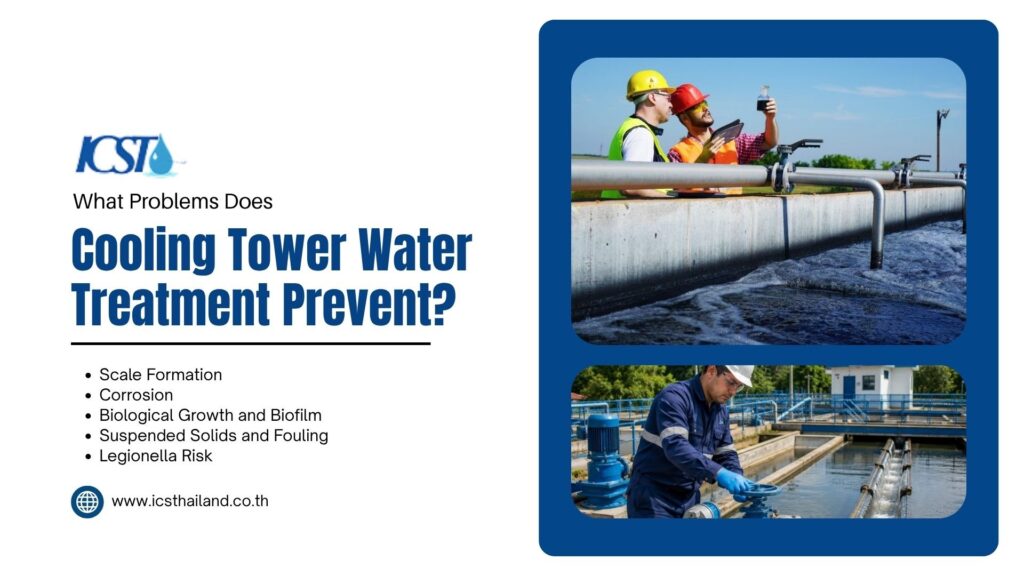
A strong program targets four connected problems. Each one feeds the others, so ignoring any single issue weakens the entire system.
Scale Formation
Scale forms when calcium carbonate and similar minerals deposit on hot metal surfaces. A thin scale layer acts like insulation and blocks heat transfer.
Even a small deposit forces equipment to work harder and use more energy. Scale prevention through inhibitors and controlled cycles costs far less than removing thick, hardened deposits later.
Corrosion
Corrosion attacks pipes, heat exchangers, tower metal, and other components. Low pH, high dissolved solids, and dissolved oxygen all speed the process.
Corrosion inhibitors form a protective film on metal surfaces. Without them, leaks and failures appear well before the equipment reaches its expected life.
Biological Growth and Biofilm
Warm, sunlit, oxygen-rich water is ideal for microbes. Algae, bacteria, and slime multiply quickly in untreated towers.
Biofilm is especially dangerous. It insulates surfaces, shields microbes from biocides, and accelerates corrosion underneath it. Controlling biofilm keeps the rest of the treatment program working.
Suspended Solids and Fouling
Dirt, dust, sediment, and airborne particles collect in the basin and settle on surfaces. This buildup fouls heat-transfer areas and clogs equipment.
Fouling also protects microbes and reduces biocide contact. Removing suspended solids supports both efficiency and microbiological control.
Legionella Risk
Microbiological control is a core part of cooling-tower water management. Cooling towers can support Legionella bacteria when conditions allow.
The CDC identifies sediment, biofilm, warm temperatures, water age, and low disinfectant residual as factors that support Legionella growth in cooling towers. Managing these factors is a water-treatment and maintenance responsibility, not a medical claim. Always follow local health guidance and qualified specialists for public-health matters.
Key Parameters to Monitor in Cooling Tower Water
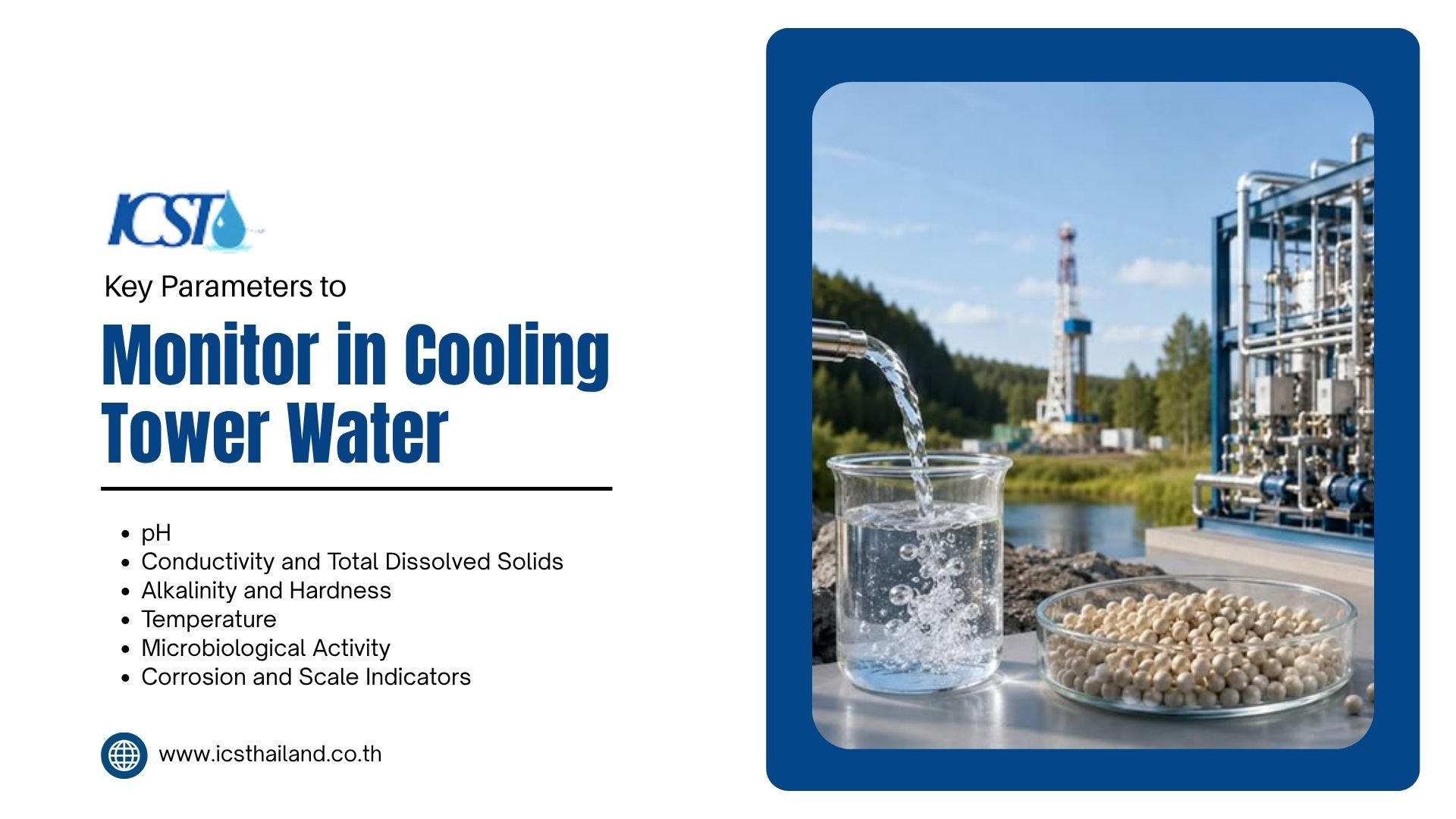
Monitoring turns treatment from guesswork into control. Tracking the right values lets operators catch problems early and adjust dosing before damage occurs.
pH
pH shapes both scaling and corrosion tendency. High pH favors scale, while low pH speeds corrosion. The correct range depends on your treatment chemistry and system metallurgy.
Conductivity and Total Dissolved Solids
Conductivity measures how well water carries electrical current, which reflects dissolved mineral content. Higher conductivity means more concentrated water. Operators use conductivity readings to trigger blowdown at the right moment.
Alkalinity and Hardness
Alkalinity and hardness drive scale formation together. Source-water chemistry sets the starting point, so towers fed by hard water need tighter control and stronger scale inhibitors.
Temperature
Temperature affects chemical reaction rates and microbial activity. Warmer water increases scaling tendency and speeds bacterial growth, so hotter systems often need adjusted dosing.
Microbiological Activity
Bacteria, algae, and biofilm must be tracked, not assumed. Regular dip-slide tests or lab counts show whether biocide levels are working before growth spreads.
Corrosion and Scale Indicators
Direct evidence beats estimates when judging long-term performance. These tools show what is actually happening on metal surfaces over time.
ASHRAE identifies monitoring devices such as corrosion coupons, test spools, and biofilm sensors as useful tools for tracking cooling-water conditions.
- Corrosion coupons: Pre-weighed metal strips reveal corrosion rates after set exposure.
- Test spools: Removable pipe sections show real-world deposit and corrosion buildup.
- Deposit checks: Physical samples confirm scale and fouling severity.
- Visual inspections: Routine tower checks catch problems automated readings miss.
Cooling Tower Water Treatment Chemicals
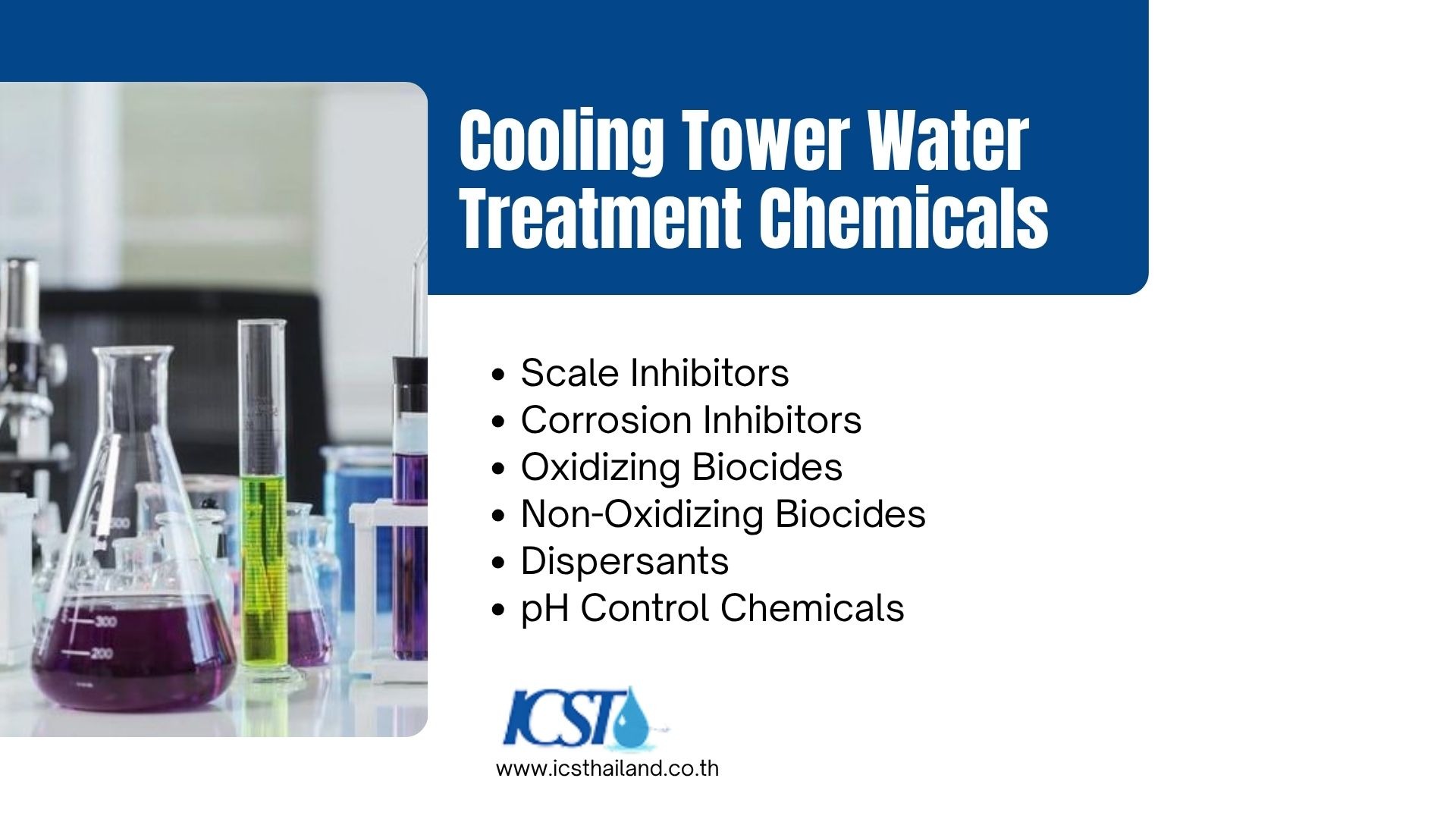
Chemical treatment remains the foundation of most programs. Each chemical class handles a specific problem, and they work best as a coordinated system rather than isolated additives.
Scale Inhibitors
Scale inhibitors interfere with crystal growth so minerals stay dissolved instead of coating surfaces. Selection depends on hardness, alkalinity, and how many cycles you plan to run.
Corrosion Inhibitors
Corrosion inhibitors build a protective layer on metal. The right product depends on system metallurgy, since steel, copper, and mixed-metal systems each need different protection.
Oxidizing Biocides
Oxidizing biocides kill microbes fast and control biofilm. Chlorine and bromine are common examples. Dosage and residual matter, since too little fails and too much harms equipment.
Non-Oxidizing Biocides
Non-oxidizing biocides handle organisms that resist oxidizers. Alternating oxidizing and non-oxidizing biocides prevents microbes from building resistance and improves long-term control.
Dispersants
Dispersants keep suspended particles floating so they leave with blowdown instead of settling. This supports fouling control and helps biocides reach hidden microbes.
pH Control Chemicals
Acid feed lowers pH and controls alkalinity, which reduces scaling. Overdosing is risky, since excess acid drives corrosion and can damage equipment quickly.
Choosing the Right Chemical Treatment Program
No single program fits every tower. The best choice reflects your specific water and operating conditions.
ASHRAE notes that treatment-program selection depends on water quality, system metallurgy, economics, performance criteria, staffing, automation, and environmental requirements. Consider these factors together:
- Source-water chemistry: Sets the baseline for scaling and corrosion risk.
- System metallurgy: Determines which inhibitors protect your metals.
- Operating temperature: Influences dosing and microbial control needs.
- Cycles of concentration: Defines how concentrated the water becomes.
- Cooling load: Affects evaporation rate and chemical demand.
- Environmental requirements: Shapes discharge limits and product choices.
- Treatment objectives: Balances water savings against equipment protection.
Cooling Tower Water Treatment Technologies
Technology extends what chemistry alone can achieve. Used well, these tools reduce chemical demand, improve efficiency, and support cleaner operation.
Side-Stream Filtration
Side-stream filtration treats a portion of the circulating water and returns it clean. It removes suspended solids and reduces fouling.
The U.S. Department of Energy notes that side-stream filtration can reduce suspended solids and help increase cycles of concentration, but it does not eliminate the need for chemical treatment. Use it in dusty or fouling-prone systems as a support, not a replacement.
Centrifugal Separators
Centrifugal separators use spinning motion to fling heavy particles out of the water. They excel at removing sand and grit but struggle with fine or low-density particles.
Multimedia Filtration
Multimedia filters pass water through layered media to capture suspended particles of different sizes. They fit well inside a broader program that also controls chemistry and biology.
Ultrafiltration
Ultrafiltration forces water through a fine membrane that blocks very small particles and microbes. It targets suspended matter, not dissolved solids, so it complements rather than replaces mineral control.
Water Softening
Softening removes hardness from makeup water by exchanging calcium and magnesium for sodium. This helps control scale in hard-water areas but must match the overall chemistry plan to avoid new problems.
Reverse Osmosis
Reverse osmosis treats makeup water by pushing it through a membrane that removes dissolved solids. Cleaner makeup water allows higher cycles, but the equipment adds cost and complexity.
Automated Chemical Feed and Monitoring
Automation keeps treatment consistent around the clock. Sensors and controllers dose chemicals only when needed.
The CDC recommends automated water-treatment systems and automated blowdown as part of cooling-tower management and Legionella control. Automation delivers:
- Automated dosing: Adds chemicals based on real readings, not fixed schedules.
- Conductivity control: Triggers blowdown at the correct concentration.
- pH monitoring: Holds pH inside the target range automatically.
- Disinfectant monitoring: Maintains steady biocide residual.
- Fewer errors: Removes the guesswork of manual dosing.
Blowdown and Cycles of Concentration
Blowdown and cycles work together to balance water savings with equipment protection. Master both, and you cut costs without inviting scale or corrosion.
What Is Cooling Tower Blowdown?
Blowdown is the deliberate draining of a portion of concentrated water. Fresh makeup water then dilutes the remaining loop.
Why Blowdown Is Necessary
Without blowdown, dissolved solids climb without limit. That leads directly to heavy scale and aggressive corrosion.
What Are Cycles of Concentration?
Cycles of concentration measure how many times minerals concentrate compared with makeup water. Higher cycles mean more concentrated water and less blowdown.
How Cycles of Concentration Affect Water Consumption
Running more cycles reuses each drop longer and cuts water waste. The trade-off is more concentrated water, which raises scaling and corrosion risk.
Automated Blowdown Control
A conductivity controller opens the blowdown valve only when water reaches the set limit. This holds cycles steady and avoids wasteful over-draining.
Balancing Water Savings With Scale and Corrosion Control
The DOE explains that increasing cycles of concentration reduces blowdown water use, while water-quality conditions determine how far a system can safely operate. Test your water to find the safe upper limit before pushing cycles higher.
How to Choose the Right Cooling Tower Water Treatment Program
Program selection is a decision, not a default. Working through these steps helps match treatment to your real conditions.
- Analyze the makeup water: Test source chemistry before anything else.
- Evaluate cooling tower design: Match treatment to tower type and layout.
- Consider system metallurgy: Choose inhibitors that protect your metals.
- Determine cooling load and operating conditions: Size dosing to real demand.
- Establish water conservation goals: Set target cycles and savings.
- Evaluate chemical vs. non-chemical technologies: Combine both where useful.
- Consider automation requirements: Decide where automation adds value.
- Calculate total treatment cost: Include chemicals, water, energy, and labor.
- Work with a qualified specialist: Get expert input for complex or high-risk systems.
Chemical vs. Non-Chemical Cooling Tower Water Treatment
Most facilities blend chemical and non-chemical methods rather than choosing one. This table compares common approaches so you can match each to your system and decide where each fits.
| Treatment Approach | Main Purpose | Best Used For | Key Consideration | Relative Complexity |
| Chemical treatment | Scale, corrosion, biological control | Most systems | Requires ongoing monitoring | Moderate |
| Side-stream filtration | Suspended solids removal | Fouling-prone systems | Does not replace chemicals | Low to moderate |
| Water softening | Hardness reduction | Scale-prone makeup water | Depends on source water | Moderate |
| Reverse osmosis | Dissolved-solids reduction | High-purity makeup needs | Higher cost and upkeep | High |
| Automated monitoring | Process control and consistency | Modern treatment programs | Requires regular calibration | Moderate |
How to Improve Water Efficiency With Better Treatment
Better treatment and lower water use go hand in hand. These steps cut waste while protecting equipment.
- Optimize cycles of concentration: Run the highest safe cycles for your water.
- Use automated blowdown: Drain only when conductivity demands it.
- Reduce unnecessary blowdown: Avoid manual over-draining habits.
- Consider side-stream filtration: Cleaner water supports higher cycles.
- Improve makeup water quality: Softening or RO can lift safe cycle limits.
- Monitor treatment performance: Use data to fine-tune water use.
- Reuse or reclaim water: Capture suitable water where regulations allow.
Cooling Tower Water Treatment Checklist
A simple checklist keeps routine tasks from slipping. Use this to standardize monitoring and maintenance across your team.
- Makeup-water testing: Confirm source chemistry on schedule.
- pH monitoring: Keep pH inside target range.
- Conductivity monitoring: Track dissolved solids for blowdown.
- Hardness and alkalinity: Watch scaling tendency.
- Chemical dosage: Verify inhibitor and biocide levels.
- Biocide residual: Maintain steady disinfectant control.
- Blowdown: Confirm automated blowdown works.
- Cycles of concentration: Hold at the safe target.
- Side-stream filtration: Check filter performance.
- Sediment inspection: Clear basins of buildup.
Conclusion
Cooling tower water treatment protects your equipment, cuts energy waste, and controls Legionella risk through one coordinated program: correct water chemistry, the right chemical mix, consistent monitoring, and automated control.
Ready to stop guessing and start controlling your water chemistry? Talk to the water treatment engineers at ICS Thailand for a site-specific assessment and a program built around your exact makeup water, metallurgy, and cooling load.
Contact ICST today to schedule your consultation.
Frequently Asked Questions
How often should cooling tower water be tested?
Test makeup water when designing or revising a treatment program, then monitor key parameters like conductivity, pH, and biocide residual continuously or daily depending on your automation level. Full lab analysis, including hardness, alkalinity, and microbiological counts, is typically done monthly or whenever operating conditions change significantly.
What is the ideal pH range for cooling tower water?
There is no single universal number, since the correct range depends on your specific treatment chemistry and system metallurgy. Most programs target a moderately alkaline range that balances scale and corrosion risk, and a qualified water treatment specialist should set the exact limits for your system rather than relying on a generic figure.
Can side-stream filtration replace chemical treatment entirely?
No. Side-stream filtration removes suspended solids and supports higher cycles of concentration, but it does not control dissolved minerals, corrosion, or microbiological growth on its own. It works best as a support technology inside a broader chemical treatment program, not as a standalone replacement for it.
How do cycles of concentration affect blowdown?
Higher cycles of concentration mean water is reused more times before being discharged, which directly reduces how much blowdown, and therefore makeup water, a system needs. The tradeoff is that higher cycles also mean more concentrated dissolved solids, so the safe upper limit depends on your specific water quality and treatment program.
Why is Legionella control part of a water treatment program rather than a separate process?
Legionella risk is driven by the same underlying conditions a treatment program already manages: sediment, biofilm, water stagnation, and inadequate disinfectant residual. Controlling these factors through routine treatment, monitoring, and automation directly reduces the conditions that allow Legionella to grow, which is why the CDC treats it as part of standard cooling tower water management rather than a separate health procedure.