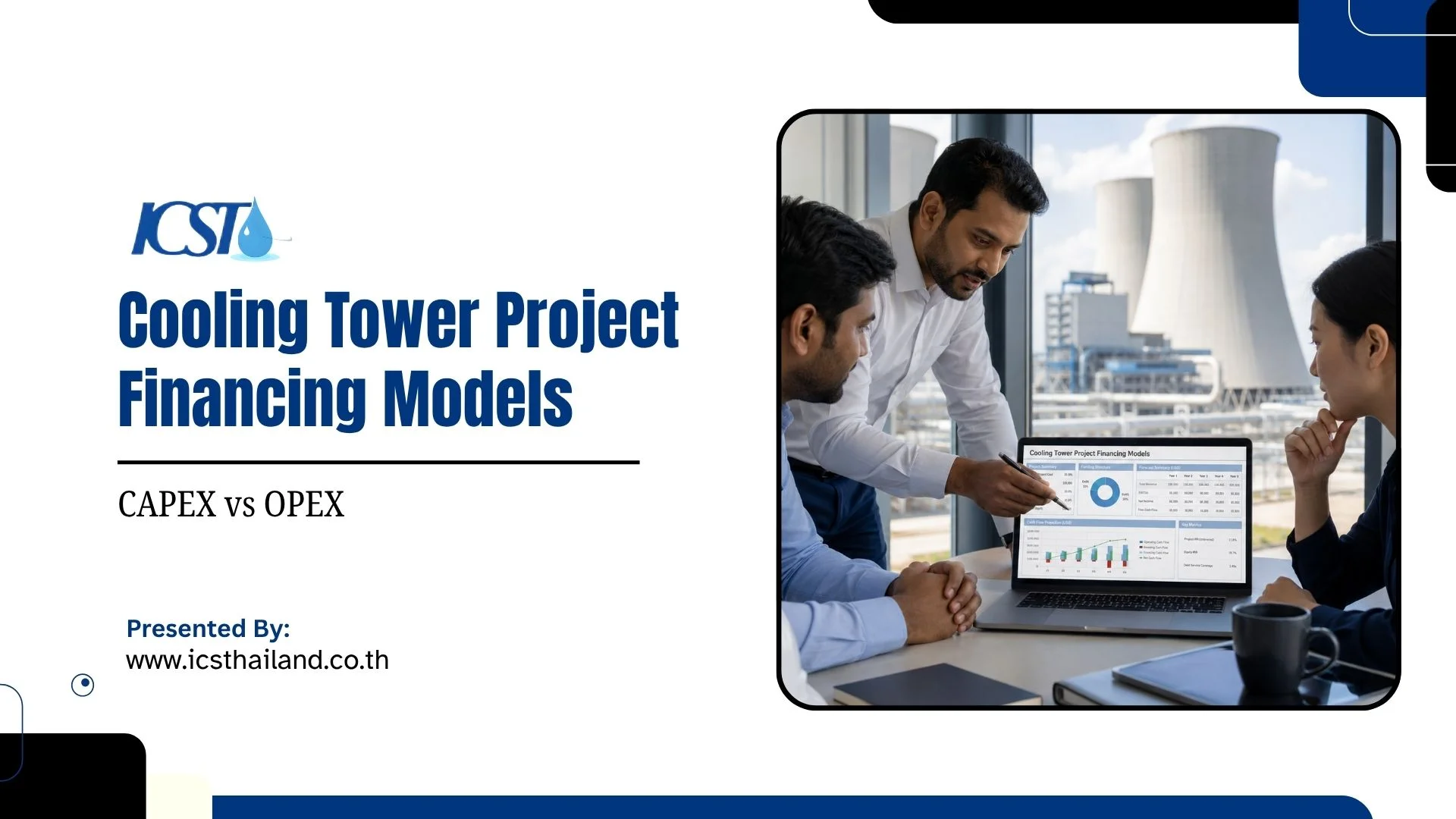
Choosing between cooling tower project financing models requires evaluating upfront capital against long-term operational costs. CAPEX OPEX decisions determine whether a facility buys the equipment outright or pays for cooling as a service over time. Facilities that buy equipment take on full maintenance responsibilities and upfront costs.
Service-based models transfer performance risks to the provider while maintaining predictable monthly expenses. Industrial plants in Thailand must align these financial structures with their specific cash flow, risk tolerance, and long-term energy efficiency goals.
Direct Understanding of Cooling Tower Financing Models
Financing structures dictate how industrial facilities acquire and operate essential cooling systems. Plant managers must understand how the payment structure impacts overall cost, asset ownership, and operational risk.
Evaluating cooling tower project financing models goes beyond the initial price tag. The decision changes who pays for maintenance, who absorbs efficiency losses, and who owns the asset at the end of the lifecycle.
Facilities traditionally choose between two main structures, though modern alternatives now offer more flexibility. Buyers must evaluate these options based on real industrial constraints.
- Capital Expenditure (CAPEX): The facility purchases the cooling tower outright, paying all upfront costs and retaining full ownership.
- Operational Expenditure (OPEX): The facility pays a recurring fee to use the cooling system without purchasing the physical asset.
- Modern Financing Shifts: Many plants now transition from purchasing equipment to using service-based models like cooling as a service to preserve capital.
What is CAPEX in Industrial Cooling Tower Projects?
Among the various cooling tower project financing models, the capital investment (CAPEX) model requires a company to pay for the entire cooling infrastructure before operation begins. This structure suits organizations with high capital reserves.
Financial structure of CAPEX model
The upfront cost model demands significant immediate cash flow. Facilities must allocate large budgets to cover the entire scope of the procurement and installation.
Companies choosing this route must account for all initial expenses before the system even activates. Understanding this financial structure helps buyers plan their capital budgets accurately.
- Equipment costs: Buyers pay directly for the cooling tower unit, fan assemblies, and internal components.
- Installation fees: The facility funds the labor, heavy machinery, and structural modifications required for setup.
- Commissioning expenses: Plants pay engineers to test and calibrate the system for optimal performance.
Ownership, control, and asset lifecycle
Purchasing the equipment gives the facility complete control over the cooling tower. The plant can modify, upgrade, or replace components without consulting an outside provider.
Full ownership also means the asset sits on the company balance sheet. This impacts the financial valuation of the facility over time.
- Asset depreciation: Financial departments can write off the value of the cooling tower over its useful life to reduce taxable income.
- End-of-life value: The facility retains the right to sell the equipment or scrap it for residual value.
- Operational control: Plant engineers dictate the maintenance schedule and replacement timelines.
Advantages in long-term industrial planning
Large industrial plants often prefer the capital investment model because it provides long-term stability. The facility does not worry about rising subscription fees or restrictive vendor contracts.
Owning the equipment outright often results in the lowest total cost of ownership over a twenty-year lifecycle. Financial planners value this predictability.
- Tax benefits: Companies use depreciation schedules to lower their annual corporate tax burden.
- Long-term cost control: The facility avoids inflation-linked price hikes that often appear in service contracts.
- Vendor independence: Plant managers hold the freedom to hire any contractor for maintenance and repairs.
What is OPEX in Cooling Tower Financing?
The OPEX approach to cooling tower project financing models shifts the financial burden from an upfront purchase to an ongoing expense. This service-based payment model treats cooling like a public utility.
Service-based cooling infrastructure model
Under the cooling as a service model, a third-party provider installs, owns, and maintains the cooling tower. The industrial facility simply pays for the cooling output it consumes.
This model removes the equipment from the plant balance sheet. The provider retains ownership of the physical asset throughout the contract.
Subscription or usage-based payment structure
Facilities pay for cooling through predictable monthly fees or usage-based metrics. This model aligns cooling costs directly with plant production levels.
Financial departments prefer this structure when they need predictable operating budgets. It eliminates surprise repair bills.
- Monthly flat fees: The facility pays a set amount every month regardless of minor fluctuations in usage.
- Pay-per-ton billing: The provider charges the plant based exactly on the chilled water or cooling capacity consumed.
- Predictable budgeting: Accounting teams can forecast annual operating expenses with high accuracy.
Risk transfer to service provider
The service provider is responsible for keeping the equipment running efficiently. If the tower fails, the provider pays for the repair.
This risk transfer protects the industrial facility from unexpected downtime costs.
- Maintenance shift: The service company hires the technicians, procures the spare parts, and schedules the labor.
- Performance guarantees: The provider faces financial penalties if the cooling system fails to meet agreed temperature targets.
- Efficiency incentives: The owner of the equipment holds a direct financial motivation to keep the system running efficiently to lower their own energy costs.
Cost predictability vs long-term expense tradeoff
Paying for a service provides short-term cash flow relief but often costs more over the total lifecycle of the equipment. Companies must weigh immediate savings against long-term spending.
A utility-style cooling system offers peace of mind at a premium. The provider builds their profit margin and risk premium into the monthly fee.
CAPEX vs OPEX: Financial Comparison in Real Industrial Scenarios
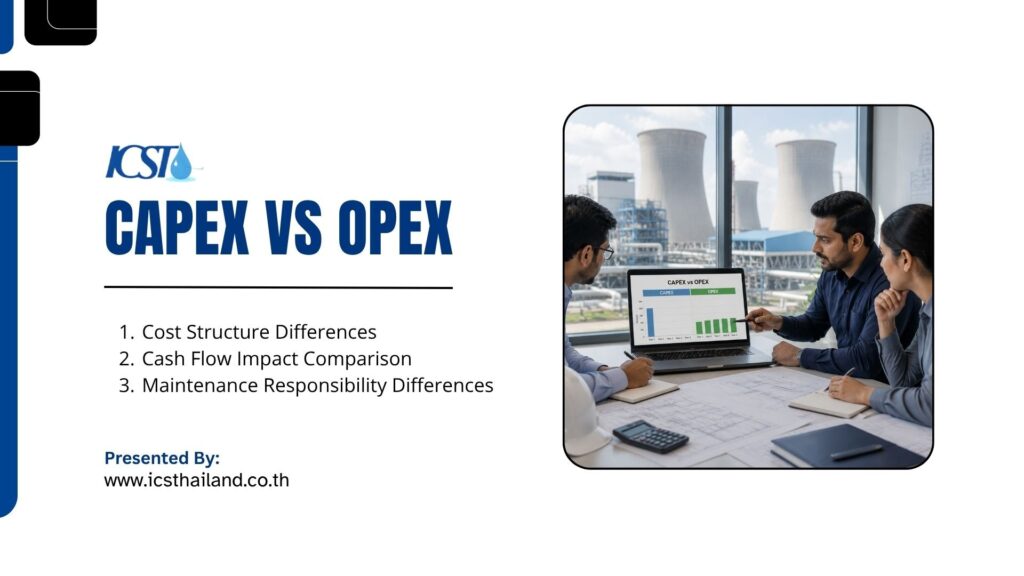
Industrial decision-makers must compare cooling tower project financing models based on real operational realities, not just accounting theory.
A plant in Thailand, for instance, faces specific constraints regarding cash flow, energy costs, and maintenance capabilities that will influence their choice.
Cost structure differences
The timing of cash leaving the business differs fundamentally between the two models. Capital purchases require massive initial funding, while service models spread costs over a decade.
Plant financial officers must evaluate how these structures impact overall corporate liquidity.
- Upfront intensity: Capital purchases drain millions of Baht on day one, whereas service models require zero initial investment.
- Recurring load: Capital models incur variable maintenance costs, while service models demand high, fixed monthly payments.
- Total lifecycle cost: Buying the equipment usually remains cheaper over twenty years, assuming the plant manages maintenance efficiently.
Cash flow impact comparison
Short-term liquidity often dictates the survival of a scaling business. Service models preserve cash for core production investments, like buying raw materials or hiring staff.
Capital purchases strengthen the balance sheet by adding a tangible asset, but they reduce the cash available for emergencies.
Maintenance responsibility differences
Industrial cooling towers require rigorous maintenance, especially in humid environments like Thailand. The financing model determines who manages this burden.
Under a capital model, plant engineers handle the stress of breakdowns. Under a service model, the provider handles the repairs.
- Breakdown response: Owners must source emergency parts themselves, while service clients simply call their provider.
- Efficiency tuning: Owners must pay for optimization audits, whereas service providers tune the system automatically to protect their margins.
- Labor allocation: Owners must train internal staff on cooling systems, while service clients free up their staff for core manufacturing tasks.
Financial and Operational Comparison Table
Decision-makers need a clear framework to evaluate the tradeoffs between purchasing equipment and using service models.
This table outlines how the two main structures compare across critical industrial metrics.
| Feature | CAPEX Model | OPEX Model | Cash Flow Impact | Risk Holder |
| Initial Cost | Very High | Zero to Very Low | High immediate drain | Facility |
| Maintenance | Facility managed | Provider managed | Variable repair costs | Provider |
| Asset Ownership | Facility owns asset | Provider owns asset | Appears on balance sheet | Provider |
| Performance Risk | Facility absorbs losses | Provider guarantees output | Unpredictable efficiency | Provider |
| Long-Term Cost | Lowest overall | Higher overall | Predictable but high | Shared |
NPV Comparison for Cooling Tower Investment Decisions
A simple cost comparison does not provide enough accuracy for multi-million-dollar industrial investments. Financial teams use a Net Present Value (NPV comparison) to determine the true cost of each model over time.
This analysis adjusts future cash flows to their present value. It reveals which cooling tower project financing models actually save money.
Understanding NPV in industrial financing
Net Present Value calculates the current worth of future cash outflows, factoring in the time value of money. Money available today holds more value than money available in ten years.
By using an NPV comparison, buyers can accurately evaluate a massive upfront payment against fifteen years of monthly service fees.
CAPEX vs OPEX cash flow over time
The capital model shows a massive negative cash flow in year one, followed by minor expenses for energy and maintenance.
The operational model shows zero upfront cost, but a steady, high negative cash flow every year for the duration of the contract.
Real decision-making implications for industries
If the NPV comparison shows a lower value for the capital purchase, the company should buy the equipment. If the service model yields a lower NPV, the company should choose the service route.
Highly profitable manufacturing plants usually find that buying the equipment yields the best NPV.
Modern Financing Models Beyond CAPEX and OPEX
The industrial market now offers hybrid cooling tower project financing models that blend the benefits of both traditional models. These structures provide flexibility for facilities with specific financial constraints.
Understanding these modern models helps procurement teams negotiate better terms.
Equipment Leasing for Cooling Towers
Equipment leasing allows a facility to use a cooling tower for a fixed term without purchasing it upfront. The facility pays a monthly lease fee to a financial institution.
Unlike service models, the facility usually takes responsibility for maintenance and energy costs.
- Fixed-term usage: The plant leases the equipment for five to ten years.
- Buyback options: The facility can purchase the tower at a discounted rate at the end of the lease.
- Capital preservation: The company keeps its cash reserves intact while securing modern cooling technology.
Energy Performance Contracts (EPC)
An energy performance contract involves an energy service company (ESCO) that installs new, efficient cooling equipment. The facility pays for the equipment using the money saved on energy bills.
If the new equipment does not generate the promised savings, the ESCO covers the difference.
- Savings-based payments: The plant only pays based on verified reductions in energy consumption.
- Zero capital requirement: The ESCO funds the entire upfront installation.
- Guaranteed efficiency: The provider carries the risk of technological performance.
Hybrid financing structures
Some providers offer customized contracts that mix capital payments with service agreements. A facility might pay for the equipment upfront but sign a long-term, risk-sharing maintenance contract.
This allows the plant to own the asset while still transferring operational risk to an expert provider.
How to Choose the Right Financing Model?
Selecting the right cooling tower project financing models requires a deep analysis of plant operations, corporate cash flow, and long-term strategy. There is no universally correct answer.
Plant executives must use a structured decision framework to evaluate their specific needs.
When CAPEX is the better choice
Established companies with strong balance sheets usually benefit from purchasing equipment directly.
This path secures the lowest long-term costs and ensures complete operational control.
- Stable cash flow companies: Businesses with large cash reserves do not need financing help.
- Long-term asset strategy: Facilities planning to operate in the same location for twenty years benefit from ownership.
- In-house expertise: Plants with dedicated engineering teams can manage maintenance efficiently without outside help.
When OPEX is the better choice
Fast-growing companies or facilities with tight budgets prefer service models.
This path protects cash reserves and allows management to focus entirely on production.
- Cash-sensitive businesses: Companies needing cash for core manufacturing processes avoid heavy upfront investments.
- Fast-scaling industries: Facilities that need to rapidly expand prefer flexible, utility-style cooling agreements.
- Limited technical staff: Plants lacking specialized HVAC technicians rely on providers to ensure reliability.
When hybrid models are ideal
Medium-scale industries often find pure capital or pure operational models too extreme.
They use equipment leasing or an energy performance contract to balance cost and control.
- Medium-scale industries: Facilities that want ownership but need to spread payments over five years.
- Technology-driven operations: Plants focused on achieving strict energy efficiency targets use performance contracts to guarantee results.
Summary
Choosing the right financing model requires balancing capital with long-term risk. Whether you opt for a traditional CAPEX OPEX structure or modern options like an energy performance contract or equipment leasing, prioritizing total lifecycle cost is essential. A thorough NPV comparison ensures your choice aligns with corporate goals.
The rise of cooling as a service shows that performance guarantees are as valuable as physical assets. Ultimately, the best cooling tower project financing models depend on your facility’s unique cash flow, risk tolerance, and operational expertise.
Ready to optimize your cooling tower’s financial and operational performance? Explore our expert solutions at ICST to find the perfect model for your facility.
Frequently Asked Questions
What is the difference between CAPEX and OPEX in industrial cooling systems?
A CAPEX model requires the facility to buy the cooling tower upfront and handle all maintenance. An OPEX model allows the facility to pay a recurring fee to use the equipment while the provider handles maintenance and ownership. The choice heavily influences long-term CAPEX OPEX strategies.
Which financing model is cheaper long-term?
Purchasing the equipment outright usually results in the lowest total cost over a twenty-year lifecycle. However, this assumes the facility manages maintenance and energy efficiency perfectly. Running an NPV comparison reveals the exact financial impact for a specific industrial plant.
What is Cooling as a Service?
Cooling as a service is an operational financing model where a third party owns, operates, and maintains the cooling tower. The industrial facility simply pays a monthly fee based on the amount of cooling consumed. This transfers all performance and maintenance risks to the provider.
How does NPV affect decision-making?
Net Present Value helps buyers compare the true cost of a large upfront payment against years of monthly service fees. It factors in inflation and the time value of money. Financial teams use this to find the most cost-effective cooling tower project financing models.
Is leasing equipment better than purchasing?
Equipment leasing benefits companies that want to preserve cash but still control their own maintenance. It offers lower upfront costs than purchasing and more control than a full service model. It serves as a strong hybrid option for growing industrial plants.
What industries prefer OPEX models?
Data centers, hospitals, and fast-scaling commercial facilities frequently prefer service models. These sectors require guaranteed uptime but do not want to manage specialized HVAC maintenance teams. Heavy manufacturing and power plants typically prefer capital ownership for maximum control.