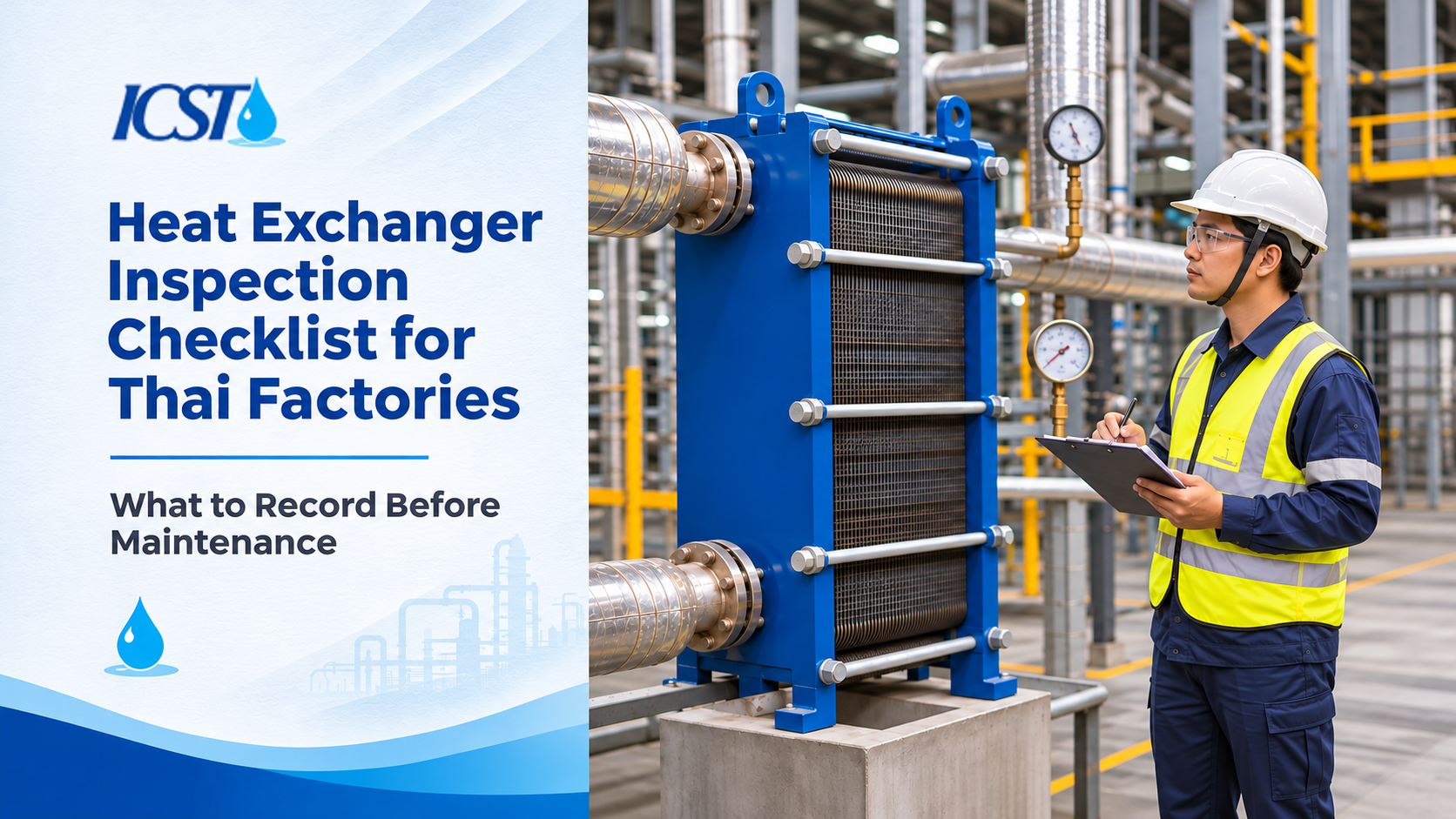
A heat exchanger inspection checklist should record the unit’s identity, design specifications, temperature, pressure, and flow readings, and what you can safely see from the outside, before anyone opens the equipment. A symptom such as a cooler outlet or a damp stain shows where to look, but it does not prove the cause.
Use this guide to build a record that a qualified technician or the manufacturer’s service team can use to evaluate the unit and act on.
It is not an opening procedure, and it gives no test pressures, torque values, or cleaning recipes, because those depend on the equipment and its manual. For background on different types, selection, and fouling, see our guides to heat exchangers and industrial heat exchangers.
Table of Contents
- Why Record Before You Open the Unit
- Identify the Asset First
- Record Comparable Performance Data
- Note External Observations Safely
- Type-Specific Questions for the Technician
- Heat Exchanger Maintenance Checklist Table
- When Further Qualified Inspection Is Appropriate
- What to Send With a Maintenance Enquiry
- Final Thoughts
- Frequently Asked Questions
Why Record Before You Open the Unit
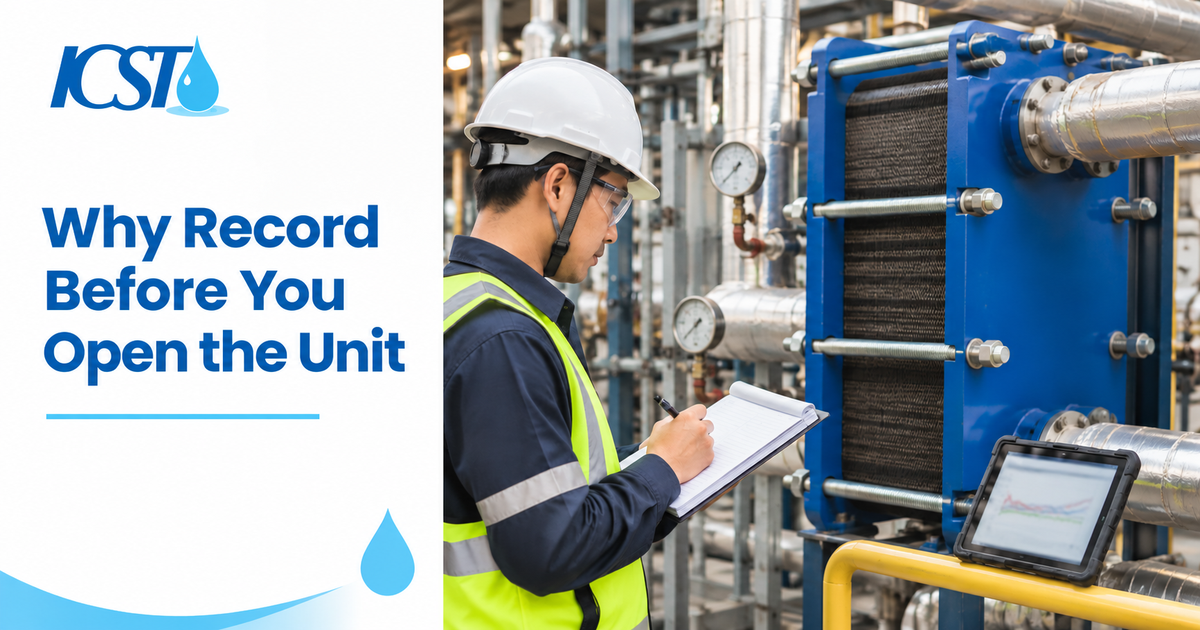
Once a unit is opened, cleaned, or reassembled, its as-found condition is gone. A record taken beforehand lets the next person compare against the design, against earlier readings, and against the state after maintenance, and consistent heat exchanger inspections with checklist-based records help protect structural integrity and thermal efficiency before defects turn into failures.
Regular maintenance works better when each visit starts from a reliable baseline, and regular inspections become more useful when the findings are written down the same way every time.
Observed Facts and Suspected Causes
Manufacturer troubleshooting guidance points the same way. Alfa Laval’s plate heat exchanger troubleshooting page compares actual flows, temperatures, and pressures with the design basis, and it sorts performance problems by timing.
A gradual decline, a sudden change, and a cyclic swing point to different families of causes, but only if your record carries timestamps, units, and design values.
Treat every entry as one of two things:
- Observed: what you measured or saw, with the date and location.
- Suspected: what it might mean, to be confirmed by a qualified person.
Identify the Asset First

Collect these details before taking any readings:
- Asset tag and location: the plant area and the process it serves.
- Make, model, and serial number: photograph the nameplate.
- Exchanger type: gasketed plate, brazed or welded plate, shell-and-tube, or another design.
- Documents: the OEM manual, datasheet, and drawings.
- Design specifications: design temperatures, pressures, and flows for both sides. These are essential, because every later reading is judged against them.
- Fluids: what runs on the hot side and the cold side, and any treatment applied.
- Service history: the last cleaning, any plate, gasket, or tube work, and earlier leaks.
- Operating state and access: running or standby, current load, and constraints such as insulation, height, hot surfaces, or isolation needs.
Work only from positions that your site’s permit-to-work and lockout rules allow. Recording must never involve opening, tightening, or entering the equipment.
Because a heat exchanger is pressure equipment, confirm during preparation which site and unit requirements apply with your safety team before planning further work, including whether ASME Code Section VIII governs the exchanger.
Record Comparable Performance Data
Readings help only when they can be compared, so use the same points, the same instruments, and a similar load each time.
- Temperatures: hot-side inlet and outlet, and cold-side inlet and outlet, from installed temperature sensors.
- Flow: each side, if a meter exists. Mark estimated values as estimated.
- Pressures: inlet and outlet on each side from the pressure gauges, then calculate the pressure drop.
- Context: units, date, time, load, and which gauge or system supplied each value.
- Instrument limits: gauge location, calibration status, and any reading you do not trust.
Some manufacturers collect this data with temporary instruments. Alfa Laval’s performance audit, for example, logs external temperature and flow sensors during normal operation and compares the results with benchmarks for that model.
That is one OEM’s service approach, not a rule for every plant. Check what your own manual and instrumentation allow.
Note External Observations Safely
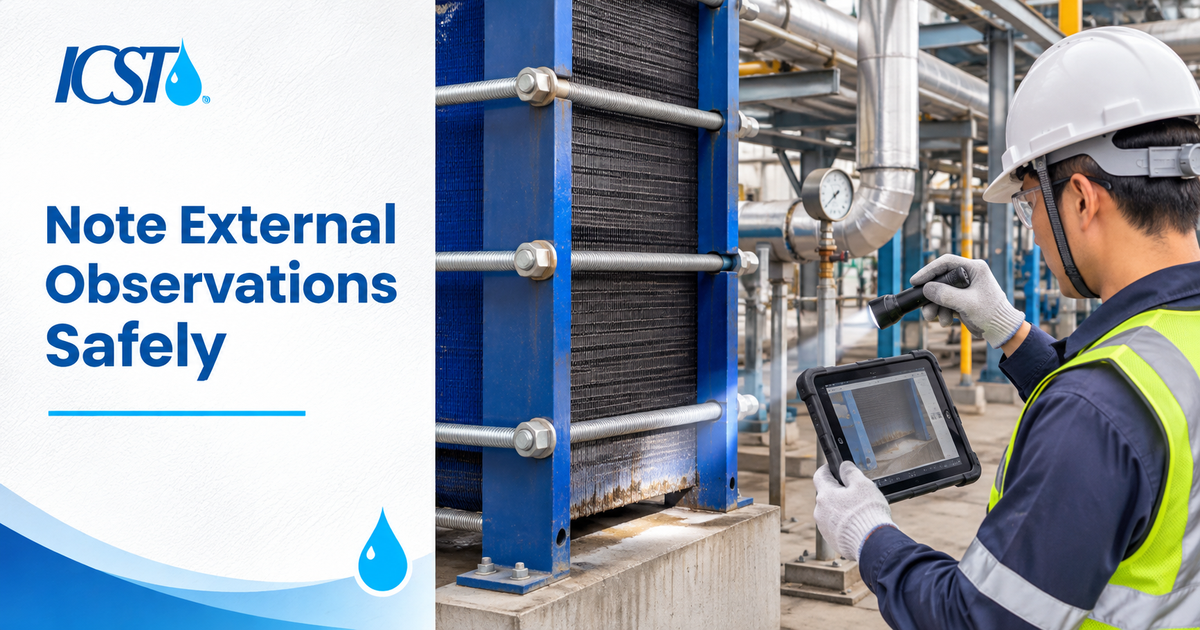
A visual inspection with the system running should be done from outside the equipment. Look for early signs of trouble without disturbing the unit:
- Leaks: location, which fluid, and whether active or dried.
- Visible damage: dents, cracks, corrosion, erosion, or paint damage.
- Seals and gaskets: visible gasket condition at accessible edges, and any moisture near the seals.
- Supports and pipework: strain, movement or loose fixings.
- Insulation: wet, missing or damaged sections.
- Operational checks: unusual noise or vibration nearby, whether nearby safety switches and alarms appear to be functioning properly, and for combustion equipment, whether the flame remains contained within the combustion chamber.
Where the exchanger is part of combustion equipment, regular inspections help prevent carbon monoxide leaks caused by unchecked defects.
Photograph each finding with a date and a scale reference. Write “damp stain at lower edge of plate pack” rather than “failed gasket.” The first is an observation, and the second is a diagnosis that needs qualified assessment.
Thermal imaging is another option. Alfa Laval describes a visual condition assessment for gasketed plate units that uses a thermal camera on a running unit and produces a report with photos and recommendations. Treat it as an example of a specialist service, not a step every plant must take.
Type-Specific Questions for the Technician
You do not need the answers yet. Write the questions down so the right person can resolve them.
Gasketed Plate Heat Exchangers
- Does the manual specify a plate pack dimension to record, and who measures it?
- Is the leakage external, or is one fluid appearing in the other?
- Were plates, gaskets, or plate order changed in the last service?
Shell-and-Tube Heat Exchangers
- Which fluid is on the tube side and which is on the shell side?
- Do earlier reports mention tube fouling, erosion, or leakage at the tube sheets?
- Is there room and an approved procedure to pull the tube bundle if a tube inspection is needed?
During a qualified shell-and-tube inspection, borescopes may be used to inspect for rust, corrosion, and sludge buildup inside accessible areas, and the tube sheet surface should be checked where relevant.
Thickness measurements should verify remaining wall thickness using ultrasonic testing, and rolled tube wall reduction is typically checked against a 5-8% reduction guideline where applicable.
Heat Exchanger Maintenance Checklist Table
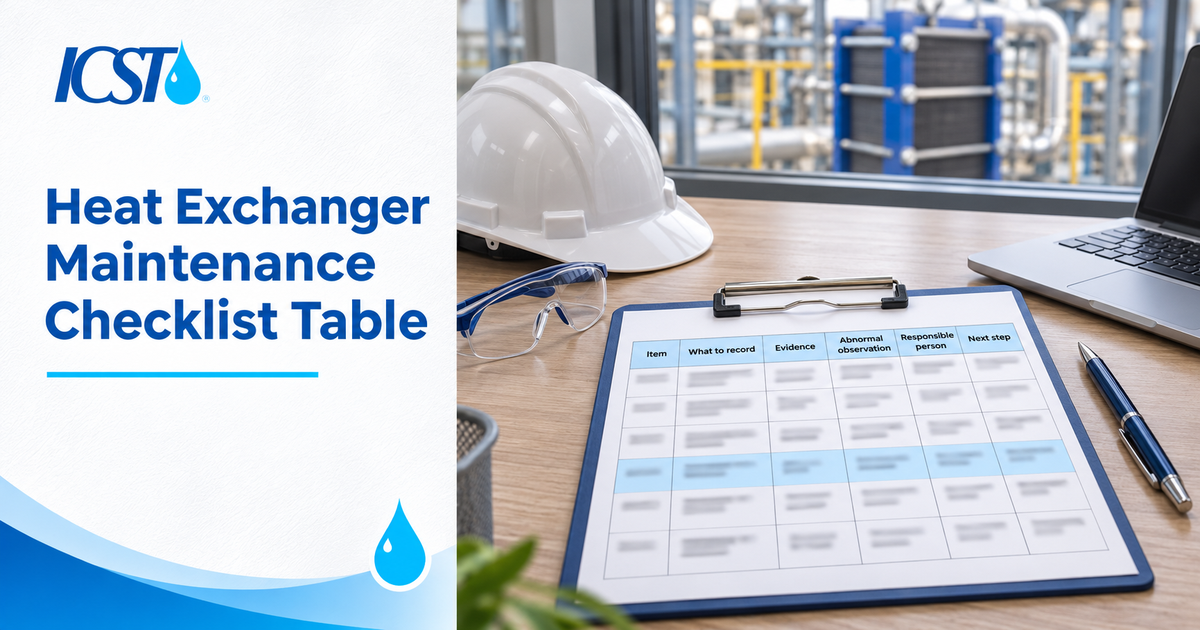
Copy this table into your maintenance system, and document findings there by severity. The last row is an illustrative example, not a real reading.
| Item | What to record | Evidence | Abnormal observation | Responsible person | Next step |
| Asset identity | Tag, make, model, serial, type, location | Nameplate photo | Nameplate missing or unreadable | Maintenance planner | Locate datasheet and OEM manual |
| Design duty | Design temperatures, pressures, flows, both sides | Datasheet or drawing | No design data available | Reliability engineer | Request from OEM or original supplier |
| Temperatures | Hot and cold inlet and outlet, units, time, load | Control system screenshot or gauge photo | Unstable reading, or outlet far from datasheet value | Operator | Confirm the instrument, then pass to reliability engineer |
| Flow | Each side, measured or estimated | Meter reading or pump data | Estimated only | Operator | Mark as estimated; note how to measure |
| Pressure and drop | Inlet and outlet per side; calculated drop | Gauge photos | Drop higher than earlier record, or greater than 5 PSI where that matches the equipment basis | Operator or technician | Compare with design and history |
| External leak | Location, fluid, active or dried | Dated photo with scale | Active leak | Maintenance supervisor | Report under site procedure; do not tighten without OEM guidance |
| Corrosion, supports, insulation | Location and extent | Dated photos | Corrosion or damaged insulation | Inspector | Log for qualified assessment and classify defects by severity |
| Service history | Last cleaning, repairs, parts changed | Job cards or maintenance system | No records found | Maintenance planner | Search records; note the gap |
| Illustrative example only | Cold-side outlet 38 °C at 80% load, 10:15 (example values) | Screenshot plus gauge photo | Datasheet value for similar load is 42 °C (example) | Shift operator | Pass to reliability engineer; do not assume fouling until flow and pressure drop are reviewed |
When Further Qualified Inspection Is Appropriate
Scope depends on the equipment, the fluids, and the service. Further inspection, testing, or cleaning is a decision for a qualified person working from the OEM manual, not a default for every unit.
Consider asking for qualified, OEM-approved input when:
- A fluid appears to be crossing between streams.
- Performance changed suddenly rather than gradually.
- Readings stay away from design values after you confirm the instruments.
- You see damage, active leaks, or corrosion that you cannot explain.
- Service history is missing for equipment in unclear condition.
Leak testing, non-destructive testing, and cleaning methods vary widely by exchanger type and material. For example, Eddy Current Testing (ECT) can help detect internal wall thinning and micro-cracks in tubes. Seal welds should pass leak tests to confirm integrity, and hydrostatic tests may be used after repair to verify zero leakage across tube sheets, gaskets, or plugs.
Let the technician define which, if any, apply, and review API 510 guidance where relevant for inspection and repair methods. Ignoring potential issues can lead to reduced efficiency, higher energy use and costly repairs, but acting without the right method can damage critical components.
What to Send With a Maintenance Enquiry
A complete enquiry should help the service provider review the case efficiently. Attach the following:
- Asset tag, nameplate photo, datasheet and drawings.
- Exchanger type and the fluids on each side.
- Your completed readings table, with units and timestamps.
- Dated photos of leaks, corrosion and insulation.
- Service history, and whether the symptom was gradual, sudden or cyclic.
- Access constraints, preferred timing and a site contact.
- Records from routine inspections, which also support compliance with safety regulations.
Our cooling tower parts RFQ checklist applies the same approach to parts requests. If your exchanger serves a tower circuit, the cooling tower annual shutdown guide covers shutdown planning for the tower side.
Final Thoughts
A good inspection record is short, dated and honest about what is observed and what is only suspected. Capture identity, design specifications, comparable readings and external findings first, and leave opening, testing and cleaning decisions to qualified people using the equipment’s own manual. Clear documentation also supports preventive maintenance, and it makes extending equipment lifespan a realistic goal.
For more practical guides, visit the ICS Thailand blog. Two useful next reads are the cooling maintenance schedule template and the cooling system energy audit checklist. To discuss a maintenance enquiry, use the ICS Thailand contact page.
Frequently Asked Questions
How often should a heat exchanger be inspected?
There is no single interval. It depends on the OEM manual, the duty, the fluids and how quickly the unit fouls. Use your site’s maintenance plan and the manufacturer’s guidance to help maintain compliance with safety regulations, then adjust from your own records.
What are common signs of fouling?
A gradual decline in thermal performance and a rising pressure drop compared with your baseline are common indicators. Alfa Laval’s troubleshooting guidance links gradual decline to fouling, among other causes. Treat it as a suspicion until a qualified person confirms it.
Should I clean the exchanger before recording readings?
No. Record the as-found condition first, unless safety requires immediate action. Cleaning changes the evidence you need for comparison.
Do I need to open the exchanger to inspect it?
Not for the records in this guide. External readings and observations come first. Opening a unit should follow the OEM manual and be done by qualified personnel.
What records should I keep after maintenance?
Keep the before and after readings, photos, parts changed, who did the work and any open questions. This gives the next inspection a reliable baseline.