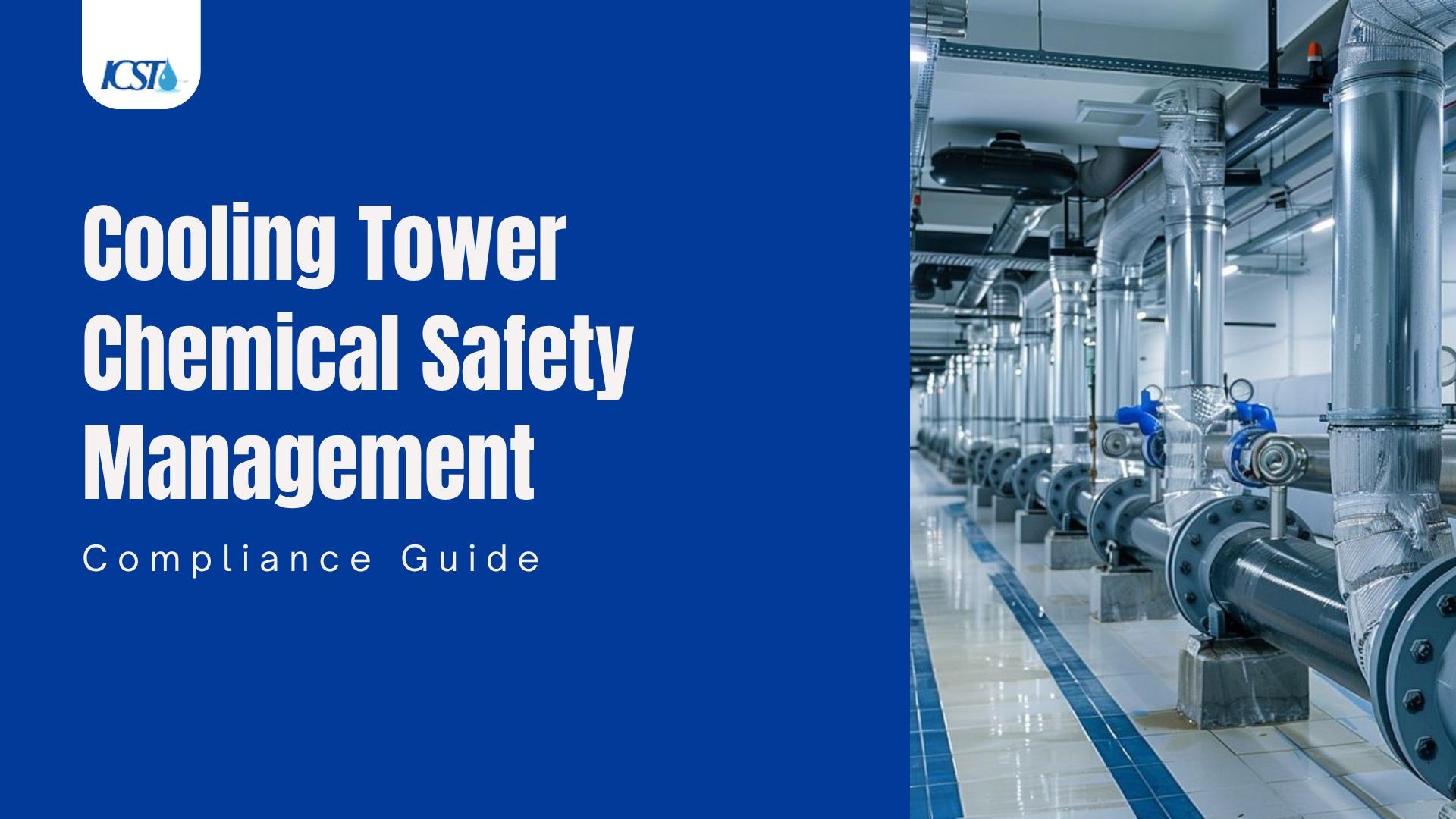
Effective cooling tower chemical safety management requires integrating strict OSHA compliance with mechanical fluid dynamics. Facilities must transition from passive paper records to active digital SDS management using point-of-use QR codes.
To eliminate catastrophic chemical incompatibility risks such as toxic chlorine gas releases from side-stream co-feeding, engineering teams must isolate injection points using high-velocity dilution loops and reliable backflow check valves. Furthermore, secondary containment structures must strictly meet the 110% volumetric capacity metric while utilizing material-compatible basins like fiberglass-reinforced polyester (FRP material) to prevent structural degradation, environmental contamination, and worker exposure during a system failure.
The Interlocking Safety Mandate: OSHA Compliance and Water Quality
Commercial facility operations require a delicate balance between mechanical performance and biological control. You cannot isolate chemical management from tower safety. Effective water treatment chemicals suppress dangerous pathogens like Legionella bacteria and prevent Legionnaires’ disease. This proactive step directly supports your ASHRAE 188-2021 water management plan while simultaneously satisfying strict worker safety rules.
[Image Placeholder: Diagram illustrating the intersection of OSHA regulations and ASHRAE water management protocols]
The regulatory framework demands absolute compliance across multiple jurisdictions:
- OSHA 1910.1200 (Hazard Communication): This standard mandates strict digital and physical safety logs, accurate container labeling, and explicit material safety profiles for all water treatment options.
- 29 CFR 1910.132 (General PPE Requirements): This rule requires comprehensive workplace hazard assessments and documented employee training verification.
┌──────────────────────────────────────────┐
│ OSHA General Duty Clause [5(a)(1)] │
└────────────────────┬─────────────────────┘
│
┌─────────────────────────────┴─────────────────────────────┐
▼ ▼
┌─────────────────────────────────┐ ┌─────────────────────────────────┐
│ Biological Control Risks │ │ Chemical Exposure Risks │
│ • Under-dosing biocides │ │ • Faulty delivery systems │
│ • Stagnant water issues │ │ • Concentrated acid splashes │
│ • Legionella amplification │ │ • Incompatible mixtures │
└─────────────────────────────────┘ └─────────────────────────────────┘
The OSHA General Duty Clause establishes that a facility must remain free from recognized hazards.
Neglecting your water treatment program can lead to poor mixing or severe chemical under-dosing. These errors cause biological growth and dangerous scale formation. If an inspection reveals that structural maintenance or chemical usage was ignored, your organization can face willful compliance citations and heavy financial penalties.
2. The Core Cooling Tower Chemical Risk & Safety Matrix
Achieving absolute site safety requires defining the exact purpose, targeted delivery controls, and specific hazards of every chemical asset in the hydronic loop.
| Chemical Category | System Role | Safe Operational Control Method | Chemical Incompatibility & Risk Factors |
| Oxidizing Biocide (e.g., Sodium Hypochlorite 12.5%, Bromine, Chlorine Dioxide) | Destroys planktonic bacteria and disrupts biofilm anchors within the fill media. | Automated inline amperometric sensor tracking ($0.5\text{–}1.5 \text{ ppm}$ free residual). | Strong oxidizer; highly corrosive to eyes and skin; releases toxic gas if mixed with mineral acids. |
| Non-Oxidizing Biocides (e.g., Glutaraldehyde, Isothiazolinone) | Penetrates and breaks down stubborn, complex biological matrices in the cooling system. | Automated timed shot-dosing ($50\text{–}100 \text{ ppm}$ active concentration). | Severe skin sensitizer; acute inhalation toxicity; requires strict contact time separation from oxidizers. |
| Mineral Acids (e.g., Sulfuric Acid 93%) | Regulates pH and alkalinity to maximize water usage cycles and control dissolved solids. | Continuous feedback pH controller targeting a tight $7.2\text{–}7.8$ window. | Highly corrosive; violent exothermic reaction with water; causes rapid tissue destruction and degrades metal surfaces. |
| Scale Inhibitors & Corrosion Inhibitors (e.g., Phosphonates, Azoles) | Prevents mineral scale formation on the heat exchanger and shields the tower structure. | Continuous feedback conductivity blowdown loop tracking. | Severe eye irritant; highly slippery if spilled; can mask mechanical scale if over-dosed. |
3. SDS Management: Transforming Compliance Binders into Active Telemetry
Relying solely on a dusty physical folder in a dark mechanical room fails modern safety audits. During rapid-response scenarios, paper documentation slows down emergency response times. Modern cooling tower chemical safety management requires converting passive data into active telemetry.
The modern 16-section SDS architecture contains exhaustive technical information. For effective on-site safety, operator training must focus heavily on the sections that matter most during an active emergency:
- Section 4 (First-Aid Measures): This section provides immediate protocols for eye splash incidents or acute skin exposure before emergency medical personnel arrive.
- Section 5 (Fire-Fighting Measures): This part outlines correct extinguishing media. It warns technicians about hazardous conditions, such as directing high-pressure water streams into concentrated sulfuric acid 93%.
- Section 10 (Stability and Reactivity): This section identifies critical chemical incompatibility risks, unstable environmental conditions, and dangerous decomposition products.
Digital SDS management systems bridge this operational gap. Forward-thinking facility managers place weather-proof QR codes directly onto chemical tanks, chemical dosing valves, and metering pumps. Field technicians can scan these codes using mobile devices to view digital safety sheets instantly. This infrastructure ensures safety instructions are available right at the point of use.
4. Preventing Chemical Incompatibility: Engineering the Injection Loop
Where chemistry meets structural hydraulics, a major competitor blind spot emerges. Standard guides frequently overlook side-stream co-feeding risks. This critical hazard occurs when an installer places an acid injection point too close to an oxidizing biocide line inside a low-velocity plumbing loop.
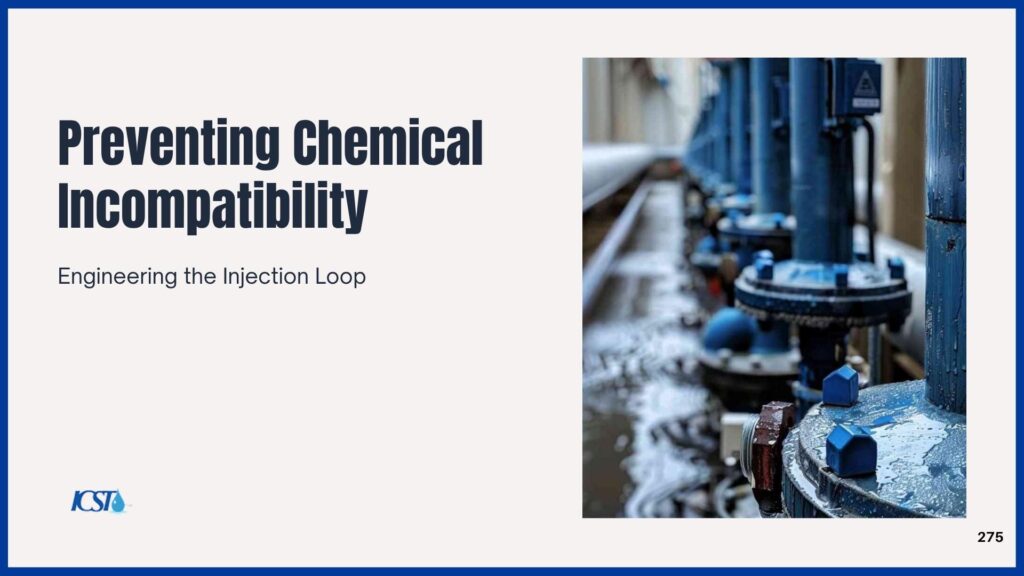
If the primary water systems experience a pump failure or a drop in flow rates, concentrated chemicals will pool in the stagnant water. Mixing sulfuric acid directly with sodium hypochlorite triggers a rapid and violent reaction:
\text{NaOCl} + \text{H}_2\text{SO}_4 \rightarrow \text{Cl}_2\uparrow + \text{H}_2\text{O} + \text{Na}_2\text{SO}_4
This specific reaction releases lethal, suffocating chlorine gas ($\text{Cl}_2$) directly into confined spaces.
[Safe Side-Stream Dosing Layout]
─────────────────────────────────────────────────────────────────────────────► Main Water Loop
▲ ▲
│ (Diluted Acid Feed) │ (Diluted Biocide Feed)
┌────┴────────────────────────┐ ┌────┴────────────────────────┐
│ High-Velocity Loop Line A │ │ High-Velocity Loop Line B │
│ Built-In Backflow Check Valve│ │ Built-In Backflow Check Valve│
└────▲────────────────────────┘ └────▲────────────────────────┘
│ │
[Sulfuric Acid 93% Pump] [Oxidizing Biocide Pum
To eliminate chemical incompatibility events, engineer a dedicated side-stream dosing architecture:
- Separate all chemical injection points physically along the cooling tower system loop.
- Utilize high-velocity water loops to guarantee immediate chemical dosage dilution.
- Install reliable backflow check valves on every chemical feed line to prevent fluid migration.
Material degradation poses another severe risk to the cooling tower structure. Highly concentrated treatment chemicals will damage standard galvanized steel basins. Ensure that your storage tanks and sumps use chemical-resistant fiberglass-reinforced polyester (FRP material) or high-density cross-linked polyethylene. Protecting these components preserves the equipment life of your chillers and heat exchanger systems.
5. Secondary Containment & Storage Infrastructure Engineering
Passive safety infrastructure must rely on precise engineering metrics rather than estimation. Secondary containment structures prevent environmental contamination, safeguard nearby floor drains, and protect your facility from catastrophic tank failure.
The volumetric capacity rule is a strict standard enforced by safety agencies. A secondary containment basin must hold a minimum of 110% of the volume of the single largest storage tank within its footprint. If your system utilizes interconnected tanks, the basin must hold 100% of the largest tank’s volume plus the combined volume of all other tanks sharing that specific containment footprint.
[Primary HDPE/XLPE Tank] ──► [Continuous Leak Sensor Monitoring]
│
┌─────┴────────────────────────────────────────┐
│ Secondary Containment Basin (110% Volume) │ ──► [Dedicated Sump / Neutralization]
└──────────────────────────────────────────────┘
Physical separation barriers are extremely important for maintaining storage safety. You must construct separate containment zones for acids and bases. If a dual-tank failure occurs, these distinct walls prevent the chemicals from mixing and generating toxic gas.
Environmental safety isolation requires active electronic monitoring. Install continuous electronic leak-detection sensors inside your secondary containment basins to detect small leaks before they expand. Keep dedicated chemical spill kits stocked with appropriate neutralizing agents, such as sodium bicarbonate for acid neutralizations, near the storage site.
Ensure compliant eyewash stations and safety showers sit within 10 seconds or 50 feet of any chemical handling zone to preserve worker health.
6. Task-Specific PPE Training Protocols
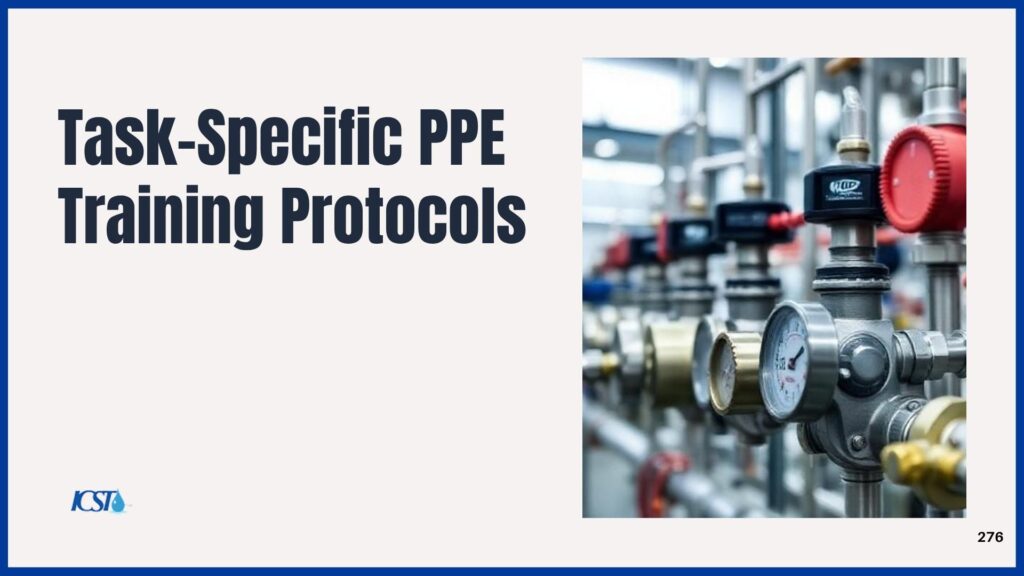
Generic safety protocols often fail because they treat all chemical hazards equally. Your facility safety program must implement task-specific PPE training protocols tailored to the exact operational risks:
- Level 1 (Routine Inspection / Visual Logs): This configuration requires standard safety glasses, steel-toed boots, and durable nitrile gloves. Personnel use this setup when reading digital conductivity controllers, tracking water consumption, or inspecting drift eliminators for airborne debris.
- Level 2 (Chemical Delivery / Line Disconnection / Pump Repair): This protocol requires an ANSI-compliant full-face chemical splash shield, impact-resistant goggles, heavy-duty neoprene gauntlet gloves, a chemical-resistant apron (such as Tychem), and waterproof safety boots. Workers must wear this equipment whenever opening chemical lines or conducting maintenance on metering valves.
[Image Placeholder: Photograph demonstrating proper Level 2 chemical PPE compliance]
Do not rely on passive sign-in sheets to verify your training programs. Create documented, practical drill assessments. Force operators to demonstrate how to inspect gloves for pinhole leaks using air-inflation methods. Technicians must also show that they can safely remove contaminated gear without touching bare skin to prevent personal exposure.
7. Spill Response SOPs: Action Plans for Chemical Releases
When a chemical line ruptures, facility personnel must act immediately. A chaotic response increases operational energy costs, damages metal surfaces, and threatens lives. Implement this strict four-step Standard Operating Procedure (SOP) for emergency spill response:
- Immediate Evacuation & Isolation: Evacuate non-essential personnel from the hazard zone immediately. Shut down all cooling tower fan blades to prevent the airborne spread of chemical mist. Seal off the mechanical room’s HVAC vents to stop dangerous vapors from migrating into the building’s main air stream.
- Source Control: If it is safe to do so while wearing full Level 2 PPE, close the nearest isolation valves. Turn off power to all chemical metering pumps and plug the leak using compatible containment materials.
- Spill Containment: Deploy non-reactive absorbent socks around the perimeter of the spill. Block all nearby floor drains to protect local municipal wastewater networks from hazardous chemical runoff.
- Neutralization and Absorption: Check the SDS to confirm the correct chemistry. Apply appropriate neutralizing media, using sodium bicarbonate for mineral acids or sodium bisulfite for oxidizer spills. Collect the neutralized waste in approved, labeled recovery containers, and log the incident fully in your compliance journal.
Ensure Safety and Optimize Facility Operations
Chemical water safety management demands absolute precision and robust engineering controls. Protecting your team from chemical exposure while maintaining biological control requires engineered dosing loops, code-compliant containment setups, and reliable water treatment programs.
At ICST, our water management and structural engineers design complete, automated chemical containment and delivery infrastructure customized to your building’s unique requirements. Contact our engineering office today to schedule your system layout and chemical safety review.
Frequently Asked Questions (FAQs)
What are the key OSHA regulations governing cooling tower chemical safety management?
OSHA regulates this through OSHA 1910.1200 (Hazard Communication) and 29 CFR 1910.132 (PPE requirements). Employers must maintain accessible SDS management systems, ensure clear chemical labeling, and conduct task-specific training. Additionally, under the General Duty Clause, failing to control hazards like Legionella bacteria or toxic gas exposures can trigger severe willful compliance citations.
Why does chemical incompatibility cause toxic chlorine gas releases in a cooling system?
Chemical incompatibility risks spike when facilities use side-stream co-feeding in a stagnant plumbing loop. If water flow drops, an oxidizing biocide (like sodium hypochlorite) and a mineral acid (like sulfuric acid 93%) can mix directly. This triggers a rapid reaction, generating lethal, suffocating chlorine gas inside confined mechanical rooms.
How do you calculate secondary containment capacity for water treatment chemicals?
Environmental regulations mandate that a secondary containment structure must hold a minimum of 110% of the single largest storage tank’s volume within its footprint. If tanks are interconnected, the basin must hold 100% of the largest tank’s capacity plus the combined volume of all other attached chemical assets to prevent environmental contamination.
How do water treatment chemicals protect a cooling tower structure from degradation?
An engineered water treatment program balances pH levels and regulates dissolved solids to stop scale formation on the heat exchanger. Precise chemical dosage prevents mineral scaling and targets sub-surface corrosion. Using non-corrosive sumps made of FRP material ensures aggressive biocides do not cause structural failure over time.
What immediate spill response steps prevent environmental contamination from water systems?
During a release, operators must immediately evacuate non-essential staff and isolate HVAC vents to block airborne vapors. Next, apply Level 2 PPE, cut pump power, and close isolation valves. Finally, deploy non-reactive absorbent socks to protect nearby floor drains and apply specific neutralizing agents like sodium bicarbonate for acid spills.