Imagine walking into your facility and watching thousands of dollars in wasted energy float away day after day, all because of overlooked details in your cooling tower system. Are you confident your cooling tower delivers peak efficiency, or are subtle design flaws silently driving up energy consumption and operational costs?
Many facilities managers and engineers believe their cooling towers perform as expected, but the reality is far more costly. An underperforming cooling tower does not just impact your monthly bills; it puts entire cooling systems, power plants, and industrial operations at risk for premature failure, wasted resources, and unnecessary downtime.
If you want more than a “good enough” solution, keep reading. This guide reveals essential Cooling Tower Design Tips, exposing the hidden pitfalls that sabotage performance and showing you how to achieve optimal results for years to come. We cover everything essential for efficient operation, from foundational thermal calculations to advanced material selection.
The Unspoken Math: Sizing and Selection Beyond the Textbook
The foundation of any high-performance cooling tower system lies in the mathematics of heat transfer and sizing. Understanding the relationship between the three defining parameters and the Nominal Load is essential for designing cooling towers that meet the demands of industrial operations and power plants. Most designers stop at the basics, but experts interpret the equations for maximum cooling performance.
- Heat Load: In cooling tower design, heat load represents the amount of excess heat the tower must reject. The standard formula is BTU/Hr = GPM × 500 × Range. The fluid factor “500” applies to clean water. Adjust this value for glycol, high dissolved solids, or for industrial process water to avoid undersizing the cooling tower.
- Nominal Load: Begin tower sizing with the formula Tons = (GPM × Range) / 30. The real size of the cooling tower system is established by a Design Correction Factor (DCF), which considers ambient air, project complexity, and desired cooling efficiency.
- Approach: Approach is calculated as T₂ – Twb (cold water temperature minus ambient wet bulb temperature). Lowering the approach temperature directly reduces chiller strain and increases energy efficiency in cooling systems. A difference of 1°F in wet bulb temperature could result in significant energy savings and reduced utility costs for industrial cooling towers.
The 12 Secrets That Guarantee Peak Performance
Beyond the numbers, elite tower performance relies on strategies standard practice often ignores. These techniques, when applied to mechanical draft cooling towers, counterflow cooling towers, crossflow cooling towers, and hybrid cooling towers, ensure sustained cooling efficiency.
- Approach Optimization: Always aim for the narrowest practical approach, ideally between 5–7°F. This critical variable affects cooling performance and energy consumption in industrial cooling towers.
- Airflow Management: Do not only measure ambient air and prevailing wind. Use Computational Fluid Dynamics (CFD) for airflow analysis. This ensures air flows horizontally across the tower and that humid plumes are not re-ingested, preventing loss of cooling efficiency.
- Piping & Hydraulics: Specify circulating pumps for at least 90 feet of head in all tower systems. This maintains adequate pressure, supporting efficient solution delivery even in closed circuit cooling towers.
- Icing Mitigation: For cooling towers operating in cold conditions, variable pitch fan blades managed by advanced control systems protect structural and mechanical elements during reverse cycling. Efficient operation is possible without damaging gearboxes or the water distribution system.
- Structural Longevity: Use high-grade epoxy or polyurethane linings on large concrete basins. Effective corrosion control enhances lifespan and performance, especially for essential systems exposed to aggressive water conditions.
- Water Conservation: Demand drift eliminators certified to 0.0005% for cooling systems, instead of the standard 0.001%. This reduces water consumption, saves resources, and lowers operational costs.
- Pump Protection: Adhere to Hydraulic Institute (HI) standards for pump suction bell clearance and submergence in all tower designs. This prevents cavitation and ensures longevity within industrial processes.
- Low-Load Efficiency: Employ variable frequency drives (VFDs) on fan motors. By responding to cold water temperature, VFDs improve low-load efficiency while reducing energy consumption in the cooling process.
- Thermal Inertia: Always account for solar heat gain on tower basins and exterior dark piping. Even a minimal rise in ambient temperatures can noticeably affect cooling tower performance during peak demand in power plant applications.
- Maintenance Access: Design cooling towers with permanent, non-slip interior walkways and oversized access doors. Inadequate access leads to neglected components and disrupts optimal performance.
- Noise Management: Specify sound dampening and silencers for the most common operational fan speed rather than the maximum. This approach ensures realistic compliance in industrial cooling towers with VFD controls.
- Future-Proofing: For structural members and motor frames, plan for at least a 20% increase in water flow or fan power. This feature supports future upgrades for both counterflow and crossflow cooling towers, reducing the need for full replacement.
Deep Dive: Material Selection and the Longevity Lie
Choosing the cheapest material for cooling tower construction is the biggest driver of premature replacement. Material choice determines the longevity and operational efficiency of the cooling tower, particularly for natural draft cooling towers, mechanical draft towers, and closed circuit cooling towers.
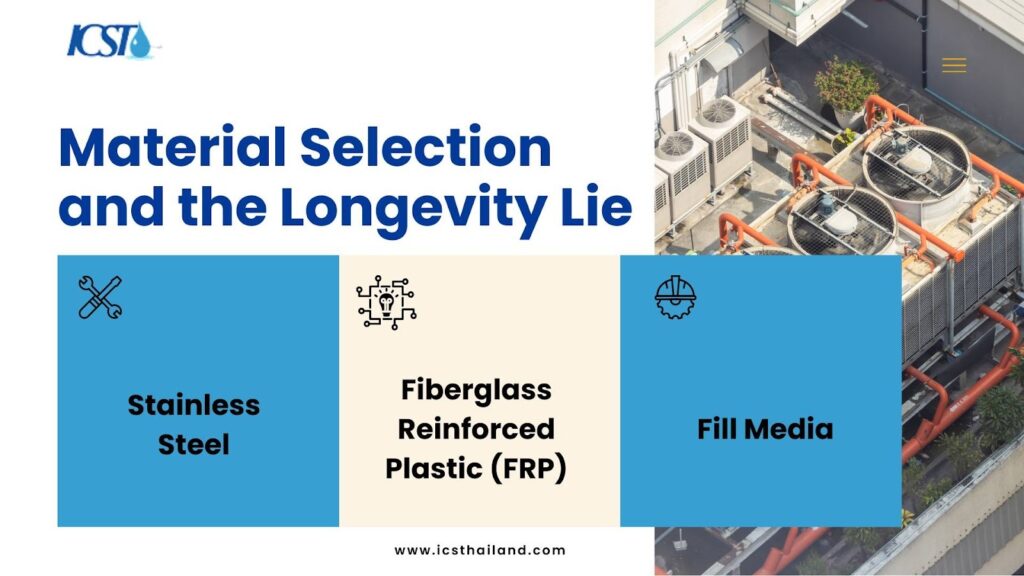
- Fiberglass Reinforced Plastic (FRP): The new standard in tower systems. FRP offers corrosion resistance, low water quality risk, and extended service life, ideal for modern cooling towers and air conditioning systems.
- Stainless Steel: Use Type 316 Stainless Steel for internal wetted components, the basin, and mechanical supports, especially when chemical treatment is aggressive or where high airborne salinity is present. Type 304, though common, often fails in these environments.
- Fill Media: Selecting between film fill and splash fill impacts biological growth prevention and cooling tower performance. Film fill maximizes heat exchange and cooling range, but may foul easily in industrial operations. Splash fill is robust for dirty water and helps reduce biological growth, but has slightly lower thermal performance.
Structural Integrity and The Vibration Warning

Vibration is a persistent threat in cooling tower systems. Continuous, low-level vibration degrades gearboxes, bearings, and heat exchangers, risking unscheduled outages and lost efficiency. Relying on visual or periodic checks is insufficient.
- Use high-end vibration sensors connected to an advanced control system or Building Management System (BMS) for real-time monitoring and automated shutdown in case of excessive vibration. This proactive method safeguards essential systems and cooling tower performance.
- Modular tower design brings reliability. With modular sections, a failure in one cell will not compromise the entire heat transfer operation, making it suitable for large-scale industrial facilities and power plants.
Conclusion:
The distinction between a merely adequate cooling tower and a high-performance system lies in attention to every detail throughout the Cooling Tower Design Tips and the cooling process. By following proven cooling tower design tips such as adhering to the 90-foot head rule, demanding certified eliminators, selecting optimal fill media, and planning for future capacity, you enhance cooling efficiency and operational reliability.
Use these cooling tower design tips to move beyond average performance. Create tower systems that deliver exceptional operational efficiency and reduce energy consumption for decades.
Ready to optimize your cooling tower system? Schedule a consultation with our experts or contact us today at ICST Thailand to unlock the full potential of your tower and achieve maximum operational efficiency.
Frequently Asked Questions
How to make a cooling tower more efficient?
Optimize approach temperature, use VFDs for fans, ensure proper airflow management, maintain water quality, and upgrade to high-efficiency fill media.
What should be the COC of a cooling tower?
Cycles of Concentration (COC) typically range from 3 to 7, depending on water quality and treatment to balance efficiency and scaling risks.
What is a VFD for a cooling tower?
A Variable Frequency Drive (VFD) controls fan speed based on cooling demand, improving energy efficiency and reducing wear on components.
What is the ISO standard for cooling towers?
ISO 16345:2014 specifies performance testing and evaluation methods for mechanical draft cooling towers.
What are the 4 types of water quality?
- Physical (e.g., turbidity, color)
- Chemical (e.g., pH, dissolved solids)
- Biological (e.g., bacteria, algae)
- Radiological (e.g., radioactive contaminants)
What is 1 TR 2.4 gpm?
It means 1 Ton of Refrigeration (TR) requires 2.4 gallons per minute (gpm) of water flow for heat rejection.