A cooling tower water distribution system spreads hot water evenly across the fill media so incoming air can absorb heat efficiently, acting as an essential link in the tower’s heat exchanger process. Gravity-flow and pressurized spray designs are the two dominant approaches, each suited to different industries and machinery demands.
This comprehensive guide examines the fundamental principles behind an effective cooling tower water distribution system. We will explore the two primary system types, analyze their strengths and limitations, and provide actionable strategies for maintenance and optimization.
The Core Purpose: Maximizing Air-to-Water Contact
Water distribution systems serve one primary function: spreading hot water uniformly across the entire surface of cooling tower fill media. This even distribution breaks water into thin films or small droplets, creating maximum surface area for heat exchange with incoming air.
- The physics are straightforward. Heat transfer occurs when water and air make contact, functioning much like any other heat exchanger. More contact area means more efficient heat removal.
- Even a small area of fill media that receives inadequate water flow reduces overall system efficiency.
- Uneven distribution creates two problematic conditions. Hot spots develop where insufficient water flow prevents proper cooling.
- These areas become thermal bottlenecks, compromising the entire system. Dry spots form where water flow is completely absent, essentially removing portions of the fill media from the cooling process.
Main Types of Water Distribution Systems
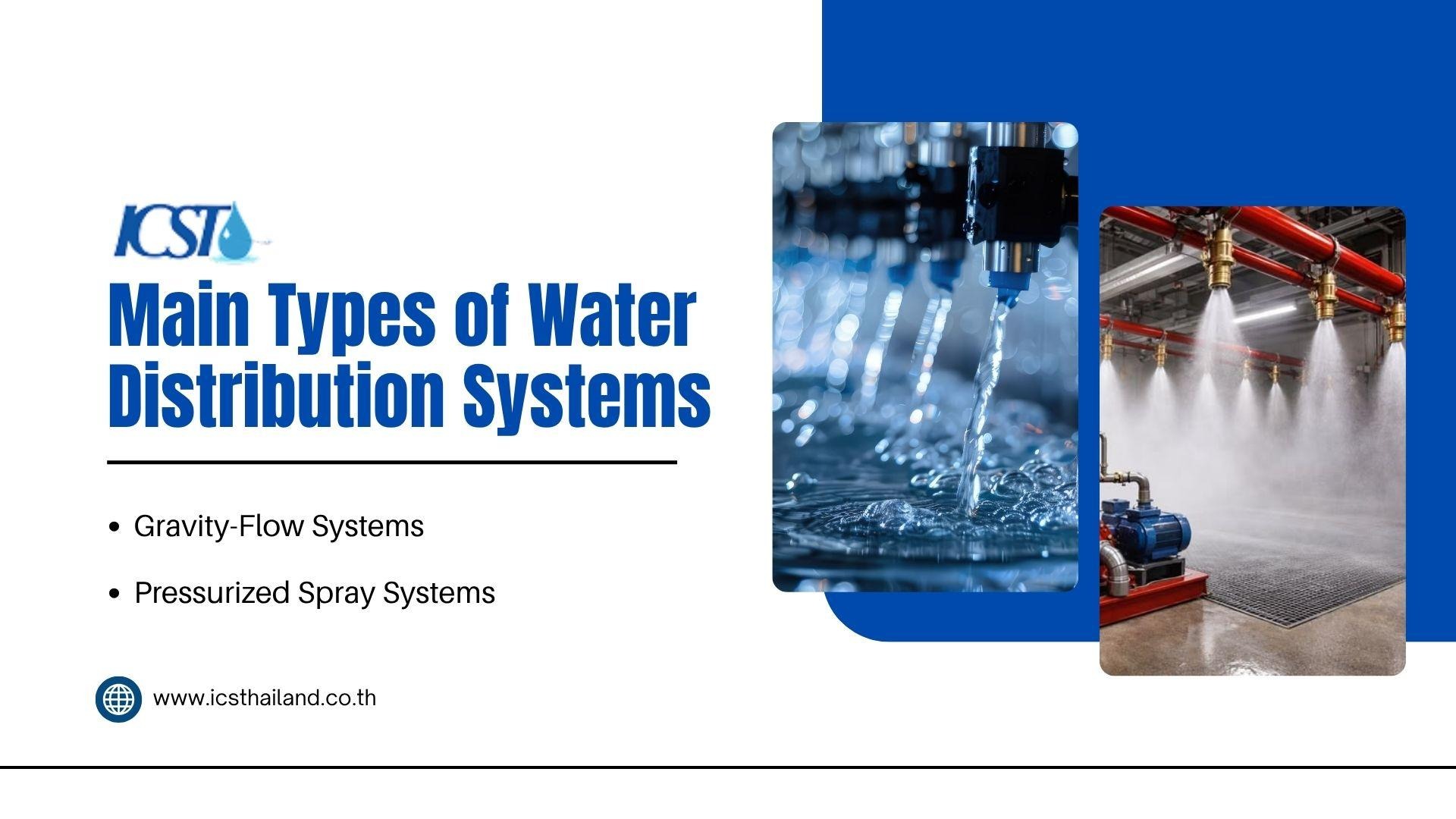
Two distinct approaches dominate cooling tower water distribution design. Each type offers specific advantages while presenting unique challenges that influence system selection and performance.
Type 1: Gravity-Flow Systems
Gravity system designs rely on water’s natural tendency to flow downward through carefully positioned openings. These systems feature an open basin or distribution trough positioned at the top of the cooling tower. Water enters this reservoir and flows by gravity through strategically placed orifices or nozzles onto the fill media below.
- Cross-flow cooling towers commonly use gravity-flow distribution.
- Design: Water flows horizontally across the fill, while air moves perpendicularly.
Key components:
- Hot water basins receive water from the cooling circuit.
- Distribution troughs channel water to fill the media.
- Flow orifices or simple nozzles control water release.
Advantages:
- Simplicity: Lower installation and maintenance costs.
- Operational ease: Inspection and cleaning during operation.
- Energy efficiency: Reduced pump head requirements save energy.
Limitations:
- Maintenance: Orifices and channels prone to debris and biological growth.
- Space: Open basin design requires more physical space.
- Contamination: Susceptible to airborne particles.
- Control: Less precise flow control than pressurized systems.
Type 2: Pressurized Spray Systems
Pressurized spray systems force water through a network of pipes and specialized nozzles using pump water pressure. This approach provides precise control over water distribution patterns and flow rates across the fill media surface.
Counter-flow cooling towers typically employ pressurized distribution systems. Water sprays downward through the fill while air moves upward in the opposite direction.
Components:
- Pressurized headers distribute water to lateral pipes.
- Lateral pipes carry water to individual spray nozzles.
- Specialized nozzles create uniform spray patterns.
Benefits:
- Highly uniform water distribution across the fill surface.
- Compact piping requires less space.
- Enclosed piping reduces biological growth and contamination.
- Precise nozzle selection optimizes for specific fill types and cooling needs.
Challenges:
- Higher pump energy consumption.
- Difficult nozzle inspection and cleaning (requires shutdown).
- Higher initial installation costs than gravity-flow systems.
Design Factors for Optimal Distribution & Efficiency
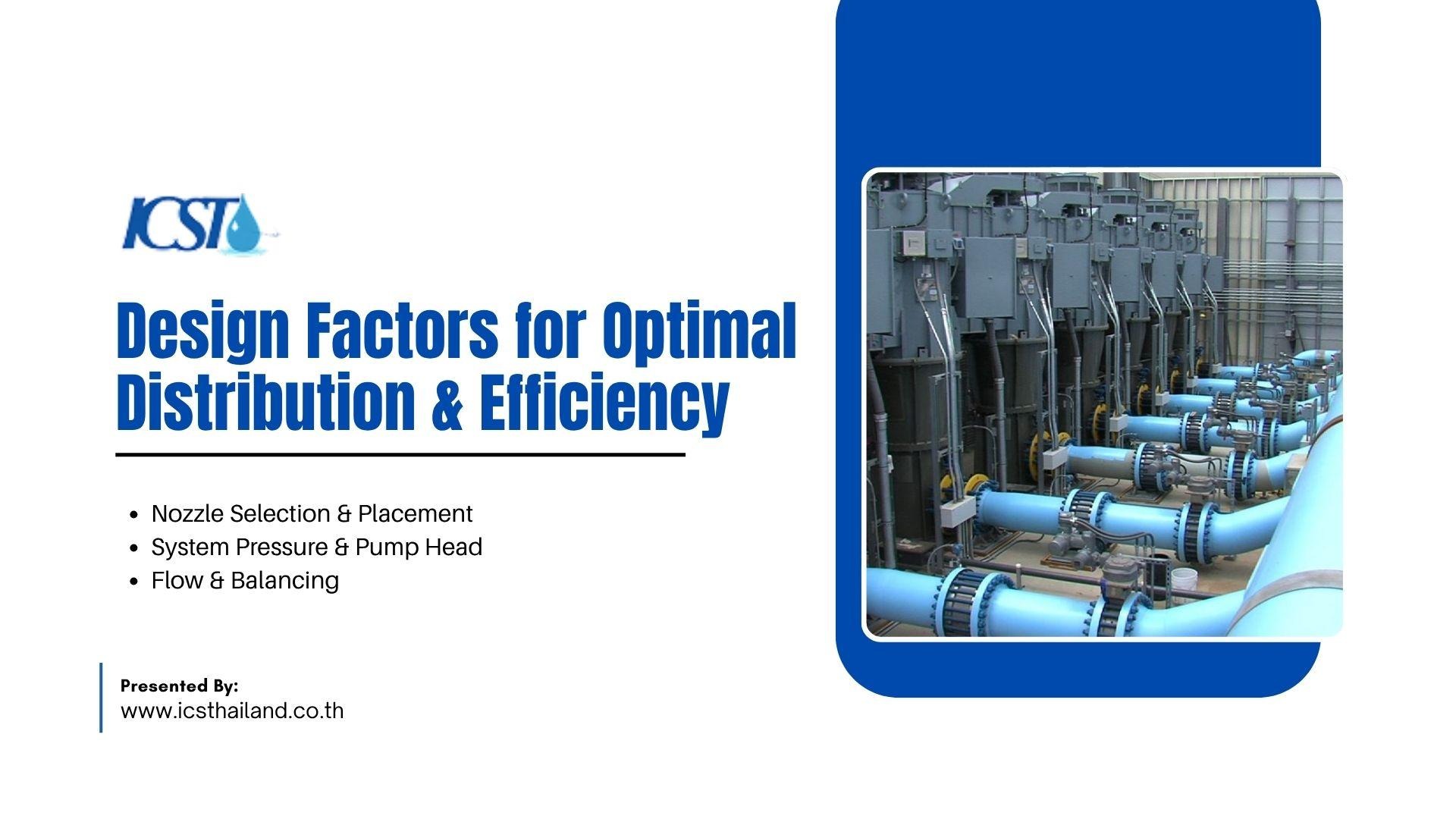
Effective water distribution system design requires careful consideration of multiple interconnected factors. Each decision influences overall system performance, energy consumption, and maintenance requirements.
Nozzle Selection & Placement
The foundation of effective distribution lies in proper nozzle selection and positioning. What spray pattern will provide complete coverage without overlap or waste? How do flow rates affect heat transfer efficiency?
- Spray Pattern Considerations: Different nozzle types create distinct spray patterns. Full cone nozzles provide circular coverage with concentrated flow at the center. Hollow cone nozzles distribute water around the perimeter of a circle. Square spray nozzles create uniform coverage over rectangular areas.
- Flow Rate Matching: Each nozzle must deliver an appropriate water flow for its coverage area. Undersized nozzles create dry spots. Oversized nozzles waste water and may damage fill media through excessive impact force.
- Positioning Strategy: Nozzle height affects spray distribution uniformity. Insufficient height prevents proper spray development. Excessive height allows wind to disrupt spray patterns. Lateral spacing must ensure complete coverage without significant overlap.
System Pressure & Pump Head
Pump selection directly influences system performance and operating costs. How much pressure do different distribution types require? What are the long-term energy implications?
- Gravity-Flow Requirements: These systems operate with minimal pump head, typically 2-5 feet above the distribution basin. Lower water pressure requirements reduce energy consumption but limit flow control precision.
- Pressurized System Demands: Spray nozzles require 15-30 feet of pump head for proper operation. Higher pressure provides better flow control but increases energy costs throughout the system’s life.
- Oversizing Consequences: Excessive pump pressure damages nozzles and creates uneven flow distribution. It may also generate spray patterns that bypass fill media entirely.
Flow & Balancing
Uniform flow distribution ensures consistent cooling performance across the entire cooling tower water distribution system. What causes flow imbalances? How can engineers prevent uneven distribution?
- Header Design Impact: Undersized headers create pressure drops that reduce flow to distant nozzles. Proper header sizing maintains consistent pressure throughout the distribution network.
- Valve Configuration: Balancing valves allow flow adjustment to individual zones or nozzles. These components enable fine-tuning after installation and provide ongoing optimization capability.
- Piping Layout Considerations: Pipe sizing and routing affect flow distribution uniformity. Sharp bends and elevation changes create pressure variations that influence nozzle performance.
Where Distribution System Design Matters Most
Water distribution quality is not equally critical everywhere. Some facilities depend on it far more heavily than others, and understanding where the stakes are highest helps prioritize maintenance budgets.
- Power plants: Cooling towers here reject an enormous heat load from turbines and condensers, so a significant amount of thermal performance rides on even water coverage across the fill.
- Process industries: Chemical, pharmaceutical, and food processing industries rely on stable cooling to protect product quality, making distribution uniformity a compliance issue as much as an efficiency one.
- Heavy machinery cooling: Manufacturing plants running continuous machinery need consistent cold water supply; a distribution fault here shows up as reduced production capacity, not just a higher utility bill.
Across all three, a well-designed distribution network is an essential part of running a sustainable, cost-controlled cooling operation rather than an optional refinement.
Evaporation and Water Loss in Distribution Design
Water distribution design also shapes how much water a tower loses to evaporation during normal operation, which matters for both cost and environmental planning.
- Even, complete coverage of the fill media promotes the intended evaporative cooling process rather than wasting water through poor contact or runoff.
- Systems with dry spots or blockages often see makeup water use climb, since the tower compensates for lost cooling capacity elsewhere in the system.
- A tower engineered for uniform distribution loses a predictable, significant amount of water to evaporation as designed, rather than an unpredictable amount to leaks, drift, or wasted flow.
Treating evaporation as an expected part of the process, rather than a symptom to eliminate, keeps water budgeting realistic and supports a more sustainable operation overall.
Conclusion
Optimizing cooling tower performance hinges on a well-designed water distribution system. As we’ve explored, factors like nozzle selection, spray patterns, and header design significantly impact efficiency.
Gravity-flow and pressurized systems each offer distinct advantages depending on the application. Regular maintenance, including inspecting nozzles, addressing clogs, and correcting uneven distribution, is crucial for sustained operation.
For comprehensive cooling tower evaluation or expert guidance on distribution system optimization, contact the specialists at ICS Thailand today. Our experienced team provides the technical expertise needed to maximize your cooling system performance while minimizing operational costs.
Frequently Asked Questions
What’s the main purpose of a cooling tower water distribution system?
Its primary purpose is to spread hot water uniformly across the entire surface of the fill media to maximize air-to-water contact and achieve efficient heat transfer.
What are the two main types of systems?
The two main types are gravity-flow systems, which rely on an open basin, and pressurized spray systems, which use pipes and nozzles to force the water.
Which system type is more energy-efficient?
Gravity-flow systems are generally more energy-efficient because they require a lower pump head, which reduces long-term energy consumption.
What are “dry spots”?
Dry spots are portions of the fill media that receive no water flow. They are a problem because they contribute nothing to cooling performance and allow air to bypass heat transfer surfaces, reducing efficiency.
What causes uneven water flow?
Uneven water flow is typically caused by clogged nozzles or orifices, dirty distribution troughs, or improperly balanced headers.
How do pressurized systems prevent algae?
Pressurized spray systems use enclosed piping, which reduces biological growth and contamination compared to the open basins of gravity-flow systems.
Why is proper nozzle selection important?
Proper nozzle selection and placement are crucial for ensuring complete, uniform water coverage of the fill media, which prevents air from bypassing the heat exchange surfaces.