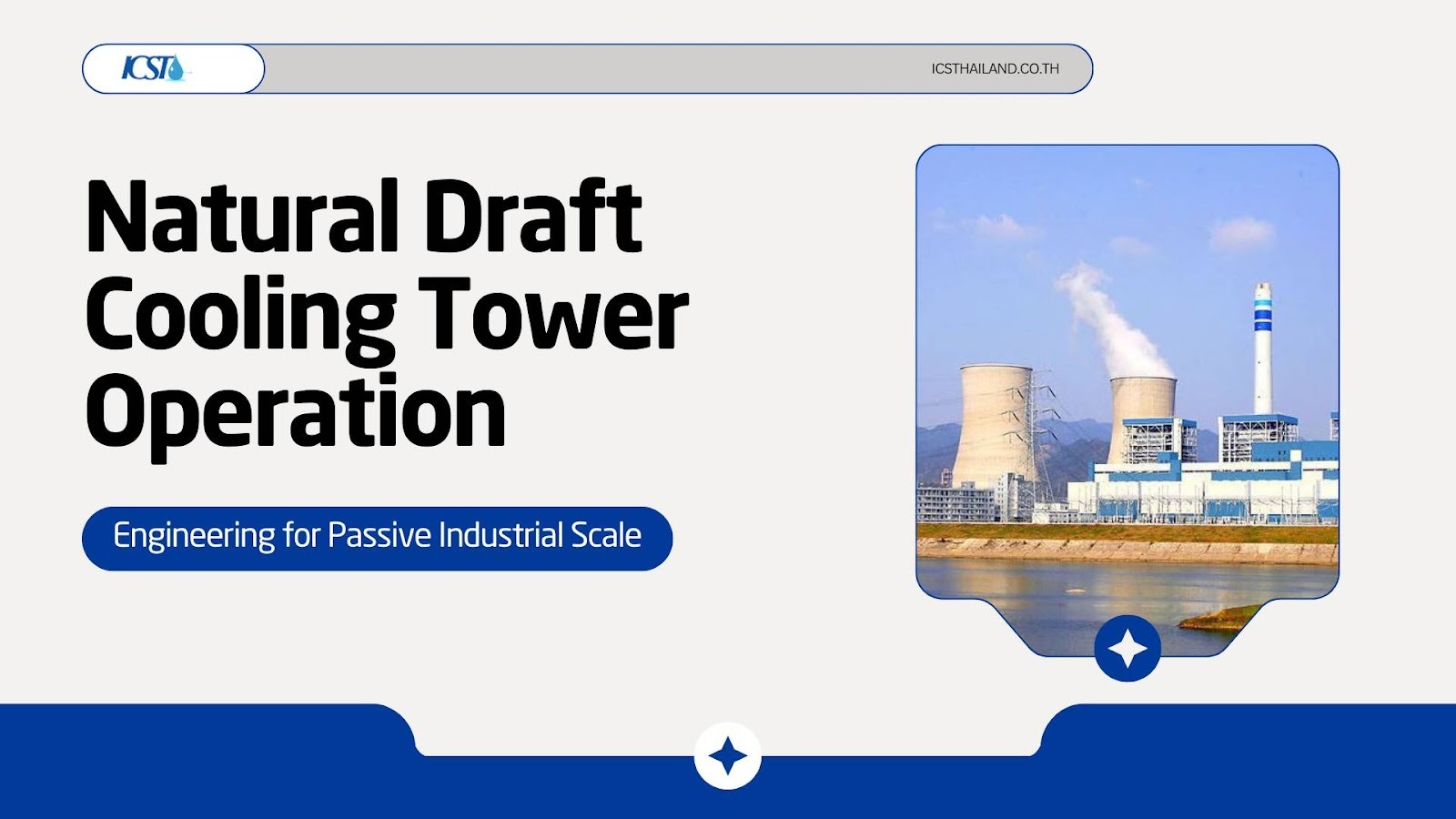
Natural draft cooling tower operation relies on the chimney effect to efficiently remove heat from industrial processes. Warm air inside the tower rises due to its lower density, drawing cooler air from the base. This natural air circulation removes the necessity for mechanical fans, leading to lower energy usage and reduced maintenance expenses.
The hyperbolic design enhances air velocity, optimizing heat transfer and cooling performance. Ideal for thermal power plants, these towers ensure consistent operation, handle large cooling capacities, and meet strict environmental standards, making them a sustainable solution for heat rejection.
The International Cooling Solutions (Thailand) (ICST) mission focuses on technical excellence. We implement financially feasible passive cooling solutions. These robust systems withstand aggressive tropical and desert environments. They remove heat effectively and ensure consistent operation.
Core Principles: The Physics of the “Stack Effect”
Natural draft cooling relies on basic physics. Air density plays a crucial role. A density difference exists between the warm air inside and the cold air outside. This variation creates a self-sustaining vertical draft. The system operates entirely as a chimney effect. As the warm water enters the tower, it transfers heat energy to the air. The heated air becomes lighter and rises. The tower draws cooler air from the bottom. This natural air flow requires no mechanical fans. The continuous air flow ensures efficient performance.
The concrete structure features a hyperbolic shape. This design acts as a massive nozzle. It increases air velocity naturally. The Venturi effect accelerates the moist air upward. This design serves a purpose beyond aesthetics. It optimizes the natural airflow and enhances cooling efficiency. High wet-bulb temperatures affect operations.
Internal Infrastructure: The Counterflow Advantage
A draft cooling tower maximizes the Logarithmic Mean Temperature Difference (LMTD). Most natural draft towers use counterflow principles. Hot water falls downward while the air passes upward. This opposing movement optimizes the heat transfer process. The system achieves a tight approach temperature. The process collects cooled water in the basin below. The cold water returns to the plant.

Fill media selection is an ICST specialty. The right material ensures optimal heat transfer. High-efficiency film fill provides maximum contact surface area. It works best for clean cooling water loops. Non-clogging splash fill handles dirty water. Industrial processes with high turbidity need this option. It prevents mineral buildup and maintains air pressure.
Nozzle technology ensures complete wetting. Pressurized spray nozzles distribute the water evenly. The water evaporates as it meets the rising draft. The remaining water cools significantly. This passive cooling tower system lacks mechanical brute force. It relies entirely on flawless water flow. Proper water treatment preserves water quality and protects key components.
Strategic Comparison: Natural Draft vs. Mechanical Draft
| Performance Metric | Natural Draft (Passive) | Mechanical Draft (Induced/Forced) |
| Airflow Driver | Chimney Effect (Stack Effect) | Electric Fan Motors |
| Power Consumption | Zero Fan Power | Significant Parasitic Load |
| Footprint | Massive (Hyperbolic Shell) | Compact & Optimized |
| Maintenance Profile | Minimal Mechanical Parts | High (Gearboxes, Fans, Drives) |
| Environmental Impact | Low Noise / Long Life | Noise Concerns / Modular Life |
| Ideal Use Case | Power Plants / Heavy Industrial | HVAC / Urban Facilities |
Engineering for Critical Requirements
Coastal power plant operations face severe challenges. Seawater introduces extreme corrosion risks. Salt-laden air destroys standard tower components rapidly. Engineers use specialized concrete additives. They install acid-resistant internal parts. These upgrades prevent structural decay. They maintain efficiency over a 50-year lifespan.
Geothermal applications require specialized engineering. Geothermal brine contains heavy mineral loads. Extreme temperatures stress the way cooling towers work. Splash fill manages these aggressive fluids. It prevents scaling and preserves cooling performance.
Strict 2026 environmental codes demand low drift loss. Water droplets escaping the tower cause problems. Modern designs achieve a 0.001 percent drift rate. High-quality drift eliminators capture the moisture. This protects surrounding equipment from mineral deposits. It ensures the evaporative cooling effect remains contained.
Operational Intelligence and Regional Support
Massive infrastructure requires reliable after-sales support. The ICST Bangkok hub provides a strategic advantage. Regional experts understand local climate constraints. They manage complex air temperature and water temperature variables.
Rapid dispatch capabilities protect facility operations. Technical teams reach any Asian site within hours. Middle Eastern facilities receive support within 24 hours. Fast response times prevent costly downtime.

Proactive audits maintain structural health. Emergency repairs disrupt the entire heat exchanger network. Regular inspections ensure tower performance meets design specifications. Engineers check the internal media and structural concrete. They monitor how the air inside behaves to ensure optimal draft cooling.
Conclusion: Precision Engineering for Permanent Performance
Natural draft cooling tower operation represents the gold standard. It provides sustainable heat rejection and low operating costs. The materials must match the specific site chemistry. ICST does not just supply equipment. We implement customized, sustainable solutions. Our designs are financially and technically sound. They support critical infrastructure worldwide. They process more air and reject waste heat perfectly.
Is your facility reaching its thermal limits?
International Cooling Solutions (Thailand) specializes in large-scale natural draft systems. We provide expert design, audit, and retrofit services. Our team handles aggressive seawater solutions and geothermal optimization. Request a professional technical consultation today. Secure the future of your industrial operations.
Frequently Asked Questions
What is a natural draft cooling tower, and how does it work?
A natural draft cooling tower is a passive cooling system that uses the chimney effect to remove heat. Warm air rises naturally due to density differences, drawing cooler air into the tower. This airflow cools water through evaporation, making it energy-efficient and ideal for thermal power plants and industrial facilities.
How does the hyperbolic shape improve cooling tower performance?
The hyperbolic shape enhances air velocity through the Venturi effect. It accelerates airflow, optimizing heat transfer and cooling efficiency. This design ensures effective natural airflow, making natural draft cooling towers highly efficient for large-scale heat rejection in power plants and industrial cooling systems.
What are the advantages of natural draft cooling towers over mechanical draft towers?
Natural draft cooling towers require no mechanical fans, reducing power consumption and maintenance costs. They are quieter, have a longer lifespan, and are ideal for large-scale operations like power generation. Mechanical draft towers, however, are compact and better suited for urban HVAC systems.
Why is fill media important in cooling tower systems?
Fill media maximizes the contact surface area for heat transfer. High-efficiency film fill is ideal for clean water, while splash fill prevents clogging in dirty water systems. Proper fill media selection ensures optimal cooling performance and prevents issues like mineral buildup and air pressure drops.
How do natural draft cooling towers handle environmental challenges?
Natural draft towers are engineered for durability in harsh environments. Specialized materials resist corrosion from seawater and extreme temperatures. Drift eliminators minimize water loss, meeting strict environmental codes while maintaining efficient performance in coastal and geothermal applications.