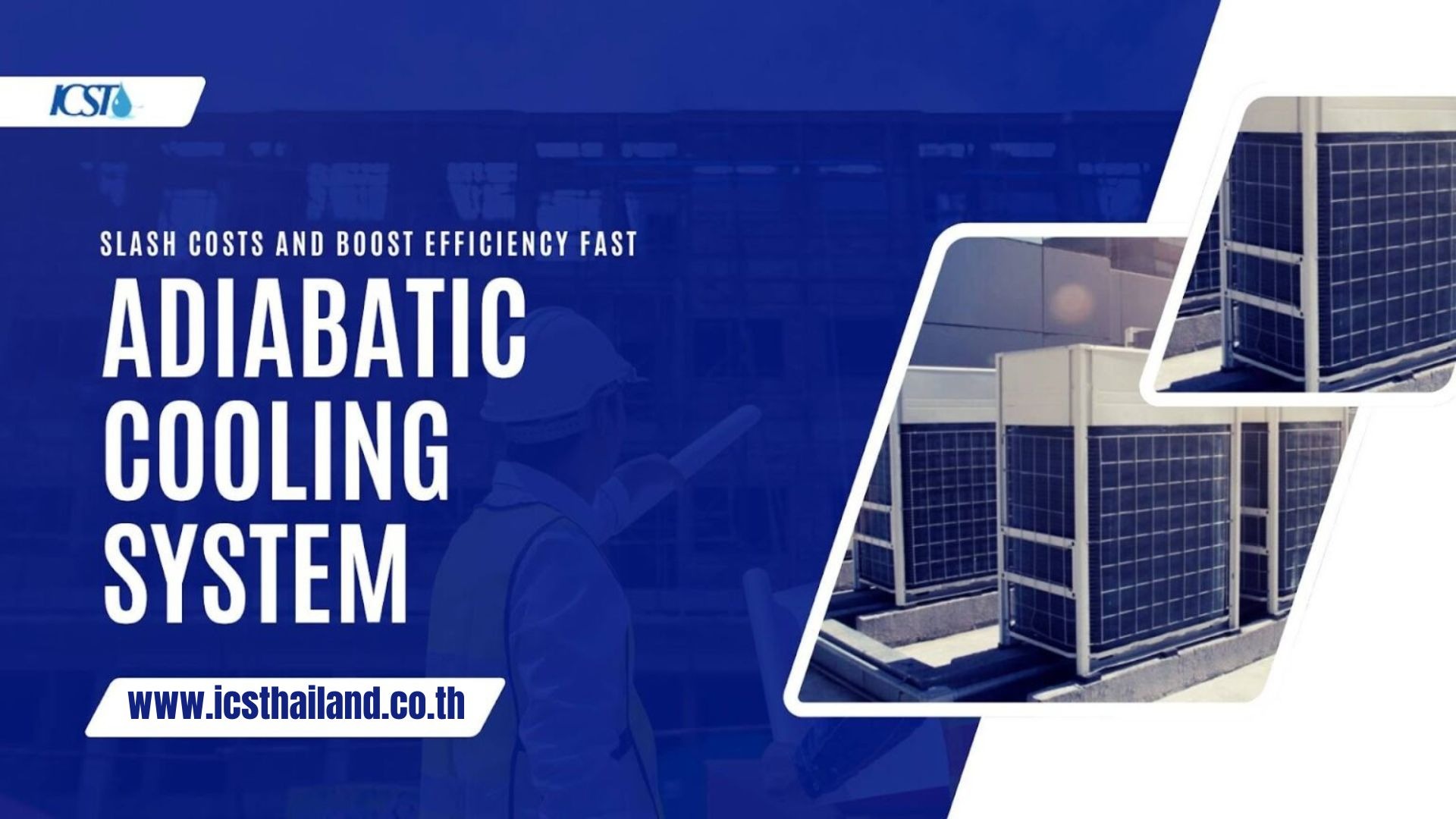
An adiabatic cooling system is an industrial cooling solution that uses the evaporation of water to pre-cool incoming air before it reaches a heat exchanger, reducing energy use, water consumption, and maintenance costs compared to traditional cooling towers and chillers. As industries face increasing pressure to cut operational costs, this closed-loop technology has become a practical, sustainable alternative for modern facilities.
This guide explores everything engineers, facility managers, and procurement teams need to know. We’ll dive into the design and operating principles of an adiabatic cooler, discuss the financial benefits of this evaporative cooling system, and look at its real-world industrial applications
What Is an Adiabatic Cooling System?
An adiabatic cooling system is an industrial cooling solution that uses the evaporation of water to reduce air temperature before it passes through a heat exchanger. The term “adiabatic” refers to a thermodynamic process in which no heat is exchanged with the surrounding environment.
In practice, this means the system cools the incoming air by converting liquid water into vapor, absorbing thermal energy in the process without adding heat to the surrounding space.
- Adiabatic Cooling vs. Adiabatic Cooling System: It’s important to distinguish between the two. Adiabatic cooling is the physical principle where air temperature drops as water evaporates. An adiabatic system is the complete industrial setup that applies this principle, integrating pre-cooling, airflow management, and heat exchanger technology.
- Closed-Loop Configuration: Unlike open-loop cooling towers that expose process fluid to the atmosphere, an adiabatic system uses a closed loop.
- Key Benefits of a Closed Loop: This design minimizes contamination risk, reduces the need for chemical treatments, and ensures consistent thermal performance even when ambient conditions change.
How an Adiabatic Cooling System Works
Understanding the operational flow of an adiabatic cooling system helps clarify why it outperforms many conventional cooling technologies. The system follows a logical, step-by-step process that maximizes thermal efficiency while minimizing resource consumption.
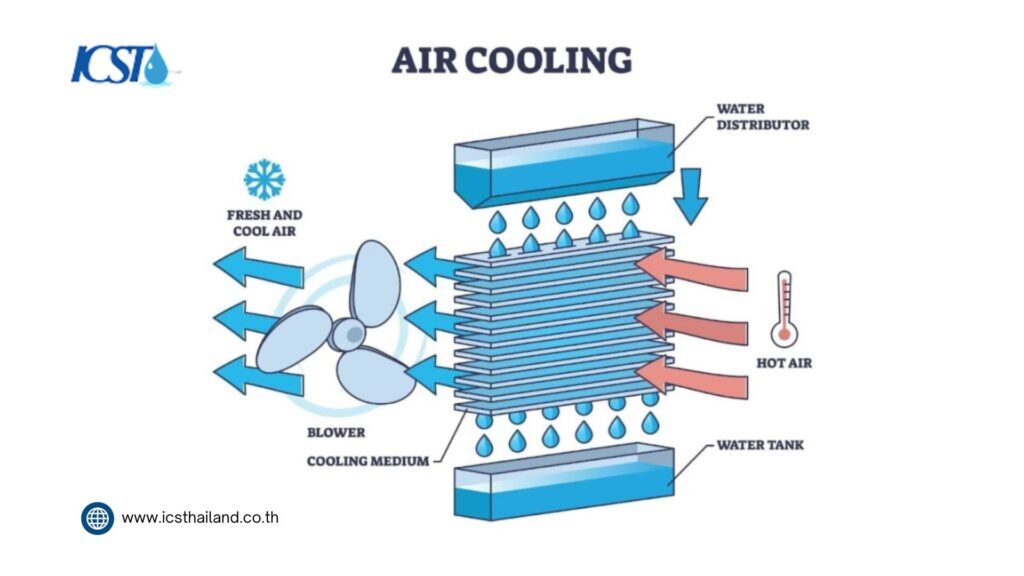
- Step 1 – Ambient Air Intake: Large-volume fans draw ambient air into the system through filtered intake panels.
- Step 2 – Evaporative Pre-Cooling Stage: Before the air contacts the heat exchanger coil, it passes through a pre-cooling zone. Here, water is applied to evaporative pads or distributed as a fine spray. As the water evaporates, it absorbs latent heat from the air, dropping its dry-bulb temperature by several degrees.
- Step 3 – Airflow Through the Heat Exchanger: The pre-cooled air flows across a closed-circuit heat exchanger coil. The lower air temperature creates a larger temperature differential, which significantly increases heat transfer efficiency.
- Step 4 – Process Fluid Cooling: Hot process fluid—typically water or a glycol mixture—circulates through the heat exchanger coil. The cooled air absorbs heat from this fluid and carries it away from the system.
- Step 5 – Closed-Loop Fluid Circulation: The now-cooled process fluid returns to the industrial equipment or process it serves, completing the closed-loop cycle.
This design reduces energy consumption because the evaporative pre-cooling stage does the heavy lifting, reducing the workload on the heat exchanger. It reduces water use because water is only applied during high-temperature periods, not continuously.
It also reduces maintenance needs because the closed-loop design limits the exposure of mechanical components to contaminants.
Key Components of an Adiabatic Cooling System
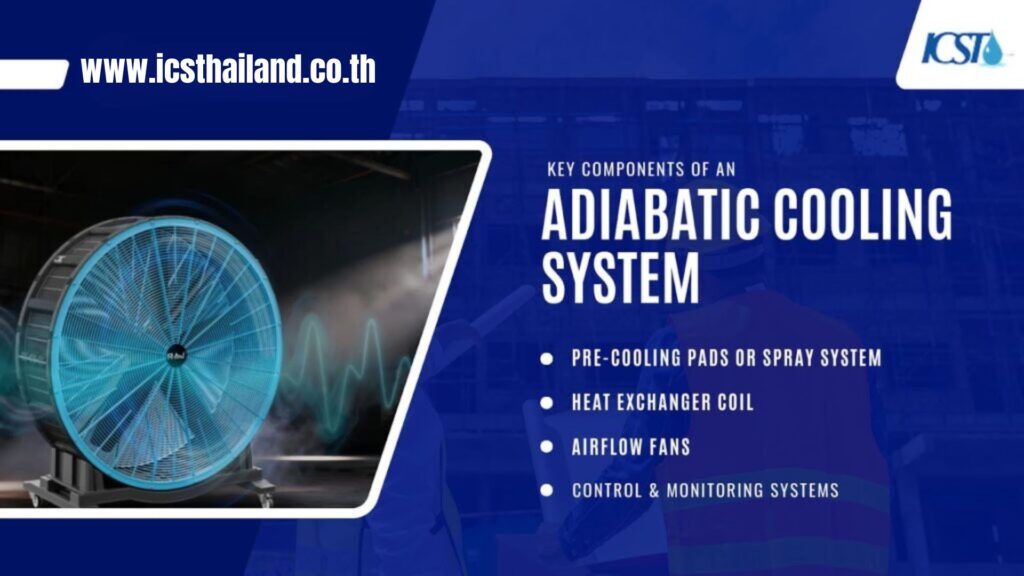
Every component within an adiabatic cooling system plays a specific role. Together, they form a tightly integrated piece of industrial cooling equipment designed for reliability and efficiency.
Pre-Cooling Pads or Spray System
The pre-cooling stage is the defining feature of an adiabatic cooling system. Two main technologies achieve this: evaporative pads and spray nozzles.
Evaporative pads are media panels saturated with water. As ambient air passes through the wetted pad surface, water evaporates and cools the air through direct contact.
Spray systems, on the other hand, atomize water into a fine mist and inject it into the airstream. Both approaches leverage the thermodynamic process of evaporative pre-cooling to reduce inlet air temperature before it reaches the heat exchanger.
Heat Exchanger Coil
The heat exchanger coil is the core thermal transfer component. It separates the process fluid from the external airstream, ensuring the fluid never contacts ambient air or water—a critical requirement in pharmaceutical, food processing, and data center applications.
Here’s how the heat exchange process works:
- Pre-cooled air flows over the finned coil surface.
- This process draws heat away from the process fluid circulating inside the coil.
- The cooling efficiency of the heat exchanger is directly linked to the temperature difference between the fluid and the incoming air.
- Lowering the inlet air temperature through pre-cooling increases this temperature difference, which maximizes the system’s output
Airflow Fans
Fans govern the volume and velocity of air moving through the system. Variable-speed drives allow fan speed to be adjusted based on real-time thermal load, which is a key factor in achieving energy-efficient cooling technology performance.
Proper airflow management ensures uniform distribution across the heat exchanger surface, prevents hot-air recirculation, and reduces noise levels. In large industrial installations, fan arrays are arranged to optimize both pressure and flow rate across the coil bank.
Water Management System
The water management system includes pumps, distribution headers, nozzles or pad-wetting channels, and filtration equipment. This system controls how water is delivered to the pre-cooling stage and ensures consistent saturation without oversupply.
A well-designed water management system is key to an efficient cooling system:
- Efficiency: Proper water management is the main difference between a water-efficient cooling system and a wasteful one.
- Smart Application: These systems apply water only when temperatures surpass a specific threshold.
- Conservation: This approach limits water consumption to periods of high thermal demand.
Control & Monitoring Systems
Modern adiabatic cooling systems are equipped with programmable logic controllers (PLCs), temperature and humidity sensors, and remote monitoring interfaces. These systems continuously measure ambient conditions, fluid inlet and outlet temperatures, fan speed, and water flow rates.
Smart automation allows the system to shift between dry-air cooling and adiabatic pre-cooling modes based on real-time data. This adaptive control strategy reduces water and energy consumption during mild weather while maintaining full cooling capacity during peak load conditions.
Exploring Different Types of Adiabatic Cooling Systems
Not all adiabatic cooling systems are configured the same way. Different designs suit different operational environments and thermal load requirements.
Direct Adiabatic Systems
In a direct adiabatic system, pre-cooled air contacts the process fluid or the load directly. These systems are simpler in design and lower in cost but introduce humidity into the airstream.
This can be advantageous in dry climates where additional moisture does not negatively affect the process, but may be problematic in humidity-sensitive environments.
Indirect Adiabatic Systems
Indirect adiabatic systems use a secondary heat exchanger to separate the pre-cooled air from the supply air or process fluid. The evaporative cooling effect is used to cool an intermediate fluid or air stream, which then cools the target space or process without introducing moisture.
This closed-loop cooling approach offers better humidity control and is suitable for data centers, cleanrooms, and manufacturing facilities with strict environmental requirements.
Hybrid Adiabatic Cooling Systems
A hybrid cooling system combines dry air cooling with adiabatic pre-cooling. During cooler periods, the system operates in dry mode—fans move ambient air across the heat exchanger without any water use. When temperatures rise above a set point, the system activates the pre-cooling stage to maintain performance.
These systems offer several key advantages:
- Highly adaptable: Hybrid adiabatic cooling systems feature dual-mode capability.
- Water conservation: They conserve water during mild conditions.
- Full cooling capacity: They can deliver the full cooling capacity needed during summer peaks.
- Versatility: This adaptability makes them one of the most versatile options in the industrial cooling equipment category.
Why Adiabatic Cooling Systems Are a Smart Choice
What makes an adiabatic cooling system the preferred choice for modern industrial facilities? The answer lies in a combination of operational, financial, and environmental advantages that are difficult to match with traditional alternatives.
Here are the primary benefits:
- Reduced Energy Consumption: Evaporative pre-cooling reduces the thermal load on the heat exchanger, which allows fans to operate at lower speeds and consume less power. Some installations report energy savings of 30 to 50 percent compared to mechanical chillers.
- Water-Efficient Cooling: Unlike traditional cooling towers that consume water continuously, adiabatic systems only activate pre-cooling when ambient temperatures demand it—significantly reducing annual water usage.
- Lower Maintenance Costs: The closed-loop design limits exposure to contaminants, reducing the need for chemical water treatment and minimizing scaling or biological fouling in the system.
- Chemical-Free Operation: Many adiabatic systems operate without the biocides and scale inhibitors required by open-loop cooling towers, which lowers both operational costs and environmental impact.
- Sustainability Benefits: Reduced energy use and water consumption directly contribute to lower carbon emissions, supporting corporate sustainability targets and regulatory compliance.
When compared to industrial chiller systems, adiabatic coolers eliminate compressors and refrigerants—two of the highest-maintenance and highest-cost elements in conventional refrigeration-based cooling.
Adiabatic Cooling System vs Traditional Cooling Systems
Selecting the right cooling technology requires a clear understanding of how each option performs across key operational metrics. The adiabatic cooling system consistently outperforms traditional alternatives in several critical areas.
| Metric | Adiabatic Cooling System | Cooling Tower | Mechanical Chiller | Dry Cooler |
| Energy Use | Low–Moderate | Moderate | High | Low (ambient dependent) |
| Water Consumption | Low (on-demand only) | High (continuous) | None–Low | None |
| Installation Cost | Moderate | Moderate | High | Low–Moderate |
| Maintenance | Low | Moderate–High | High | Low |
| Climate Sensitivity | Moderate | Low | Low | High |
| Chemical Treatment | Minimal | Required | Required (circuit) | None |
Cooling towers: Good thermal performance, but need a continuous water supply, regular chemical treatments, and risk of Legionella contamination.- Mechanical chillers: Precise temperature control, but use a lot of electricity and require refrigerant management.
- Dry coolers: Simple and low-maintenance, but inefficient in hot weather.
- Adiabatic cooling systems: The best of both worlds, combining the simplicity of dry cooling with the performance of evaporative pre-cooling, minus the hassle of traditional cooling towers.
The environmental trade-offs of continuous-water cooling towers are covered in more depth in our analysis of their broader impact.
Cost Savings and Return on Investment
Financial performance is often the deciding factor when selecting industrial cooling equipment. The adiabatic cooling system delivers measurable cost savings across multiple cost centers—and the financial case strengthens over time.
How quickly can a facility expect to recover its investment? Most industrial installations report ROI within two to three years, depending on local energy prices, water tariffs, and operational hours. Here is a breakdown of where the savings accumulate:
- Energy Savings: By reducing compressor use or lowering fan energy demands through pre-cooling, facilities can reduce cooling-related electricity consumption by 30 to 50 percent annually.
- Water Savings: Because the system only consumes water during high-temperature periods, annual water usage is typically 50 to 80 percent lower than that of an equivalent cooling tower installation.
- Lower Maintenance Costs: Fewer moving parts, no refrigerant circuits, and minimal chemical treatment requirements translate directly into reduced scheduled maintenance and emergency repair costs.
- Longer Equipment Life: The closed-loop design protects heat exchanger coils and connected equipment from scaling, corrosion, and biological fouling—extending service life and reducing capital replacement costs.
When these savings are calculated over a five- to ten-year operational period, the total cost of ownership for an adiabatic cooling system is significantly lower than traditional alternatives, even accounting for a higher initial purchase price.
Design Considerations for Installing an Adiabatic Cooling System
Getting the engineering right from the start is critical to achieving maximum performance and efficiency. Poorly designed installations may underperform or incur unnecessary costs.
Several key factors must be evaluated during the design phase. Each one directly influences how efficiently the system will operate throughout its service life:
System Sizing:
Thermal load calculations must account for peak process heat output, ambient design temperatures, and safety margins. Undersized systems fail during peak demand; oversized systems waste capital and energy.
Climate Conditions:
The effectiveness of evaporative pre-cooling depends on ambient dry-bulb and wet-bulb temperatures. Hot, dry climates deliver the greatest benefit; humid climates reduce the achievable temperature drop.
Airflow Requirements:
Fan selection and placement must ensure even air distribution across the heat exchanger surface. Poor airflow design leads to hot spots, reduced thermal efficiency, and premature coil wear.
Installation Space:
Adiabatic coolers require adequate clearance for air intake and discharge. Restricted spaces cause recirculation of warm discharge air, which reduces performance significantly.
Water Quality:
High mineral content in supply water increases the risk of scale buildup on pad media and coil surfaces. Water softening or filtration may be required depending on local water quality.
Engaging experienced system designers who understand both the thermodynamic principles and the site-specific constraints is the most reliable way to ensure a high-performance installation.
Challenges and Limitations
A credible assessment of any technology must acknowledge its limitations alongside its strengths. The adiabatic cooling system offers compelling advantages, but it is not without constraints.
The following challenges should be factored into any procurement or design decision:
- Higher Initial Cost: Compared to basic dry coolers, adiabatic systems carry a higher upfront capital cost due to the pre-cooling infrastructure, water management components, and control systems. This cost is typically recovered through operational savings, but it requires a larger initial investment.
- Space Requirements: Effective adiabatic cooling installations require sufficient space for air intake, discharge clearance, and water distribution infrastructure. Sites with limited footprint may require custom engineering solutions.
- Climate Sensitivity: In high-humidity environments, the evaporative pre-cooling process delivers a smaller temperature reduction. Facilities located in persistently humid climates may find that adiabatic systems offer limited advantages over dry cooling during certain seasons.
- Water Quality Management: Poor water quality can lead to scaling on evaporative pads and heat exchanger surfaces. Facilities with hard water supplies must invest in appropriate filtration and water treatment to maintain system performance and extend component life.
Acknowledging these limitations does not diminish the case for adiabatic cooling; it ensures that facility managers approach the technology with realistic expectations and appropriate design specifications.
Conclusion
The adiabatic cooling system represents a meaningful advancement in industrial cooling technology. It reduces energy consumption, minimizes water use, lowers maintenance requirements, and delivers a measurable return on investment—typically within two to three years for most industrial applications.
As industries face increasing pressure to operate sustainably and cost-effectively, the case for adopting adiabatic cooling systems continues to strengthen. From data centers and food processing plants to power generation facilities and large HVAC installations, the technology proves its value across a broad range of demanding environments.
For facilities evaluating their cooling infrastructure, an adiabatic system is a strategic investment in long-term operational efficiency, not just a replacement for old equipment. To design a system that meets your specific needs, or to explore repairs or new builds for any kind of cooling tower, consult with the experts at ICST.
Frequently Asked Questions
What is an adiabatic cooling system?
An adiabatic cooling system is an industrial solution that uses evaporative pre-cooling to lower ambient air temperature before it passes through a heat exchanger. This process reduces energy and water consumption compared to traditional cooling methods.
How does an adiabatic cooler work?
An adiabatic cooler works by evaporating water at the air inlet, which absorbs heat from the incoming air and lowers its temperature. This pre-cooled air then flows over a heat exchanger coil, more efficiently cooling the process fluid inside.
What industries use adiabatic cooling systems?
These systems are widely used in data centers, manufacturing, food and beverage processing, power generation, and large commercial HVAC. Any industry with high heat rejection needs can benefit from this technology.
Are adiabatic cooling systems energy efficient?
Yes, they are highly energy-efficient. By using evaporative pre-cooling to reduce the thermal load, the system’s fans can run at lower speeds, consuming far less electricity than traditional compressor-based coolers.
What is the difference between adiabatic and evaporative cooling?
Evaporative cooling is any process using water evaporation to cool air. Adiabatic cooling is a specific application where inlet air is pre-cooled before entering a closed-circuit heat exchanger, keeping the process fluid separate from the outside air.