
Engineers often face a critical challenge during the design phase of a project. Vague requirements lead to costly errors, disputes between stakeholders, and systems that fail to meet operational needs. A robust cooling system specification template addresses these issues by providing a clear, technical roadmap for all parties involved.
This document acts as more than just a list of parts. It aligns project managers, engineers, and contractors on the exact standards required for success. By standardizing these requirements, teams accelerate the procurement process and eliminate ambiguity. The result is a system that operates efficiently and aligns with the client’s long-term objectives.
This guide provides a practical framework for creating effective specifications. It is not a theoretical discussion but a working tool for professionals who demand precision in their designs.
What Is a Cooling System Specification Template?
A cooling system specification template is a comprehensive document that defines the technical and operational requirements for a cooling project. It details every aspect of the system, including design parameters, manufacturing standards, delivery logistics, testing procedures, and commissioning protocols.
- Beyond the Checklist: Unlike a basic checklist or price quote, a specification defines exact quality and performance standards rather than just verifying a component’s presence.
- Contextual Clarity: While a data sheet offers a technical snapshot, the specification dictates how those components must perform within the project’s specific environment.
- Contractual Accountability: The specification acts as the primary benchmark for performance verification, providing the legal and technical grounds to hold contractors accountable if criteria aren’t met.
- Engineering Alignment: It ensures the final physical installation remains perfectly aligned with the original engineering intent.
Core Components of a Cooling System Specification Template
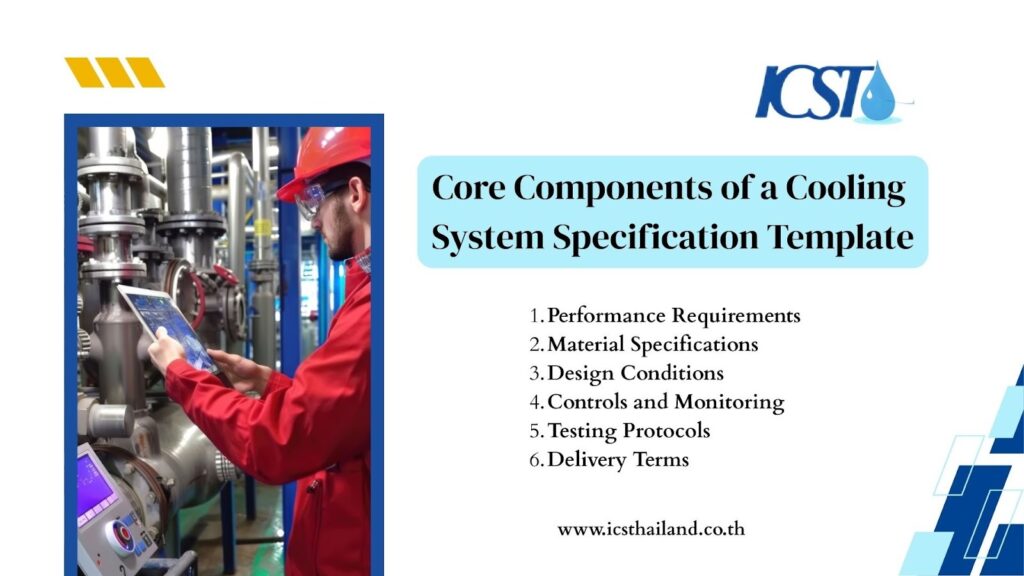
A complete specification covers the entire lifecycle of the equipment. Does the document address every phase from initial concept to final handover? A well-structured template must include specific sections to ensure no critical requirement is overlooked.
- Performance requirements: This section defines the capacity, efficiency, and load handling capabilities the system must achieve under various operating scenarios.
- Material specs: Engineers must detail the specific grades of metals, polymers, and coatings allowed to ensure durability and corrosion resistance.
- Design conditions: This critical component establishes the environmental boundaries, such as ambient temperatures and humidity levels, within which the system must operate.
- Controls and Monitoring: This area specifies the sensors, software interfaces, and automation logic required to manage the system effectively.
- Testing protocols: The template must outline the specific factory and site tests required to prove the equipment meets all performance guarantees.
- Delivery terms: This section clarifies responsibilities regarding shipping, handling, and the condition of equipment upon arrival at the site.
How to Use a System Specification Template
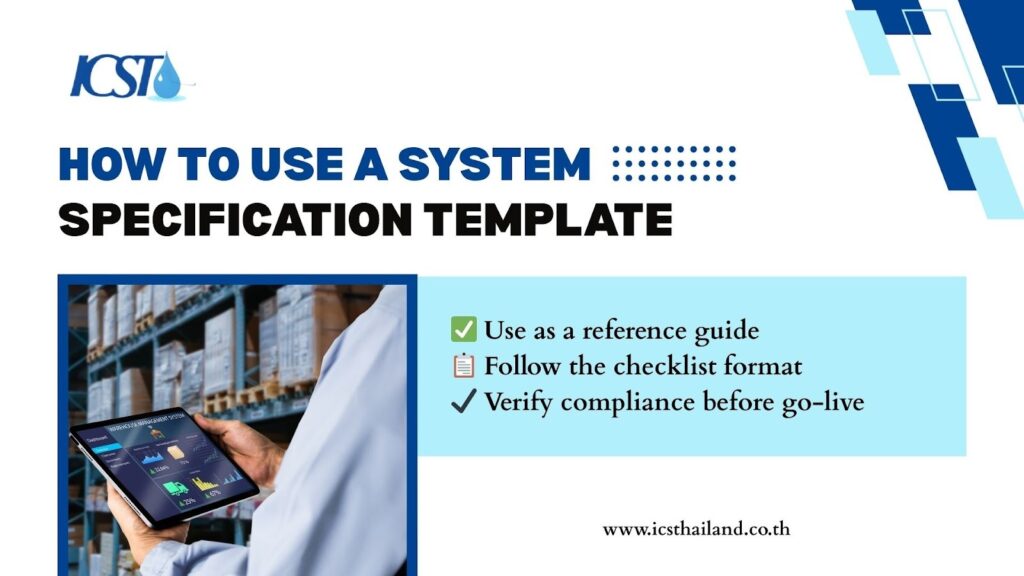
Project teams should introduce the template at the earliest stage of design. Applying it before the tendering process begins ensures that all vendors bid on the same requirements. This creates a level playing field and prevents contractors from cutting corners to offer a lower price.
Here’s how to use the template during the installation and commissioning phases:
- Use it as a reference guide: During the build, refer back to the template to ensure the physical installation aligns with the approved design specifications.
- Utilize the checklist format: The template should include a checklist that allows inspectors to systematically go through each requirement.
- Verify compliance: This process helps confirm that every component is correctly installed and prevents any critical details from being overlooked before the system goes live.
Checklist 1: Performance & Design Conditions (Core Requirements)
This section represents the foundation of the entire cooling system. Failure to define these parameters accurately usually results in a system that cannot handle peak loads or consumes excessive energy.
| Parameter | Required Specification | Status | Notes |
|---|---|---|---|
| Cooling Capacity | To be specified | To be specified | — |
| Design Ambient Temperature | To be specified | To be specified | — |
| Operating Load Range | To be specified | To be specified | — |
| Seasonal Performance Expectations | To be specified | To be specified | — |
| Noise and Vibration Limits | To be specified | To be specified | — |
Defining performance requirements and design conditions together is mandatory. A chiller might meet its capacity target at standard conditions but fail miserably when the ambient temperature rises five degrees above average. Engineers must specify these values explicitly rather than assuming standard manufacturer data applies to their specific site.
Using this checklist protects the project from underperformance. It forces the design team to consider the full operating range and seasonal variations. This ensures the specification template delivers a solution that remains reliable and energy-efficient year-round.
Checklist 2: Material & Construction Specifications
The second most critical aspect of the specification focuses on the physical build quality. How long will the system last in its intended environment? This checklist ensures the selected components can withstand operational stress and environmental factors.
| Component | Material Requirement | Standard | Remarks |
|---|---|---|---|
| Heat Exchanger | To be specified | To be specified | — |
| Piping and Fittings | To be specified | To be specified | — |
| Structural Frame | To be specified | To be specified | — |
| Corrosion Protection | To be specified | To be specified | — |
| Insulation | To be specified | To be specified | — |
Engineers must pay close attention to material specs to prevent premature failure. Selecting the wrong tube material for a heat exchanger in a coastal environment will lead to rapid corrosion. This checklist forces a review of material compatibility with both the process fluid and the external environment.
- Prioritize long-term operational impact: High-grade materials may increase upfront costs but drastically reduce maintenance expenses and downtime over the system’s life.
- Avoid vague material specs: Clear specifications prevent contractors from supplying inferior products that appear acceptable at handover but fail prematurely.
Checklist 3: Testing, Acceptance & Documentation
The final phase ensures the system performs as promised before the owner takes control. Does the equipment actually work as specified in the contract? This checklist governs the verification process and the handover of essential data.
| Item | Requirement | Verified | Notes |
|---|---|---|---|
| Factory Acceptance Testing | To be specified | To be specified | — |
| Site Performance Testing | To be specified | To be specified | — |
| Control System Verification | To be specified | To be specified | — |
| O&M Manuals Provided | To be specified | To be specified | — |
| Warranty and Compliance Documents | To be specified | To be specified | — |
Testing is an integral part of the design specification, not an afterthought. The template must define rigorous testing protocols to validate capacity, noise levels, and control response. Without these pre-defined benchmarks, acceptance becomes a subjective argument rather than an objective fact.
The following points are the essential documentation requirements for a successful project handover:
- Operation and Maintenance Manuals: Ensure the contractor provides comprehensive guides so the facilities team can manage the system effectively.
- Warranty Certificates: Secure all necessary proof of coverage to protect the asset against future defects.
- Compliance Reports: Confirm that all installations meet relevant standards and regulatory requirements.
Common Specification Gaps This Template Prevents
Even experienced engineers sometimes miss critical details when writing specifications from scratch. Does the current documentation leave room for interpretation? The cooling specification template systematically closes these gaps to protect the project owner.
- Missing design conditions: Failing to specify maximum and minimum ambient temperatures often leads to system trips during extreme weather.
- Undefined performance benchmarks: Without clear efficiency targets (e.g., kW/ton), contractors may supply energy-intensive equipment.
- Incomplete material descriptions: General terms like “stainless steel” do not specify the grade (e.g., 304 vs. 316), leading to corrosion issues.
- No acceptance criteria: A lack of specific pass/fail criteria for testing makes it difficult to reject non-compliant equipment.
- Lack of documentation requirements: Projects often end without the client receiving proper wiring diagrams or parts lists.
Conclusion
The success of any HVAC project relies heavily on the clarity of its documentation. A well-crafted cooling system specification template serves as the primary defense against mediocrity and failure. It ensures that every stakeholder understands the exact requirements for performance, materials, and verification.
By utilizing the three checklists provided, engineers improve design clarity and significantly reduce project risk. These tools ensure accountability, guaranteeing that the installed system meets all testing protocols and material specs. Ultimately, a precise specification leads to a smoother installation, fewer disputes, and a high-performance cooling system that stands the test of time.
Frequently Asked Question
What is a cooling system specification template?
A cooling system specification template is a structured document that outlines the technical, performance, material, and testing requirements of a cooling system. It ensures engineers, contractors, and project managers have a clear roadmap to deliver a system that meets design and operational standards.
What is a Cooling System Specification Template and why is it important?
A Cooling System Specification Template is a structured document used by engineers, consultants, and project managers to define performance requirements, materials, standards, testing criteria, and compliance documentation for cooling systems such as HVAC units, chillers, or industrial cooling equipment.
It is important because it ensures design consistency, prevents ambiguous requirements, supports vendor comparison, and reduces the risk of performance failures, premature corrosion, or non-compliance during installation and operation.
What materials should be specified for cooling system components?
Specify exact material grades for each component (for example, stainless steel 316 vs. 304), corrosion protection, insulation types, and compatibility with the environment and process fluids. Avoid vague terms like “stainless steel” to prevent premature failures.
How should testing and acceptance criteria be included in the template?
Include factory and site testing procedures, control system verification, clear pass/fail criteria, and required documentation such as operation manuals, warranty certificates, and compliance reports. This ensures the system is validated before commissioning.
What should be included in a Cooling System Specification Template?
A comprehensive Cooling System Specification Template should include:
- Performance requirements (cooling capacity, ambient design conditions, load range)
- Material and construction specifications (heat exchangers, piping, corrosion protection)
- Applicable standards and codes (ASHRAE, ASME, ISO, ASTM)
- Testing and verification requirements (FAT, site performance testing)
- Documentation and compliance (O&M manuals, warranties, certifications)
Including these elements helps ensure the cooling system meets operational, environmental, and lifecycle performance expectations.