Water scarcity and rising energy costs are reshaping industrial infrastructure. As industries face stricter environmental regulations and operational budget constraints, the limitations of traditional cooling methods become increasingly apparent.
Purely wet systems consume vast amounts of water, while purely dry systems struggle with efficiency during peak heat. This dilemma drives the rapid adoption of hybrid cooling systems, a sophisticated approach that balances the strengths of both technologies.
This guide explores the engineering principles, operational benefits, and strategic value of hybrid cooling. It provides a detailed look at how these systems function, helping facility managers and engineers understand why this combined cooling technology is becoming the standard for sustainable thermal management.
What Is a Hybrid Cooling System?
A hybrid cooling system is an advanced heat rejection device that integrates wet evaporative cooling with dry air cooling within a single unit or improved system architecture. Unlike traditional cooling towers that rely solely on evaporation or air-cooled heat exchangers that rely solely on sensible heat transfer, hybrid systems switch between or simultaneously use both methods.
- The primary engineering goal is optimization: Integrating two technologies to maximize performance while minimizing waste.
- Wet cooling for peak efficiency: Activates evaporative cooling during high-load periods to handle maximum heat rejection.
- Dry cooling for resource conservation: Switches to air-cooled heat exchangers during cooler or off-peak periods to significantly reduce water usage.
- Dynamic environmental adaptability: Features intelligent controls that adjust operations based on real-time ambient temperature and humidity.
- Balanced resource consumption: Ensures consistent process stability while lowering overall water and energy costs.
Core Technologies Behind Hybrid Cooling
Understanding hybrid cooling systems requires breaking down the two distinct technologies they combine. By merging these elements, engineers design a cooling solution that is greater than the sum of its parts.
Wet Cooling Components
The wet section functions on the principle of evaporative cooling. Water flows over a fill media, increasing the surface area for interaction with air. A small portion of this water evaporates, removing heat from the remaining water.
Key components include the fill media (film or splash type), drift eliminators to prevent water droplets from escaping, and basins for water collection. This section provides the massive cooling capacity needed during hot weather.
Dry Cooling Components
The dry section operates similarly to a car radiator. It utilizes air-coil heat exchangers, typically consisting of finned tubes. Hot fluid passes through these tubes, and fans blow ambient air across them.
Heat transfers from the fluid to the air through sensible heat transfer, meaning no water evaporates. This component is crucial for water conservation and plume abatement.
Hybrid Integration Elements
The intelligence of a wet-dry cooling tower lies in its integration. Control valves regulate the flow of the process fluid, directing it to the wet or dry section based on thermal load and ambient temperature.
Advanced sensors monitor humidity and temperature, feeding data to an automation system. This control logic executes mode transition strategies, ensuring the system operates in the most efficient manner possible at any given moment.
Why Switch to Hybrid Cooling?
Facilities choose hybrid solutions to solve specific operational challenges that single-mode systems cannot address. But why are engineers prioritizing hybrid cooling systems for new builds and retrofits?
- Water Savings: By operating in dry mode during cooler months or low-load periods, facilities dramatically reduce evaporation losses.
- Energy Efficiency: Intelligent controls optimize fan speeds and pump operations, aligning energy consumption with actual cooling needs rather than peak design conditions.
- Part-Load Performance: Hybrid systems maintain high efficiency even when operating below full capacity, which is common in variable manufacturing processes.
- Reduced Plume: Mixing dry, warm air with moist discharge air prevents the formation of visible water vapor plumes, which is critical for visibility and community relations.
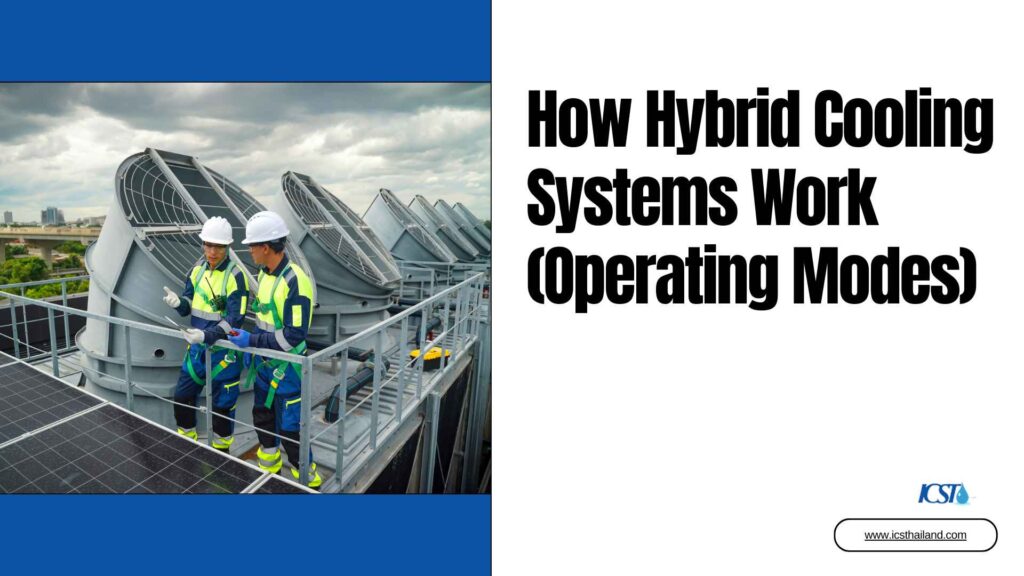
How Hybrid Cooling Systems Work (Operating Modes)
The versatility of hybrid cooling systems comes from their ability to shift between different operational states. This adaptability ensures optimal performance regardless of the weather or heat load.
Dry Mode (Air-Only)
During cooler seasons or periods of low thermal load, the system operates in dry mode. The process fluid passes solely through the dry air coils. Fans induce airflow over the coils, removing heat without consuming any water. This mode offers maximum water conservation and is ideal when ambient temperatures are low enough to achieve the desired fluid outlet temperature.
Wet Mode (Evaporative)
When ambient temperatures rise or the process demands maximum heat rejection, the system switches to wet mode. The fluid flows through the wet section, utilizing evaporation to cool the water efficiently. This mode provides the high cooling capacity associated with traditional cooling towers, ensuring process stability during the hottest days of the year.
Hybrid or Economizer Mode
This is the most sophisticated operating state. In hybrid mode, the system uses an intelligent combination of both wet and dry sections. For example, the fluid might be pre-cooled in the dry section before entering the wet section.
Key Components and System Architecture
Hybrid cooling systems rely on the seamless interaction of robust hardware. Each component plays a specific role in maintaining the delicate balance between wet and dry operations.
Heat Exchangers
The heart of the dry section is the finned-tube heat exchanger. These coils must be constructed from materials with high thermal conductivity, such as copper or aluminum, and are often coated to resist corrosion. The wet section utilizes high-efficiency fill media designed to maximize the air-water interface while minimizing pressure drop.
Control Valves
Precision flow control is essential. Automated valves divert the process fluid between the dry coils and the wet section. These valves must actuate smoothly and reliably to prevent hydraulic shock and ensure seamless transitions between operating modes.
Fans and Airflow Systems
Hybrid systems typically employ variable frequency drives (VFDs) on fan motors. This allows the system to modulate airflow precisely. In dry mode, fans may run at higher speeds to compensate for the lower heat transfer coefficient of air. In wet mode, they may slow down to save energy.
Water Distribution and Basin
The wet section requires a spray distribution system that ensures uniform water coverage over the fill. The cold water basin collects the cooled water and houses the makeup water line and blowdown connections. In hybrid designs, the basin capacity may differ from standard towers to accommodate the variable water usage.
Performance Metrics and Evaluation
To justify the investment in this technology, engineers must accurately quantify performance. How do we define and measure the success of hybrid cooling systems in real-world installations?
- Approach Temperature: This measures how close the leaving water temperature gets to the ambient wet-bulb temperature. A tighter approach indicates higher efficiency.
- Cooling Capacity & Effectiveness: This defines the total heat rejection capability of the system under specific design conditions.
- Water Usage Efficiency: This tracks the volume of water consumed per unit of cooling provided.
- Part-Load Efficiency: This evaluates how well the system performs when not running at full capacity, which is a critical factor for seasonal industries.
- Operating Costs: This combines water, chemical treatment, and electricity costs to provide a total cost of ownership view.
Hybrid Cooling Performance Metrics
| Metric | What It Measures | Why It Matters |
| Approach Temp | Temp difference to ambient wet-bulb | Indicates the thermal efficiency of the heat transfer. |
| Water Usage | Gallons per ton-hour | Directly impacts operational expenses and sustainability. |
| Power Consumption | kW per ton of cooling | Determines the electrical energy cost of the system. |
| Part-load Efficiency | Load % vs. energy input | Reveals seasonal performance and adaptability. |
Design Considerations
Designing a hybrid system requires a holistic view of the facility and the environment. Engineers cannot simply size a unit based on peak load; they must analyze the entire operational profile.
- Climate Analysis: A detailed study of local dry-bulb and wet-bulb temperatures is vital. This data determines how many hours per year the system can operate in dry mode.
- Load Profile: Understanding the heat rejection requirements throughout the day and year helps in sizing the wet and dry sections appropriately.
- Control Strategy: The logic governing mode switching must be robust. It needs to account for hysteresis to prevent rapid cycling between modes.
- Redundancy: Critical processes may require redundant fans or pumps to ensure continuous operation during maintenance.
Selection Criteria: When to Use Hybrid Cooling
Not Dry-only over traditional alternatives.

- Water Scarcity: In regions with frequent droughts or high water costs, the ability to run dry is invaluable.
- Plume Abatement: Facilities located near airports, highways, or residential areas must prevent visible steam plumes for safety and aesthetics.
- Regulatory Limits: When local environmental agencies cap annual water usage or discharge volumes, hybrid systems offer a compliance pathway.
- Retrofit Projects: Older facilities looking to expand capacity without increasing their water footprint often turn to hybrid solutions.
Comparative Analysis: Hybrid vs Traditional Systems
To fully appreciate the value proposition, one must compare hybrid units against single-mode counterparts. How do they stack up against conventional wet and dry options?
Wet-only systems excel at heat rejection but consume massive amounts of water and generate visible plumes.
Dry-only systems use no water but require significantly more surface area and fan power to achieve the same cooling effect, especially on hot days. Hybrid systems bridge this gap, offering the “best of both worlds” performance.
Cooling System Comparison
| Feature | Wet Cooling | Dry Cooling | Hybrid Cooling |
| Water Consumption | High | None | Reduced |
| Energy Use | Moderate | High | Moderate |
| Peak Capacity | High | Moderate | High |
| Operating Cost | Moderate | High | Optimized |
| Plume | High | None | Very Low |
Maintenance and Reliability Issues
Complexity introduces new maintenance requirements. Facilities must be prepared to maintain two distinct types of heat transfer surfaces.
- Wet Section: Regular water treatment is essential to prevent scaling and biological growth (Legionella). The fill media requires periodic inspection for clogging.
- Dry Section: The finned coils are susceptible to fouling from dust and pollen.
- Mechanical Components: With more valves and actuators than standard towers, the mechanical maintenance schedule is more rigorous. Fans and motors require standard lubrication and vibration analysis.
Conclusion
Hybrid cooling systems represent the future of responsible thermal management. By intelligently integrating wet and dry technologies, facilities can navigate the complex trade-offs between water scarcity, energy efficiency, and environmental compliance.
The ability to switch between energy-efficientwater-saving cooling and water-saving. Visit cooling modes provides a level of operational resilience that single-mode systems cannot match.
For engineers and facility managers, the move toward hybrid solutions is not just a technical upgrade; it is a strategic decision that safeguards operations against future resource constraints.
Keep your cooling towers running at peak performance. Visit the ICST website today for expert repairs and reliable maintenance you can trust.
Frequently Asked Questions
What is a hybrid cooling system?
A hybrid cooling system is a heat rejection solution that combines wet evaporative cooling and dry air cooling within a single unit. By switching between operating modes based on ambient conditions, it improves energy efficiency, reduces water consumption, and ensures stable thermal performance for industrial and commercial processes.
How does a hybrid cooling system work?
A hybrid cooling system operates in three intelligent modes: dry mode (air-only cooling), wet mode (evaporative cooling using water), and hybrid mode (a combination of both). Sensors continuously monitor temperature and humidity, allowing the system to automatically select the most efficient operating mode.
What are the main components of a hybrid cooling system?
The primary hybrid cooling system components include dry air-coil heat exchangers, wet section fill media, drift eliminators, variable-speed fans, automated control valves, a water distribution system, and a collection basin. These components work together to optimize cooling performance and resource efficiency.
What is the difference between wet and dry hybrid cooling system operation?
In dry operation, the hybrid cooling system relies solely on air cooling to minimize water usage. In wet operation, evaporative cooling is used to enhance heat transfer during high ambient temperatures. Hybrid mode combines both methods to balance cooling efficiency and water conservation.
Why are hybrid cooling systems energy-efficient for industrial applications?
Hybrid cooling systems improve energy efficiency by optimizing fan speeds, cooling modes, and water usage based on real-time environmental conditions. This adaptability lowers power consumption, reduces operating costs, and supports sustainability goals in industrial facilities.