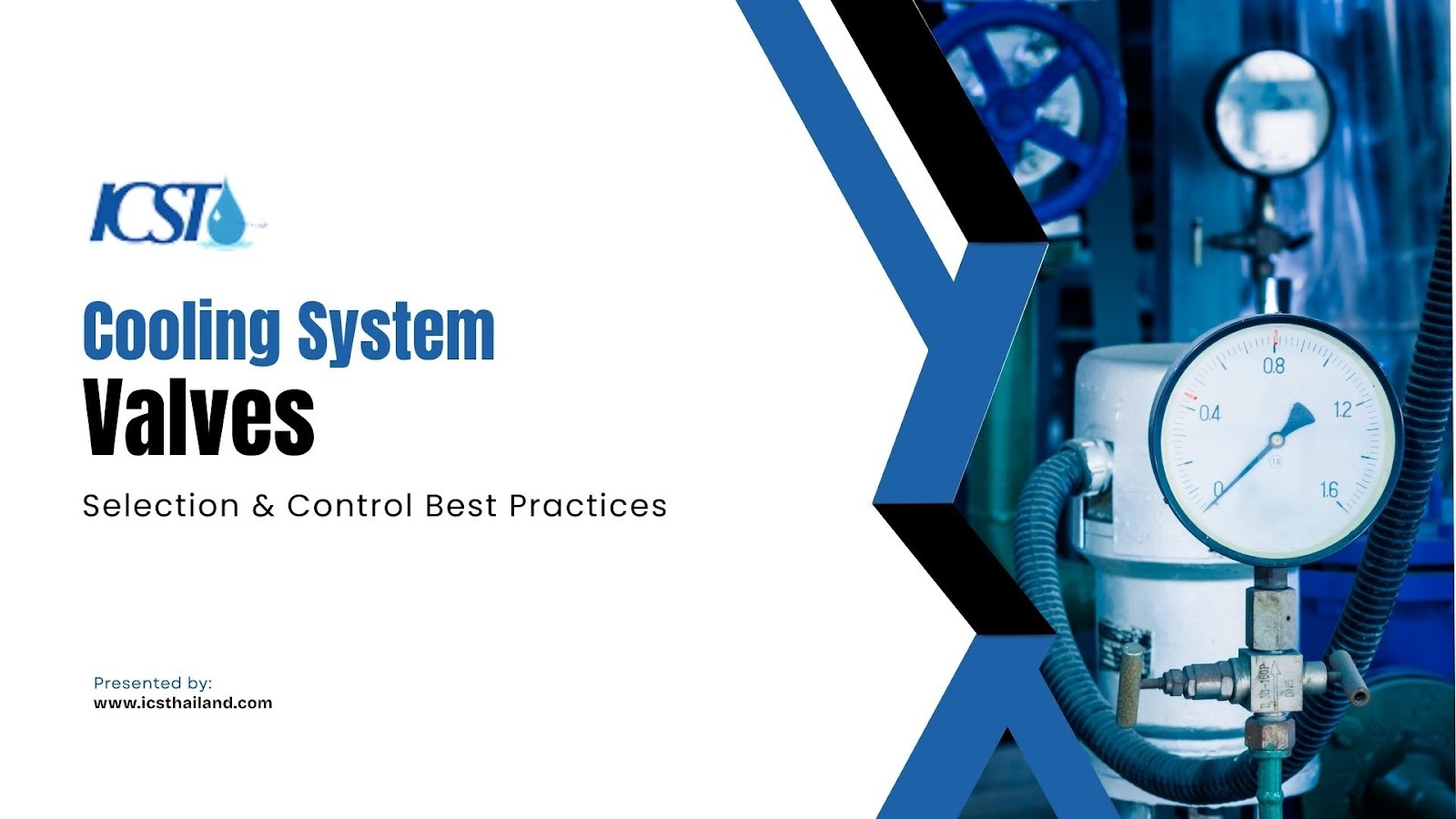
Efficient cooling systems don’t just happen; they rely on precise control at every step. At the heart of this process are cooling system valves, the unsung heroes that regulate flow and ensure your chillers and cooling towers perform at their best.
Think of them as the gatekeepers of efficiency, keeping energy waste in check and maintaining stable temperatures even under demanding conditions. But without the right strategy for control valves and valve automation, you could be facing higher energy bills and inconsistent system performance.
So, how do you choose the right components and optimize their use? In this guide, we’ll walk you through everything you need to know about selecting and automating valves to achieve maximum cooling system efficiency.
What Are Cooling System Valves?
Cooling system valves are mechanical devices that regulate, direct, or control the flow of a fluid (water or refrigerant) by opening, closing, or partially obstructing passageways. They act as the primary interface between the control system and the physical process.
Proper valve operation directly influences system stability. If a valve fails to respond accurately to temperature changes, the system experiences hunting, where the temperature oscillates wildly.
This instability causes unnecessary wear on pumps and chillers. By maintaining precise flow rates and pressures, these valves ensure that the cooling load matches the demand exactly.
Main Valve Functions in Cooling Systems
Engineers typically categorize valves by the specific job they perform in the loop. Do you need simple isolation or complex flow regulation? Isolation valves, such as gate or ball valves, are ideal for completely stopping or allowing flow. In contrast, regulation valves like globe or butterfly valves help control the flow rate and pressure.
- On/Off Service: These valves fully open to allow flow or fully close to stop it. Operators use them primarily for equipment isolation during maintenance.
- Proportional Control: This function allows the valve to vary the flow rate continuously. It matches the cooling output to the current heat load.
- Pressure Regulation: Specific valves maintain a set pressure downstream or upstream. This protects sensitive heat exchangers from pressure spikes.
- Temperature Control: These valves mix hot and cold streams or divert flow to achieve a specific temperature setpoint.
- Isolation and Safety: These provide a positive shutoff to prevent leaks during repairs or emergency shutdowns.
Types of Valves Used in Cooling Systems
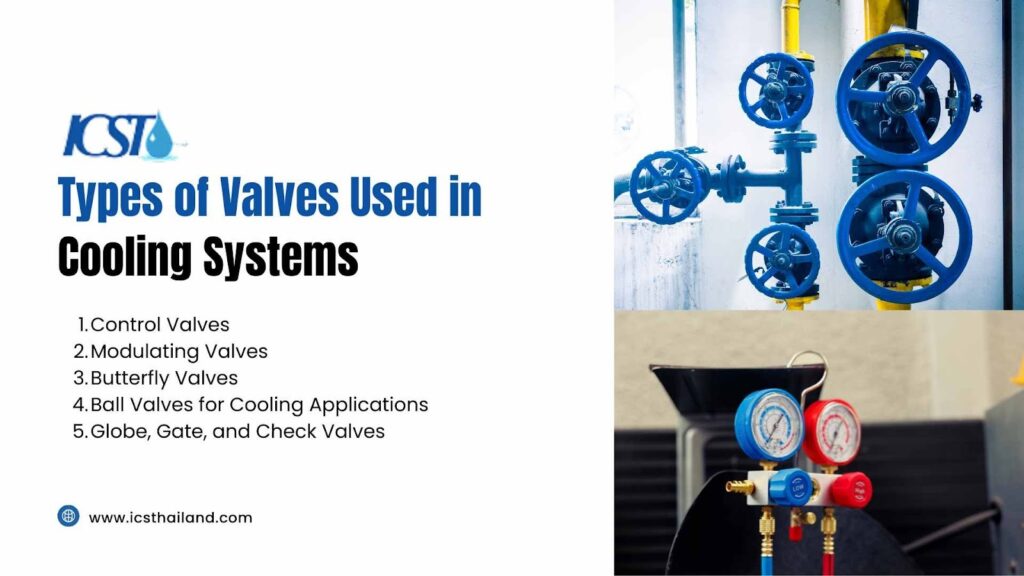
To select the correct hardware, you need to understand the mechanical advantages of each valve type. Different valves handle pressure, flow, and temperature differently. The choice between a valve that opens gradually (modulating) versus one that is simply on or off can significantly impact system efficiency and equipment lifespan.
Control Valves
A control valve modifies fluid flow by varying the size of the flow passage as directed by a signal from a controller. These are the workhorses of PID loops in cooling applications. They typically utilize pneumatic or electric actuators to position the closing element with high precision.
Modulating Valves
A modulating valve provides precise control by adjusting to the exact load requirement, offering smooth operation compared to traditional on/off valves. It’s an essential component for facilities with variable cooling needs, ensuring optimal energy efficiency.
Advantages of a modulating valve:
- Infinite positioning between fully open and fully closed.
- Prevents water hammer and abrupt temperature changes.
- Adjusts strictly based on load requirements for precise control.
- Enhances energy efficiency in variable cooling load systems.
Butterfly Valves
A butterfly valve uses a disc mounted on a rotating shaft to regulate flow. They are popular in large-diameter cooling pipes due to their compact design.
Why do engineers frequently specify these for cooling towers?
- Cost-Effectiveness: They cost significantly less than globe or gate valves in large sizes (over 4 inches).
- Low Head Loss: When fully open, the disc presents minimal resistance to flow.
- Quick Actuation: A 90-degree turn moves the valve from fully open to fully closed.
Ball Valves (Cooling)
Ball valve cooling applications generally involve smaller pipe diameters or isolation duties. These valves use a spherical closure unit with a hole in it. When the valve opens, the hole aligns with the flow path. They provide a tight shutoff with almost zero leakage, making them ideal for isolating fan coils or heat pumps.
Globe, Gate & Check Valves
Globe valves provide excellent throttling capabilities but induce a high pressure drop. Gate valves serve well for isolation but possess poor control characteristics. Check valves prevent reverse flow, which protects pumps when they cycle off.
While useful, these types often play supporting roles alongside the primary control valves in modern cooling loops.
Valve Selection Criteria | How to Choose the Right Valve
Selecting the wrong cooling system valves can lead to inefficient performance, increased energy costs, and premature system failure. To avoid these issues, it’s crucial to evaluate several technical parameters before making a purchase.
The right valve not only ensures precise temperature control but also contributes to the longevity and reliability of the entire cooling system.
What specific factors dictate the success of your valve selection?
- Flow Characteristics: Determine if the application requires linear or equal percentage flow characteristics. Equal percentage works best for heat transfer control loops.
- Pressure & Temperature Ranges: Verify that the valve body and seal materials can withstand the maximum system pressure and temperature.
- Fluid Quality: Dirty water systems require valves that resist clogging, such as ball or butterfly valves, rather than globe valves.
- Installation Space: Consider the physical envelope. Butterfly valves fit in tight spaces, while globe valves require more room.
- Maintenance Accessibility: Ensure technicians can reach the actuator and valve stem for routine checks.
- Cost vs. Lifecycle: Do not choose the cheapest option if it requires frequent replacement. Calculate the total cost of ownership.
Decision logic simplifies the process. For cooling tower isolation, a butterfly valve usually offers the best value. For precise chilled water control, a globe or characterized ball valve provides the necessary accuracy.
Valve Control Strategies for Cooling Systems
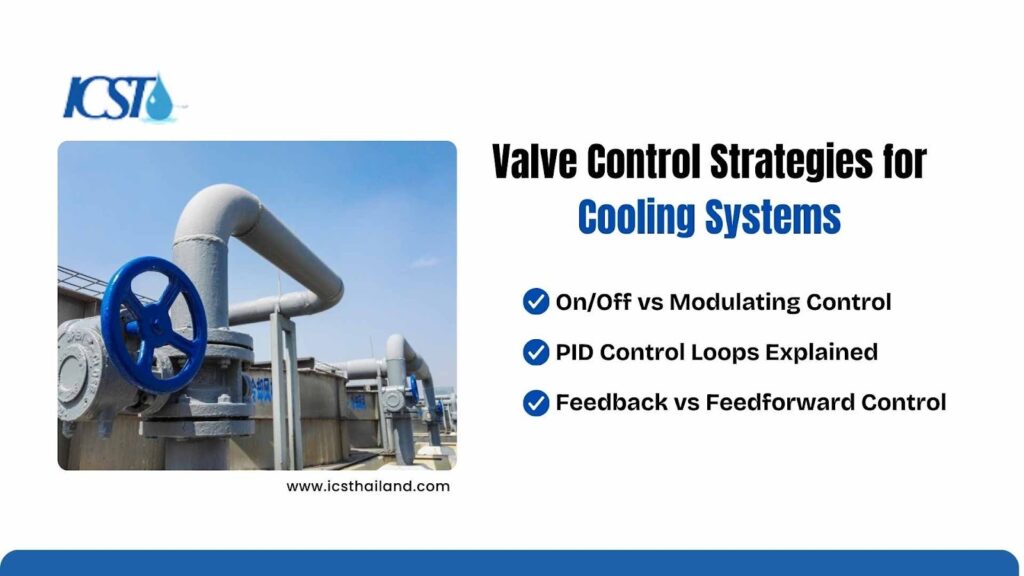
Even the best hardware will fail without an intelligent control strategy. Proper valve control isn’t just about opening and closing; it’s about programming logic that matches your system’s specific dynamics.
An effective strategy ensures efficiency, protects equipment from wear, and maintains stable temperatures. You must program the logic to match the system dynamics.
On/Off vs Modulating Control
On/off control suits systems with large thermal mass where precise temperature holding matters less. However, most modern cooling applications demand tighter control. Modulating control eliminates the “sawtooth” temperature profile associated with on/off cycling. It reduces mechanical stress on the valve and improves energy efficiency by matching the flow to the exact load.
PID Control Loops
Proportional-Integral-Derivative (PID) control loops are the industry standard for precise temperature and pressure regulation in modern cooling systems. PID controllers fine-tune the valve’s response by continuously calculating an error value as the difference between a desired setpoint and a measured process variable.
They use three core terms to achieve this:
- Proportional (P): Looks at the current error and adjusts the valve in proportion to the size of the error.
- Integral (I): Considers past errors to eliminate any residual offset, ensuring the system reaches its setpoint over time.
- Derivative (D): Predicts future errors by analyzing the rate of change, allowing the system to anticipate disturbances.
Properly tuning these three parameters ensures the valve can react swiftly to load changes without overshooting the setpoint, leading to stable and efficient operation.
Feedback vs Feedforward Control
Effective control systems ensure stability and efficiency by managing system changes proactively and reactively. Understanding the difference between feedback and feedforward control is key to optimizing operations. Here’s how they work:
- Feedback Control: Responds to errors after they occur, adjusting the system to correct deviations.
- Feedforward Control: Anticipates changes and makes adjustments before they impact the system, such as opening a valve in response to rising ambient temperatures before chilled water is affected.
- Optimal Strategy: Combining feedback and feedforward control provides the most stable and efficient system performance.
Valve Automation & Integration
Modern facilities require valve automation to meet energy standards and operational goals. Manual adjustment no longer suffices in complex cooling environments.
Automated Actuators
Electric actuators provide precise positioning and interface easily with digital control systems. Pneumatic actuators offer fast response speeds and fail-safe operation (spring return), which remains vital for safety in large plants.
Building Management System (BMS) Integration
Integration with a Building Management System (BMS) ensures seamless monitoring of valve position and performance, providing valuable insights and enhancing operational efficiency.
Key benefits of integrating valves with a BMS:
- Continuous monitoring of valve position and performance for enhanced visibility.
- Remote setpoint adjustments to streamline operations.
- Immediate alerts to facility managers if a valve fails to reach its commanded position.
- Alarm generation for quick identification and resolution of issues.
Smart Controls & Predictive Algorithms
Smart positioners now include onboard diagnostics. They track stem friction and total travel distance. Predictive algorithms use this data to schedule maintenance only when necessary, rather than on a fixed calendar. This approach reduces downtime and maintenance costs.
Best Practices for Installation & Commissioning
Proper installation is key to the performance of even the best cooling system valves. Incorrect setup can lead to premature failure, costly repairs, and system inefficiencies.
By following the correct procedures, you can ensure long-term reliability, optimal performance, and a smoother startup for your cooling system.
Proper Alignment & Orientation
Install the valve so that the flow direction matches the arrow cast into the valve body. Reversing the flow can damage the trim and increase noise. Ensure the actuator sits in an upright position whenever possible to prevent fluid from pooling in the housing.
Pre-Commissioning Checks
Verify the integrity of the installation before turning the system on.
- Leak Testing: Pressurize the system and check for leaks at the flange connections.
- Actuator Calibration: Confirm that 0% signal corresponds to fully closed and 100% signal corresponds to fully open.
- Signal Verification: Test the control loop to ensure the valve receives the correct command from the BMS.
Check Valve Response & Hysteresis
Hysteresis occurs when the valve position differs depending on whether it is opening or closing. Excessive hysteresis causes control instability. Test the valve by ramping the signal up and down. Ensure the movement remains smooth and eliminates control deadband.
Maintenance & Troubleshooting Tips
Regular maintenance is key to extending the lifespan of your valves and ensuring your system runs smoothly and efficiently. By addressing minor issues early, you can prevent costly repairs or unexpected downtime. Proper care not only improves performance but also enhances safety and reliability across your operations.
Essential Tips for Regular Inspections
Proper valve inspection is essential to ensure optimal performance and prevent issues like leakage or damage. Follow these key steps during your inspection:
- Visually inspect the valve for any external leakage.
- Check the packing nut for tightness, but avoid overtightening to prevent the stem from sticking.
- Examine the valve stem and actuator linkage for signs of corrosion.
Actuator Health Checks
Perform a stroke test annually. Drive the valve from fully open to fully closed and measure the time it takes. A slow response indicates potential issues with the actuator diaphragm or motor. Validate the position feedback signal against the actual physical position of the valve.
Frequent Issues & Fixes
- Sticky Valves: This often results from overtightened packing or debris in the line. Loosen the packing slightly or cycle the valve to clear debris. Regularly inspect and clean the valve to prevent recurring issues.
- Oscillating Control Loop: This points to aggressive PID tuning. Reduce the proportional gain in the controller. Additionally, check for external disturbances or process changes that may be affecting loop stability.
- Cavitation & Noise: High pressure drop causes bubbles to form and collapse, damaging the valve. Install a valve with anti-cavitation trim or reduce the pressure drop across the valve. Consider using multi-stage pressure reduction for high-pressure systems.
- Slow Valve Response: This can be caused by clogged pilot lines or insufficient air pressure in pneumatic systems. Clean the pilot lines and ensure adequate air supply to improve response time.
- Excessive Wear: Frequent cycling or abrasive fluids can wear down internal components. Use durable materials for high-cycle applications and schedule regular inspections to replace worn parts.
Conclusion
Properly selecting cooling system valves is crucial for ensuring your facility runs at peak efficiency. Understanding the specific benefits of different valves, whether it’s a butterfly valve for large-scale applications or a modulating valve for precise temperature control, helps protect your equipment from premature wear and tear.
Even a top-tier ball valve cooling system needs consistent maintenance to perform optimally. By assessing your infrastructure and implementing these best practices, you can achieve a more sustainable and effective operation.
For premium cooling tower parts and expert advice, visit Industrial Cooling Solution Thailand to enhance your system’s performance and longevity.
Frequently Asked Questions
What are cooling system valves?
These are mechanical devices that regulate the flow, pressure, and temperature of fluids within a cooling system to ensure efficient operation.
What is the difference between a control valve and a modulating valve?
A control valve is a broad category of hardware, while modulating refers to the specific capability of adjusting flow continuously rather than just opening or closing.
How does valve automation improve cooling control?
It removes manual error, allows for continuous adjustment based on real-time data, and enables integration with Building Management Systems for optimized performance.
What are the best practices when commissioning cooling valves?
Always verify flow direction, calibrate actuator span, check for leaks, and test the response to control signals to ensure smooth operation.