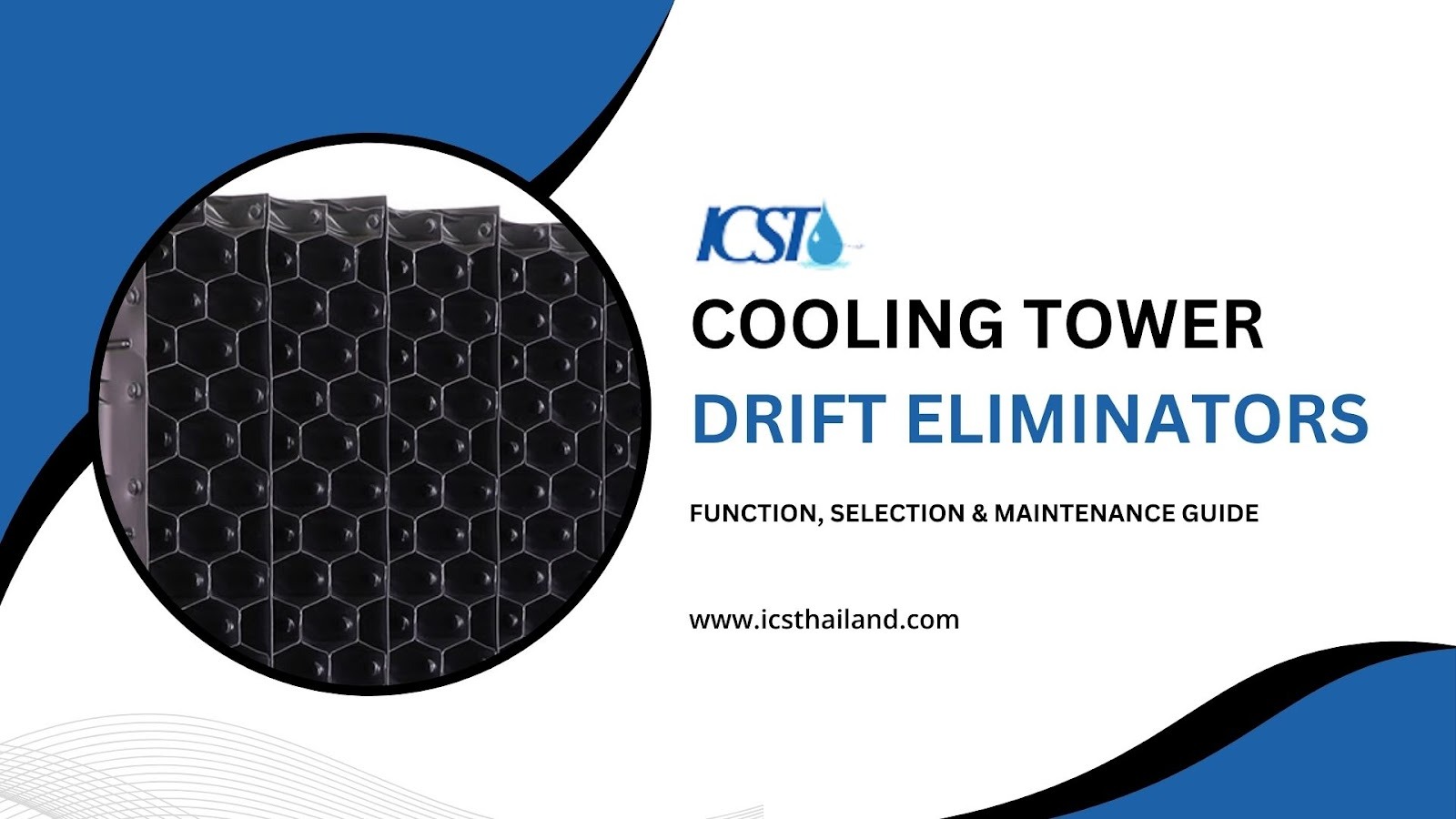
Cooling tower drift represents more than just water loss; it signifies energy waste, safety risks, compliance issues, and increased maintenance costs. Facility managers rely on cooling tower drift eliminators to serve as the primary defense against escaping moisture and chemicals.
These critical components function as a sophisticated mist eliminator, protecting system integrity while ensuring compliance with environmental standards.
By acting as a highly efficient droplet separator, these devices capture water droplets from the exhaust air and return them to the process loop. This guide covers the essential aspects of drift eliminator function, design selection, installation, and best practices to help you optimize your cooling operations.
What Are Cooling Tower Drift Eliminators?
Engineers define these components as baffled devices designed to capture and redirect water droplets entrained in the cooling tower exhaust air flow. While the cooling process naturally generates evaporation, drift consists of actual liquid droplets that carry dissolved solids, chemicals, and bacteria.
A well-designed eliminator functions as a powerful water-saving device, distinguishing it from simple splash guards.
How do we distinguish between evaporation and drift in a cooling context? Understanding the difference is vital for calculating true efficiency and water savings.
- Evaporation is pure vapor: This is a necessary part of the heat transfer process where water turns to gas, leaving impurities behind in the basin.
- Drift contains chemicals: These are liquid droplets that escape the tower, carrying the same chemical composition as the circulating water, including biocides and minerals.
- Capture mechanism: Drift eliminators physically trap liquid droplets through inertial impaction, whereas they allow vapor (evaporation) to pass through to the atmosphere.
Why Drift Eliminators Matter (Performance & Compliance)
Why is this technology indispensable for modern industrial operations? Ignoring drift leads to compounded operational costs, significant regulatory risks, and potential damage to surrounding infrastructure.
- Water conservation: Effective eliminators return water to the system, significantly reducing the volume of makeup water required to operate the tower.
- Corrosion protection: Drift droplets contain salts and chemicals that settle on nearby cars, buildings, and equipment, causing rapid corrosion and costly property damage.
- Chemical retention: When water escapes, water treatment chemicals escape with it, requiring operators to add more chemicals to maintain the correct balance.
- Health and safety: Drift can carry Legionella bacteria and other pathogens, making drift reduction a critical component of a facility’s health and safety compliance plan.
How Drift Eliminators Work (Engineering Mechanism)
How do these static components capture rapidly moving water without choking airflow? The engineering relies on forcing air to change direction while water momentum carries droplets into the baffle walls.
- Inertial separation: As air travels through the sinusoidal or chevron-shaped paths, the inertia of the water droplets prevents them from turning as quickly as the air, causing them to strike the eliminator surface.
- Coalescence and drainage: Once droplets strike the surface, they adhere to the material and coalesce into larger drops that eventually become heavy enough to drain back into the wet section of the tower.
- Airflow management: Manufacturers design the geometry to maximize droplet capture while minimizing the pressure drop, ensuring the fan does not have to work harder than necessary.
Types of Drift Eliminators & Common Designs
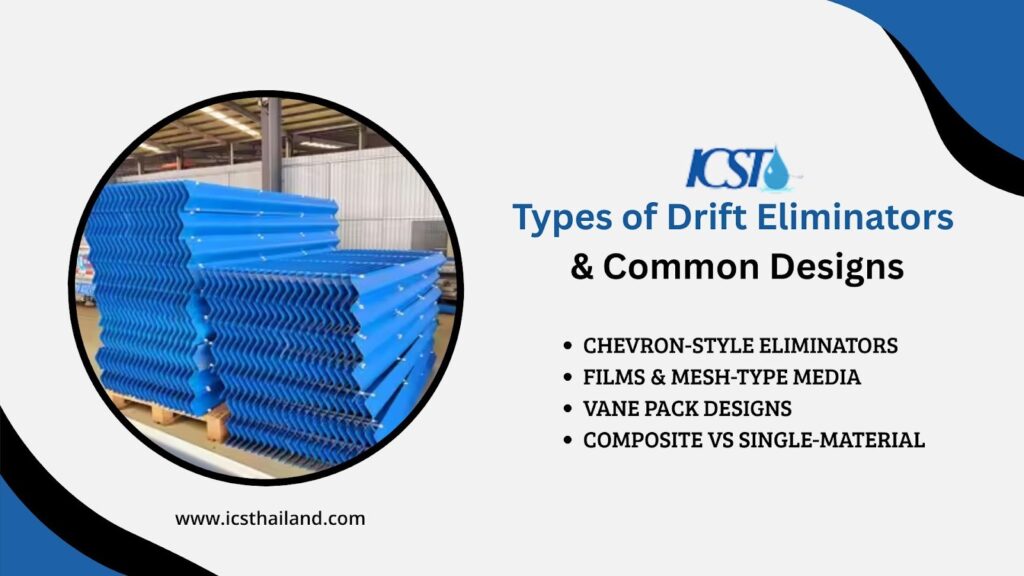
Selecting the correct droplet separator requires understanding the different configurations available on the market. Manufacturers offer various designs to suit specific applications and efficiency requirements.
Chevrons
Chevron-style eliminators are the most common design in modern cooling towers. They feature a zigzag pattern that forces air to change direction multiple times.
- Pros: High efficiency, low pressure drop, and durable construction.
- Applications: Widely used in counterflow and crossflow towers.
Films & Mesh-Type Media
These designs use tightly packed layers of material to create a dense barrier for droplets. This structure helps block tiny particles effectively, enhancing protection in various settings.
- Pros: Can be effective for smaller droplets.
- Cons: Higher susceptibility to fouling and clogging in dirty water applications.
Vane Pack Designs
Vane packs use streamlined blades similar to a turbine, designed to improve efficiency and reduce energy consumption. These blades help in directing flow with minimal resistance, making them ideal for applications where precision and performance are critical.
- Pros: Good structural integrity and lower resistance.
- Suitability: Often used in industrial applications with high air velocities.
Composite vs. Single Material
Some advanced eliminators use composite materials to enhance UV resistance or chemical compatibility, while others rely on single-material extrusion for cost-effectiveness. The choice depends heavily on the water quality and environmental exposure of the tower.
Selection Criteria: Choosing the Right Drift Eliminator

What factors determine success when specifying a new component for your tower? Selecting the correct model requires balancing capture efficiency with energy consumption and structural limitations.
- Drift rate requirements: You must select a model that meets your specific drift limit, which typically ranges from 0.005% down to 0.001% of the circulating water flow rate, depending on local regulations.
- Operating conditions: High-temperature applications or environments with high chemical concentrations may require specialized materials like polypropylene instead of standard PVC.
- Hydraulic and aerodynamic impact: You must consider the pressure drop across the media to ensure your existing fan motor has the capacity to handle the resistance without reducing cooling performance.
- Structural considerations: For retrofit projects, the physical dimensions, span capabilities, and support structure requirements will dictate which eliminator modules you can successfully install.
Expert Tips for a Flawless Installation
Proper installation ensures that the cooling tower drift eliminators perform according to their design specifications. Even the highest quality product will fail if installed incorrectly.
Correct Orientation & Spacing
Installers must ensure the blades align correctly with the airflow. In many designs, installing the panels upside down or backward will render them ineffective. The spacing between modules must be tight to prevent air from bypassing the media.
Sealing and Framing
Gaps between the eliminator packs and the tower walls are common failure points. Installers should use proper sealing kits or foam to close these gaps. Any opening offers a path of least resistance for air, carrying water droplets out with it.
Avoiding Bypass Paths
During retrofitting, it is crucial to ensure that the new support beams do not create gaps. Every square inch of the exhaust area must be covered by the eliminator media.
Common Installation Mistakes:
- Misalignment: Placing packs slightly askew creates gaps.
- Incorrect Tilt: Some eliminators require a specific drainage angle.
- Loose Retainers: Failing to secure the packs can lead to displacement during high winds or fan startup.
Maintenance & Inspection Guide
How does a facility manager ensure long-term performance and prevent fouling? Regular maintenance prevents scale buildup that increases pressure drop and reduces airflow.
- Routine visual checks: Perform monthly inspections to look for signs of scale buildup, algae growth, or physical damage that could impede airflow or water drainage.
- Cleaning procedures: Clean the packs annually using a low-pressure water spray and mild detergent; do not use high-pressure washers as they can shatter brittle PVC material.
- Replacement triggers: Plan to replace the eliminators if they show signs of brittleness, significant warping, or if you detect a noticeable increase in drift emissions despite cleaning.
Performance Monitoring & Drift Loss Prevention
Effective drift loss prevention requires active monitoring rather than passive assumption. Tracking specific metrics allows operators to intervene before small issues become expensive failures.
- Visual plume analysis: While pure water vapor is visible, frequent observations can help you distinguish between a normal steam plume and a heavy, spitting drift plume that indicates eliminator failure.
- Makeup water trends: Monitor your water meter readings; a sudden, unexplained increase in makeup water usage often points to increased drift loss or leaks.
- Surface wetness checks: Regularly inspect the area immediately surrounding the cooling tower; wet spots on dry days are a clear indicator that droplets are escaping the plenum.
Cost & ROI of Drift Eliminators
Where does the financial return come from when upgrading capture technology? The return on investment extends beyond water bills to include reduced chemical treatment costs and extended equipment life.
Water and Chemical Savings
Reducing drift directly lowers the water bill. Furthermore, because treatment chemicals stay in the system longer, the annual cost of chemicals decreases.
Energy Efficiency
Effective mist elimination keeps the fan blades dry and efficient. It also prevents water from accumulating on downstream equipment, reducing the load on pumps and fans.
Maintenance and Asset Protection
Preventing mineral-laden water from landing on expensive mechanical equipment reduces corrosion rates. This extends the lifespan of pumps, fans, and metal structures, deferring costly capital replacements.
Compliance Avoidance Costs
The cost of a regulatory fine for emission violations far exceeds the price of new drift eliminators. Compliance is a significant financial incentive for maintaining high-efficiency systems.
Industrial operators typically see a payback period of less than two years when upgrading from older, inefficient slats to modern cellular drift eliminators.
Common Problems & Troubleshooting
What issues typically plague these systems during their operational lifespan? Identifying the root cause of performance drops is the first step toward restoring system efficiency.
- Media clogging: Algae, scale, and airborne debris can clog the narrow passages of the eliminator, which restricts airflow and forces fan motors to overwork.
- Physical damage: Hail, ice formation, or careless maintenance from foot traffic can crack the media, creating large gaps that allow drift to bypass the separation process.
- Improper sizing: If the air velocity through the eliminator exceeds its design limit, droplets can be stripped off the surface and re-entrained into the airstream, rendering the device ineffective.
Conclusion
Understanding the function and maintenance of cooling tower drift eliminators is essential for any responsible facility manager. By prioritizing the right water-saving device and maintaining a robust eliminator design, operators ensure long-term efficiency and regulatory compliance.
Regular inspection and proactive replacement strategies are the keys to effective drift loss prevention. Investing in high-quality cooling tower drift eliminators ultimately protects your infrastructure, your budget, and the environment.
Ready to boost your cooling tower’s performance and protect your bottom line? Explore our industry-leading drift eliminators at the Industrial Cooling Solutions, Inc. website and discover the perfect solution for your facility today.
Frequently Asked Questions
What are cooling tower drift eliminators?
Drift eliminators are baffles placed in the air discharge path of a cooling tower. They capture water droplets entrained in the airflow and return them to the tower basin to conserve water and chemicals.
How much water can drift eliminators save?
Standard eliminators reduce drift loss to between 0.001% and 0.005% of the circulating water flow. Without them, drift loss could be significantly higher, wasting thousands of gallons of water annually.
What is the difference between a mist eliminator and a drift eliminator?
The terms are often used interchangeably in the industry. However, a mist eliminator is sometimes a broader term used in various industrial gas cleaning applications, while a drift eliminator specifically refers to cooling tower applications.
How often should drift eliminators be inspected?
You should perform a visual inspection at least once a month. A more thorough inspection for structural integrity and fouling should occur quarterly or semi-annually.
Can drift eliminators be retrofitted?
Yes, you can retrofit most cooling towers with newer, high-efficiency drift eliminators. This is a common upgrade to improve plant efficiency and meet stricter environmental regulations.