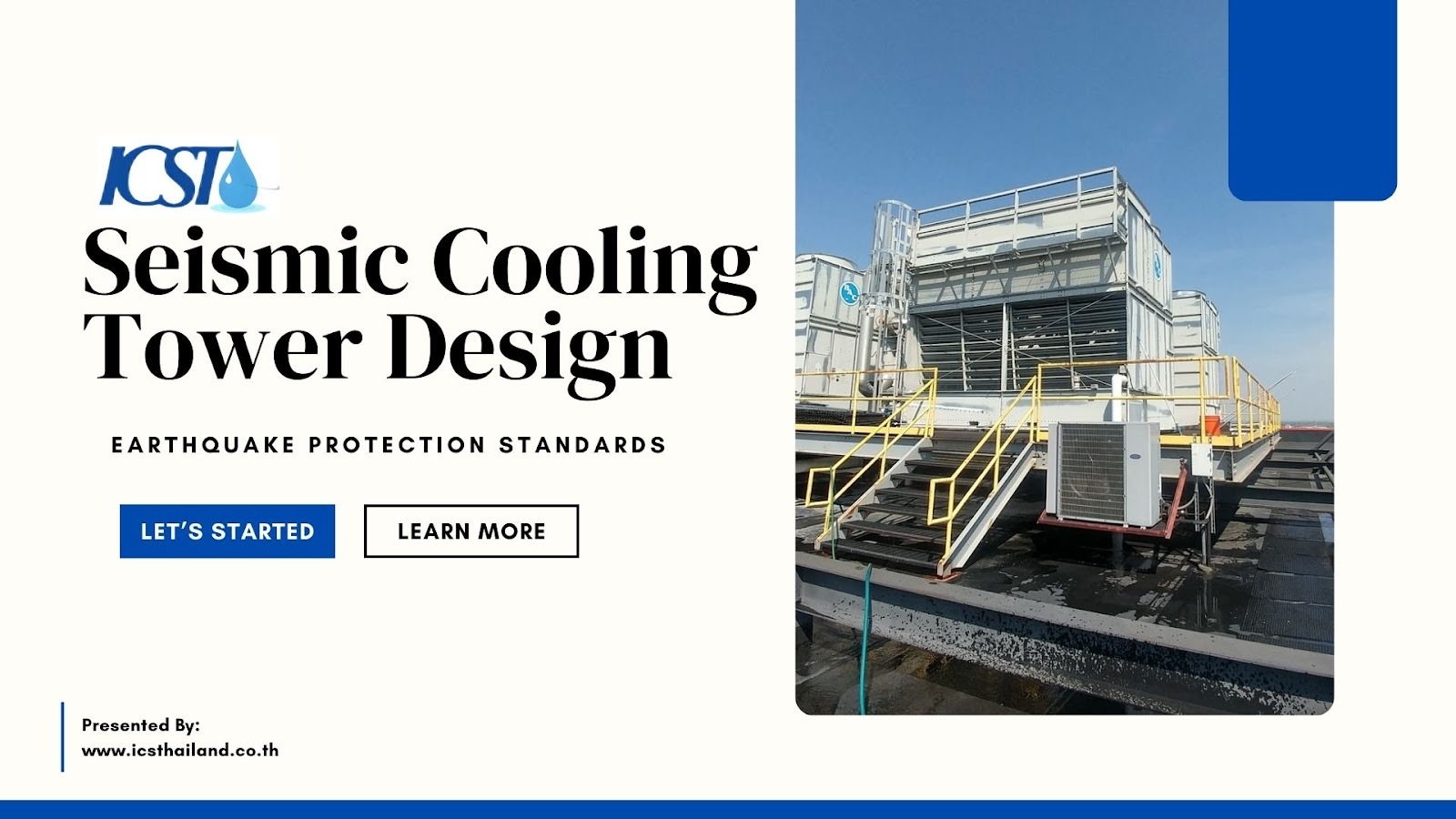
Designing industrial structures requires more than just managing operational loads; it demands preparation for the unpredictable forces of nature. Seismic cooling tower design is a specialized engineering discipline focused on ensuring these critical heat rejection systems withstand earthquake events without catastrophic failure.
Unlike standard buildings, cooling towers present unique challenges due to their height, slender profiles, and the dynamic behavior of the water they contain.
Engineers must account for complex variables, including dynamic water mass, sloshing effects, and mechanical system vibrations. A failure in earthquake protection planning can lead to operational shutdowns, costly repairs, or hazardous working conditions.
This guide examines the essential codes, analysis methods, and structural criteria necessary to achieve robust structural integrity in cooling tower projects.
Why Earthquake Protection Is Critical for Cooling Towers
Cooling towers are particularly vulnerable during seismic events due to their physical characteristics and operational nature. The combination of heavy water loads at elevation and open structural framing creates a complex dynamic response.
Engineers must address several specific vulnerabilities to prevent failure:
- Height and Geometry: Tall, slender structures amplify ground accelerations, leading to higher overturning moments.
- Water Mass Dynamics: The large volume of water in the basin and distribution systems creates sloshing effects that generate significant lateral forces.
- Operational Vibration: Existing mechanical vibrations from fans and pumps can compound the stress placed on structural members during an earthquake.
- Risk Consequences: Structural failure compromises the entire industrial process, potentially causing chemical spills, fires, or flooding.
Effective earthquake protection strategies mitigate these risks by ensuring the tower remains stable and operational, even after significant ground motion.
Applicable Seismic Design Codes & Standards
Regulatory frameworks provide the baseline for safe engineering practices. While local codes vary, international standards offer a consistent methodology for seismic analysis.
Key documents governing seismic cooling tower design include:
- International Building Code (IBC): This code sets the general safety standards for all building types, including industrial structures.
- ASCE/SEI 7: This standard provides specific design criteria for mechanical structures and non-building structures, offering detailed guidance on load combinations.
- Local Seismic Codes: Regional regulations often impose stricter requirements based on local fault lines and historical data.
Engineers must interpret seismic hazard maps to determine the site class and spectral response accelerations. These classifications dictate the seismic design category, which subsequently influences the rigorousness of the required analysis and detailing. Building code compliance is not optional; it is the legal and ethical minimum for public safety.
Seismic Load Analysis for Cooling Towers
Accurate load analysis distinguishes a resilient structure from a vulnerable one. Simple static analysis methods often fail to capture the complex behavior of cooling towers.
The analysis process typically involves several advanced techniques:
- Base Shear Calculation: Determining the total lateral force the earthquake exerts on the base of the structure. This serves as the foundation for designing the tower’s resistance to seismic forces.
- Dynamic vs. Static Loads: Static analysis assumes forces are constant, providing a simplified approach, whereas dynamic analysis accounts for the varying magnitude and direction of seismic waves, offering a more accurate representation of real-world scenarios.
- Response Spectrum Analysis: This method estimates peak structural response by analyzing the natural frequencies and mode shapes of the tower. It’s particularly useful for structures with multiple degrees of freedom.
- Time-History Analysis: For critical or irregular structures, engineers simulate specific earthquake records to observe the tower’s performance over time. This approach helps identify vulnerabilities under real seismic conditions.
- Sloshing Effects: The impulsive and convective components of water motion in the basin require separate calculations to prevent wall failure or excessive spillover. Proper design ensures stability and minimizes the risk of structural damage.
Cooling towers frequently require dynamic analysis because their mass distribution and flexibility do not fit the assumptions of equivalent lateral force procedures.
Structural Design Criteria for Seismic Resilience
The primary goal of seismic design is not necessarily to prevent all damage but to prevent collapse and maintain function. This requires a careful balance of strength, stiffness, and ductility.
Designers must focus on these critical structural aspects:
- Shell Stiffness: For hyperbolic towers, the thin concrete shell must possess sufficient stiffness to resist buckling under lateral loads.
- Framing Systems: In mechanical draft towers, the leg and support framing must transfer shear forces effectively to the foundation.
- Ductility: The structure needs the ability to deform plastically without breaking, absorbing energy during strong ground shaking.
- Redundancy: A well-designed system includes multiple load paths so that if one member fails, others can carry the load.
- Connection Detailing: Joints and connections are often the weak points; they require robust design to withstand cyclic loading.
Prioritizing structural integrity ensures the tower can endure the immense stresses generated during a seismic event.
Seismic Bracing and Reinforcement Techniques
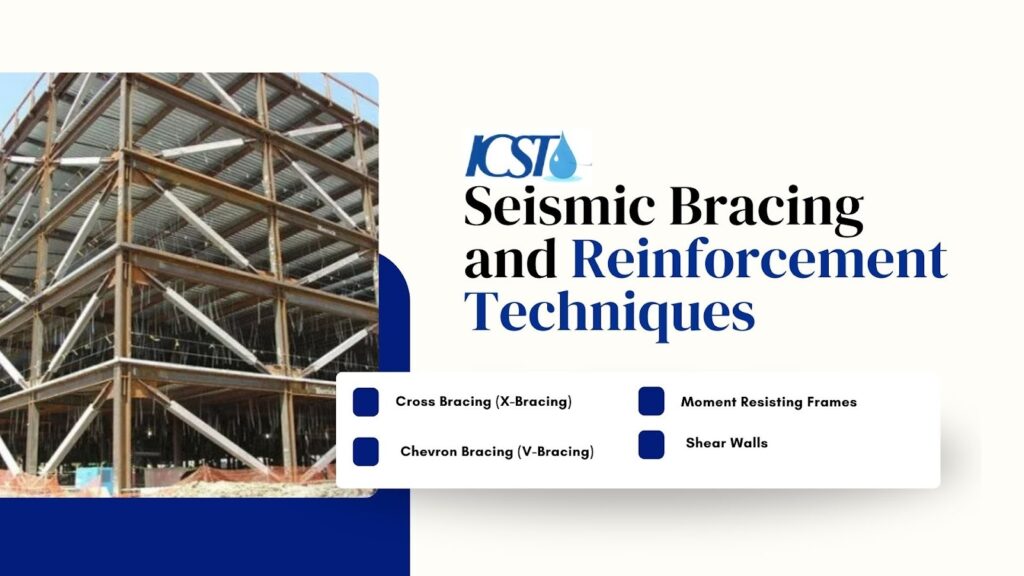
Lateral stability depends heavily on the bracing system employed. Without adequate seismic bracing, the open frame of a cooling tower can easily rack or twist.
Engineers implement various bracing strategies to distribute forces:
- Cross Bracing (X-Bracing): Tension-only or tension-compression members that provide high lateral stiffness.
- Chevron Bracing (V-Bracing): This configuration allows for doorways or equipment access while maintaining stability.
- Moment Resisting Frames: These rigid frames rely on strong connections to resist rotation, useful where bracing would obstruct airflow.
- Shear Walls: Concrete or masonry walls provide exceptional stiffness and are common in larger concrete towers.
Effective seismic bracing prevents excessive drift, which protects both the structure and the sensitive mechanical equipment housed within.
Foundation & Soil Interaction Considerations
The stability of the superstructure relies entirely on the ground beneath it. Seismic forces transfer from the structure into the soil, and the soil response feeds back into the structure.
Foundation design must address several geotechnical factors:
- Site Class: The soil profile type (hard rock to soft clay) dramatically amplifies or dampens seismic waves.
- Soil-Structure Interaction: Flexible soils can lengthen the natural period of the structure, altering the seismic demand.
- Overturning Resistance: High lateral loads can cause the tower to lift off its foundation; designers must provide sufficient dead weight or anchorage to resist uplift.
- Liquefaction: Loose, saturated sandy soils may lose strength during shaking; deep foundations like piles are often necessary to reach stable strata.
Foundations typically utilize spread footings for stable soil or deep pile systems for poorer conditions to mitigate settlement and tilting risks.
Design for Operational Safety Under Seismic Loads
A standing tower that cannot function is still a failure in critical industrial applications. Seismic cooling tower design must extend to the mechanical and non-structural components.
Operational safety considerations include:
- Equipment Anchorage: Fans, motors, and gearboxes must be bolted down to resist high acceleration forces.
- Piping Flexibility: Rigid pipes break when the tower moves; flexible couplings or expansion joints allow for differential movement.
- Sloshing Impact: Water splashing against the fan deck or mechanical equipment can cause damage; baffles may be necessary.
- Vibration Isolation: Isolators used for noise and vibration dampening must have snubbers (restraints) to prevent equipment from toppling during an earthquake.
Ensuring these elements remain secure prevents secondary damage and facilitates a rapid return to service.
Verification, Testing & Compliance Documentation
The design process concludes with rigorous verification. Engineers must prove that their design meets all safety criteria before construction begins.
The verification workflow typically includes:
Software Simulation
Engineers use advanced software to ensure a design is safe and resilient against seismic forces. These computer models help predict how a structure like a cooling tower will behave during an earthquake, allowing for precise adjustments before construction begins.
This digital testing process typically involves:
- Finite Element Analysis (FEA): This software simulates potential stresses, displacements, and weak points in the design.
- Design Optimisation: Based on the simulation results, engineers can refine the design to enhance its strength and resilience.
Peer Review
A thorough peer review is a key step in ensuring the reliability and safety of any engineering design. By having a fresh set of eyes review the work, potential errors or oversights can be identified early, saving time, resources, and ensuring compliance with safety standards. This process not only strengthens the design but also builds confidence in its quality and adherence to engineering principles.
Key aspects of the peer review process:
- Independent engineers evaluate all calculations, drawings, and assumptions.
- The review identifies errors, omissions, or oversights in the design.
- Objective feedback ensures the design meets safety and engineering standards.
Performance Criteria
Seismic designs must meet specific performance criteria outlined in building codes to ensure a cooling tower can withstand an earthquake. These strict, measurable limits ensure the structure not only survives but also maintains its structural integrity without catastrophic failure. Key performance criteria include:
- Drift Limits: Dictates how much the structure can sway during an earthquake.
- Stress Levels: Sets the maximum stress that components can endure to prevent failure.
- Foundation Stability: Ensures the base of the structure can support loads and movement during seismic activity.
- Energy Dissipation: Focuses on how the structure absorbs and reduces seismic energy to minimize damage.
Comprehensive Documentation
Finally, all analysis methods, load assumptions, calculations, and results are compiled into a comprehensive report. This detailed documentation is submitted to the relevant building authorities for approval. It serves as official proof that the design complies with all legal and safety requirements and acts as a critical reference for future maintenance, inspections, and any potential modifications.
Thorough documentation serves as proof of building code compliance and provides a roadmap for future inspections.
Retrofitting Cooling Towers for Seismic Resistance
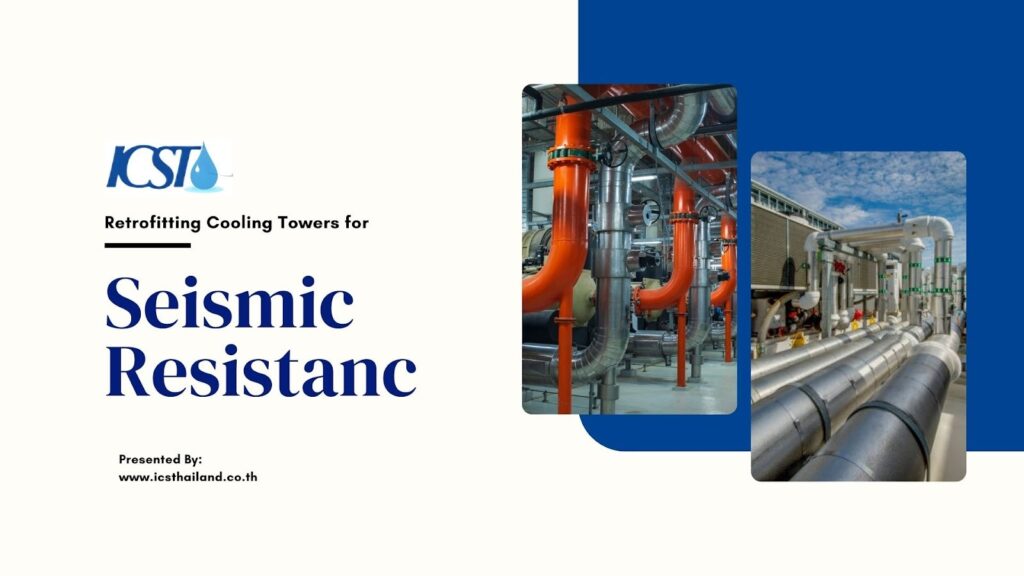
Many existing cooling towers do not meet modern seismic standards. Retrofitting offers a cost-effective alternative to replacement.
Common strengthening techniques involve:
Bracing Upgrades
Enhancing a structure’s lateral capacity is crucial for withstanding seismic forces. By adding new cross-bracing or replacing corroded members, the stability and durability of the structure are significantly improved. This upgrade ensures the tower can better distribute lateral loads and resist potential collapse during strong winds or earthquakes.
Connection Reinforcement
Strengthening the joints between beams and columns is essential to maintaining the structural integrity of a tower. Reinforced connections prevent separation and ensure the entire system moves as a cohesive unit under stress, reducing the risk of failure during unpredictable events.
Foundation Enlargement
A strong foundation is key to structural stability. Enlarging the size of footings bolsters resistance to overturning forces, such as those caused by earthquakes or strong winds. This upgrade can drastically improve the overall load-bearing capacity of the structure.
Base Isolation
Installing base isolators between the superstructure and foundation is an advanced method for reducing seismic forces. These isolators decouple the tower from ground motion, allowing it to move independently of the earth’s vibrations. This technology significantly lowers the risk of damage during earthquakes, protecting both the structure and its occupants.
Retrofitting extends the service life of the asset while bringing it into alignment with current disaster-resistant design principles.
Common Mistakes in Seismic Cooling Tower Design
Even experienced engineers can overlook critical details. Awareness of common pitfalls helps prevent costly errors.
Avoid these frequent design mistakes:
- Ignoring Soil-Structure Interaction: Assuming a fixed base on soft soil leads to inaccurate load calculations.
- Static vs. Dynamic: Relying solely on equivalent lateral force methods for complex or irregular towers yields unsafe results.
- Underestimating Water Mass: Failing to account for the dynamic effects of the water basin can result in wall failure.
- Poor Detailing: Designing strong members but weak connections creates immediate failure points.
- Lack of Documentation: Failing to record the design basis makes future modifications or safety assessments impossible.
Avoiding these errors ensures the seismic cooling tower design performs as intended during a crisis.
Conclusion
Designing for seismic events is a non-negotiable aspect of modern industrial engineering. Seismic cooling tower design requires a holistic approach that integrates geotechnical data, advanced structural analysis, and practical detailing. By strictly adhering to building code compliance and utilizing rigorous verification methods, engineers protect both human life and critical infrastructure.
The strategies discussed, from seismic bracing to dynamic load analysis, form the backbone of disaster-resistant design. Investing in these standards ensures that cooling towers maintain structural integrity when it matters most.
As seismic risks evolve, the commitment to robust engineering remains the most effective defense against the forces of nature. At ICS Thailand, we bring the same dedication to excellence in every cooling tower project. Whether you need cooling tower maintenance or are building a new tower, trust our expertise to deliver reliable and efficient solutions. Visit our website today to learn more and get started!
Frequently Asked Questions (FAQs)
What is seismic cooling tower design?
It is the engineering process of designing cooling towers to withstand earthquake forces, ensuring structural stability and operational continuity.
How do building codes apply to cooling towers?
Codes like IBC and ASCE 7 classify cooling towers as non-building structures, assigning specific factors for importance, risk, and structural behavior that dictate design loads.
When is dynamic analysis necessary?
Dynamic analysis is required for tall, irregular, or critical structures where static methods cannot accurately predict the complex response to ground motion.
What are common seismic protection methods?
Common methods include installing heavy-duty seismic bracing, reinforcing connections, using deep foundations, and anchoring mechanical equipment.
How is seismic compliance documented?
Compliance is documented through detailed calculation reports, structural drawings, and third-party peer reviews that verify adherence to relevant codes.