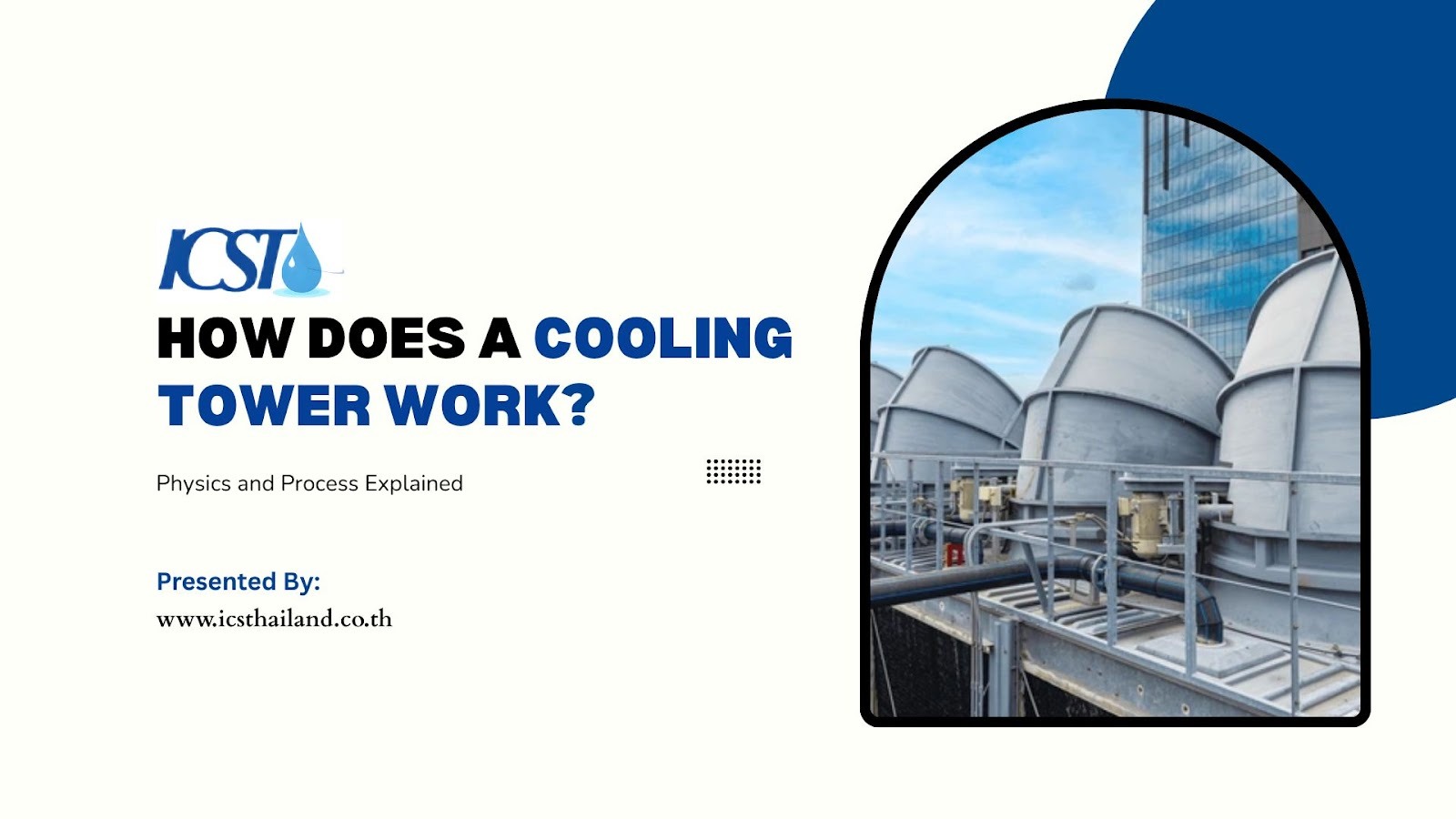
Cooling towers are essential to keeping large-scale industrial and commercial systems running safely. But how does a cooling tower work? At its core, a cooling tower removes heat from water using evaporative cooling—a process where a small portion of water evaporates, absorbing latent heat from the remaining water and lowering its temperature.
This chilled water is then recycled back into the system. This process of heat rejection depends on fill media, airflow, and ambient wet bulb temperature, all working together to transfer thermal energy from water to the atmosphere efficiently.
Understanding this process is crucial for managing industrial facilities, designing HVAC systems, or simply learning about large-scale heat management
What Is a Cooling Tower?
A cooling tower is a device that transfers heat from a system to the atmosphere. Its primary function is to remove excess heat from process water and discharge that heat into the atmosphere through evaporation.
Without cooling towers, heat generated by industrial and commercial processes would accumulate in the water used to cool machinery, condensers, and equipment—leading to overheating and system failure. Cooling towers solve this problem by continuously cycling water through an evaporative cooling process.
Common applications include:
- HVAC systems: Cooling towers work alongside chillers to reject heat from air conditioning systems in commercial buildings.
- Power plants: Steam turbines generate significant heat, and cooling towers manage the thermal load from condensers.
- Industrial processes: Petrochemical plants, steel mills, and manufacturing facilities use cooling towers to maintain safe operating temperatures.
How Does a Cooling Tower Work? A Step-by-Step Guide
To understand how does a cooling tower works, it’s helpful to break down the process into a clear sequence. Each stage transfers heat from the water to the surrounding air, progressively reducing the water temperature before it returns to the system.
Hot Water Enters the Tower
Warm water from a condenser or process equipment enters the cooling tower at an elevated temperature. The heat absorbed during the industrial or refrigeration process causes this temperature rise.
Once inside the tower, a water distribution system—typically a network of pipes and spray nozzles—spreads the water evenly across the top of the tower.
Water Spreads Over Fill Media

The water then flows down through the fill media, which is a material designed to increase the surface area for heat transfer. This step is crucial for maximising the contact time and surface exposure between the water and the moving air, leading to more efficient cooling.
- Flow and Distribution: Water flows down through fill media, which can be either structured or splash-type.
- Increased Surface Area: The fill media spreads the water into thin films or droplets.
- Efficient Heat Transfer: Maximising air-water contact time is essential for effective heat transfer.
Airflow Through the Tower
Air is drawn through the cooling tower to facilitate heat exchange. Depending on the tower’s design, this can happen mechanically with fans or naturally through buoyancy. This airflow is crucial as it passes through the wetted fill media, enabling the evaporation process.
- Mechanical vs. Natural Draft: Fans (mechanical draft) or natural buoyancy (natural draft) drive the airflow.
- Contact with Water: The moving air passes through the wetted fill media.
- Enabling Heat Exchange: This interaction enables both evaporation and sensible heat exchange between the air and water.
Evaporative Cooling Occurs
When air moves across the water’s surface, a phase change occurs, which is the primary mechanism for cooling. This evaporation process absorbs heat from the remaining liquid water, effectively lowering its temperature. The evaporated water then carries this thermal energy out of the system and releases it into the atmosphere.
- A small amount of water evaporates into the moving airstream.
- The evaporation process absorbs heat from the rest of the liquid water, cooling it down.
- The system expels the evaporated water, now carrying thermal energy, into the atmosphere.
Cooled Water Returns to the System
After passing through the fill media, the cooled water collects in a cold water basin at the base of the tower. Pumps then recirculate this water back to the condenser or process equipment, ready to absorb heat again and continue the cycle.
The Physics Behind Cooling Tower Operation
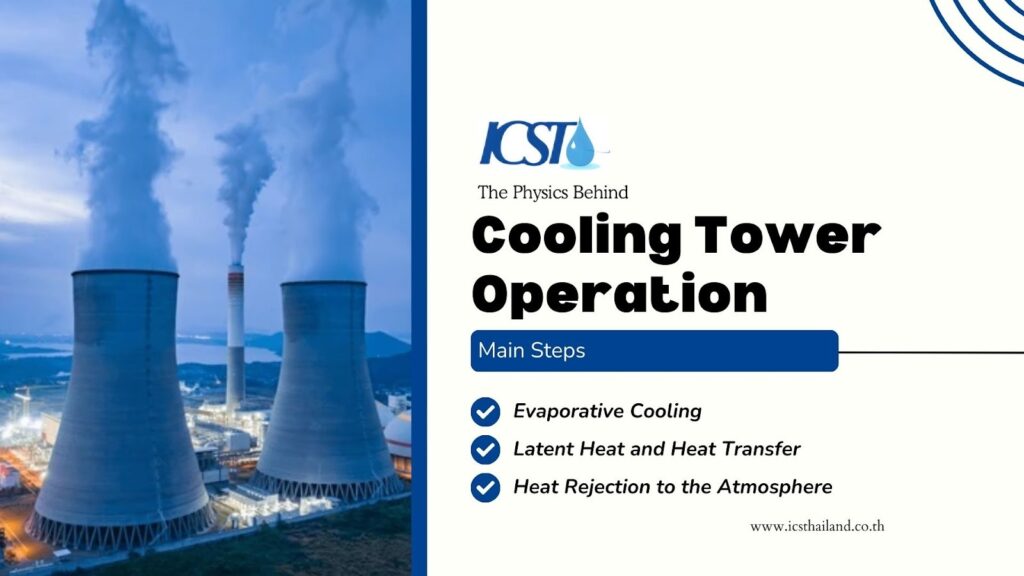
Understanding these physics is key to answering the question “how does a cooling tower work?” and explains why these evaporative systems often outperform simple heat exchangers in many industrial applications.
Evaporative Cooling
Water molecules at the surface of a liquid do not all possess the same energy. The highest-energy molecules escape the liquid phase and enter the vapor phase—this is evaporation.
When these molecules leave, they carry energy with them, which reduces the average kinetic energy of the remaining water molecules. The result is a measurable drop in water temperature. This is evaporative cooling in action, and it forms the foundation of cooling tower operation.
Latent Heat and Heat Transfer
The energy needed to change liquid water into vapor is known as the latent heat of vaporization. This process is the powerhouse behind a cooling tower’s effectiveness, as it allows for a massive amount of heat to be removed from the system.
- Latent Heat of Vaporization: For water, this is about 2,260 kilojoules per kilogram.
- Primary Heat Removal: The vast majority of heat removal in a cooling tower happens through this phase change (latent heat), not just by cooling the water (sensible heat).
- Thermal Effectiveness: This high energy transfer is what makes evaporative cooling systems so efficient.
Heat Rejection to the Atmosphere
The thermal energy absorbed during evaporation transfers to the airstream and disperses into the atmosphere. This is why cooling towers are classified as heat rejection systems. They do not destroy heat—they move it from process water to the surrounding environment, maintaining the energy balance of the facility.
Why Wet Bulb Temperature Matters
Every cooling tower has a thermodynamic limit. What determines that limit? The answer lies in the wet bulb temperature of the ambient air.
Wet bulb temperature measures the lowest temperature that air can reach through evaporative cooling. It reflects both the air’s temperature and its humidity. When humidity is high, air is already saturated with moisture, and evaporation slows significantly. This reduces the cooling tower’s ability to remove heat.
Here is why this matters in practice:
- Wet bulb vs. dry bulb temperature: Dry bulb temperature measures the actual air temperature. Wet bulb temperature is always equal to or lower than dry bulb temperature, and the gap between them indicates how much evaporation is possible.
- Approach temperature: This is the difference between the cooled water temperature leaving the tower and the ambient wet bulb temperature. A smaller approach temperature means the tower is operating near its thermodynamic limit.
- Performance ceiling: A cooling tower cannot cool water below the wet bulb temperature. This is a hard physical limit, not an engineering constraint.
Operators monitor wet bulb temperature closely because it directly determines how effectively the tower rejects heat on any given day.
The Anatomy of a Cooling Tower: What Are the Core Components?
How does a cooling tower work so reliably across different scales and conditions? The answer lies in several purpose-built components, each performing a specific role in the heat rejection process.
Fill Media
Fill media is the heart of the heat transfer process. It provides the large surface area needed for water and air to interact. What makes fill media so effective?
- Film fill: Creates thin water films across structured surfaces, maximizing evaporation area.
- Splash fill: Breaks water into droplets using a series of horizontal layers, increasing air-water contact time.
- Material selection: Modern fill media is typically made from PVC or polypropylene, offering durability and resistance to biological growth.
Spray Nozzles and Water Distribution
Uniform water distribution over the fill media directly affects tower performance. Poorly distributed water creates dry spots that reduce contact area and lower efficiency.
What does an effective water distribution system achieve?
- Even coverage across the entire fill surface.
- Consistent droplet size that optimizes evaporation.
- Prevention of channeling, where water flows in concentrated streams rather than spreading uniformly.
Fans and Airflow System
Airflow drives evaporation. Without adequate air movement through the fill media, the evaporative cooling process stalls. How do fans support cooling tower operation?
- Forced draft fans: Position at the air inlet and push air through the tower.
- Induced draft fans: Mount at the top of the tower and draw air upward through the fill.
- Variable speed drives: Allow operators to adjust fan speed based on real-time cooling demand, reducing energy consumption.
Drift Eliminators
As air exits the tower, it can carry small water droplets with it. Drift eliminators address this by capturing these droplets before they leave the system.
Why does this matter?
- Water conservation: Recovered droplets reduce overall water consumption.
- Environmental protection: Prevents chemical-laden water from dispersing into the surrounding environment.
- Legionella risk reduction: Limiting water drift reduces the potential spread of waterborne bacteria.
Factors That Affect Cooling Tower Efficiency
Even a well-designed cooling tower can underperform if operational conditions are not managed correctly. Several variables directly influence how effectively a tower rejects heat.
What determines real-world cooling tower performance? Consider these key factors:
- Wet bulb temperature: Higher ambient humidity reduces evaporation rates and limits cooling capacity.
- Airflow rate: Insufficient airflow reduces evaporation and sensible heat transfer across the fill.
- Water flow rate: Excessive flow can overwhelm the fill media, while too little reduces heat transfer surface utilization.
- Fill condition: Fouled, scaled, or damaged fill media reduces air-water contact area and degrades performance.
- Ambient humidity: High relative humidity limits the vapor pressure differential that drives evaporation.
Regular maintenance and performance monitoring are essential to keeping these variables within their optimal ranges.
Applications of Cooling Towers
Cooling towers serve a broad range of industries. Any process that generates significant heat and requires continuous temperature control will likely rely on a cooling tower at some point in its system.
Which industries depend most on cooling tower technology?
- HVAC chillers: Large commercial buildings use cooling towers to reject condenser heat from their refrigeration cycles.
- Power plants: Both fossil fuel and nuclear power stations use cooling towers to manage heat from steam condensers, preventing thermal discharge into natural water bodies.
- Petrochemical and chemical plants: Refineries and chemical processing facilities depend on cooling towers to protect heat exchangers and reactors from overheating.
- Data centers: High-density server farms generate immense heat and require robust cooling tower systems to maintain optimal operating temperatures for their equipment.
- Semiconductor manufacturing: The fabrication of microchips involves precise temperature control at multiple stages, making cooling towers essential for process stability and yield.
- Manufacturing industries: Steel production, food and beverage processing, pharmaceutical manufacturing, and plastics molding all rely on the precise temperature control enabled by cooling towers.
Cooling towers help maintain safe operating temperatures for industrial systems while supporting water recirculation and reducing freshwater demand compared to once-through cooling methods.
Conclusion
How does a cooling tower work? It works by moving heat—from process water, through evaporation, and into the atmosphere. The physics of latent heat absorption during phase change drives most of this heat removal, while fill media, fans, and water distribution systems create the conditions for evaporation to occur at scale.
The wet bulb temperature of ambient air determines the thermodynamic ceiling, and system components like drift eliminators and spray nozzles ensure the process runs efficiently and safely.
Understanding these core principles is key to evaluating performance, troubleshooting issues, or designing a new system. This knowledge is fundamental for reliable, efficient thermal management.
Need to build, maintain, or repair a cooling tower? Contact the experts at Industrial Cooling Solutions Thailand today for a custom quote.
Frequently Asked Questions
How does a cooling tower cool water?
A cooling tower cools water through evaporative cooling. Warm water passes over fill media, where air moves across it. A small percentage of the water evaporates, absorbing heat from the remaining liquid and reducing its temperature. After cooling, the water is sent back into the system to be used again.
What role does evaporation play in cooling towers?
Evaporation is the primary mechanism of heat removal. When water evaporates, it absorbs the latent heat of vaporization from the surrounding liquid—approximately 2,260 kJ/kg. This phase change carries far more thermal energy away from the water than simple air-to-water sensible heat transfer alone.
Why is wet bulb temperature important for cooling towers?
Wet bulb temperature sets the thermodynamic limit for cooling tower performance. A cooling tower cannot reduce water temperature below the wet bulb temperature of the ambient air. This is because evaporation depends on the vapor pressure difference between the water surface and the surrounding air, which diminishes as humidity increases.
What is the purpose of fill media in a cooling tower?
Fill media increases the surface area and contact time between water and air inside the tower. By spreading water into thin films or small droplets, fill media maximizes the evaporation rate and improves overall heat transfer efficiency.
How much heat can a cooling tower remove?
The heat rejection capacity of a cooling tower depends on its size, airflow, water flow rate, and ambient wet bulb temperature. Industrial cooling towers can range from small units rejecting a few kilowatts to large hyperboloid natural draft towers at power plants rejecting hundreds of megawatts of thermal energy.