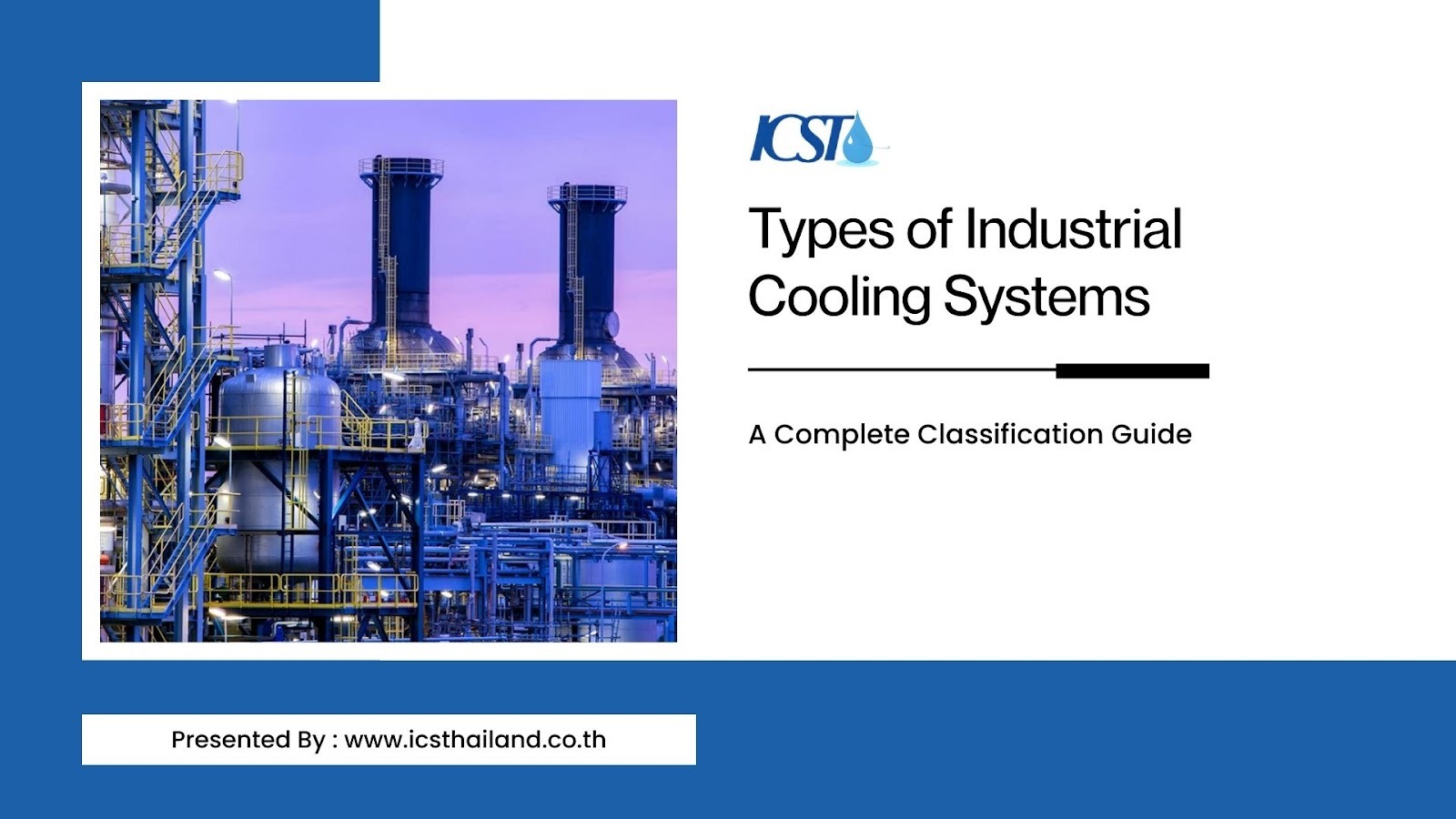
Industrial cooling systems fall into four main types: evaporative, dry cooling, fluid coolers, and hybrid systems. These are essential for managing the immense heat generated by industrial facilities to prevent equipment failure and productivity loss.
Choosing the right technology among the various types of industrial cooling systems is crucial, as it directly impacts energy costs, water use, and operational uptime in sectors like manufacturing and data centers. This guide breaks down each classification clearly and practically.
What Are Industrial Cooling Systems?
Industrial cooling systems are engineered solutions that remove excess process heat from equipment, machinery, and industrial fluids. Their core function is heat rejection — transferring thermal energy away from a heat source and dissipating it into the surrounding environment.
These systems are critical across a wide range of sectors:
- Manufacturing plants rely on them to maintain safe operating temperatures for machinery and process lines.
- Power plants use them to condense steam and maintain thermodynamic efficiency.
- HVAC systems depend on cooling to regulate building temperatures at scale.
- Data centers require continuous, precision cooling to protect sensitive hardware.
Without effective heat management, thermal buildup can cause equipment degradation, unplanned downtime, and significant financial losses.
The various types of industrial cooling systems solve this problem by transferring heat away from critical components and maintaining stable operating conditions.
Cooling Classification in Industrial Systems
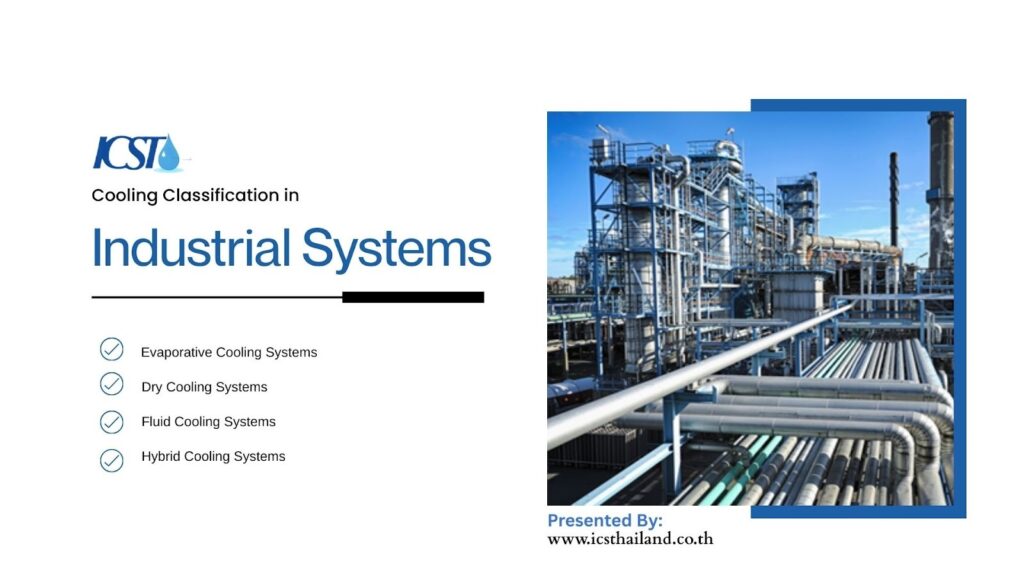
Cooling systems are classified based on two primary factors: their heat rejection method and their water usage. Understanding the different types of industrial cooling systems helps engineers and facility managers match the right technology to the right application.
The four main types of industrial cooling systems are:
Evaporative Cooling Systems
These systems use the evaporation of water to remove heat. They achieve very high cooling efficiency but consume significant volumes of water.
Dry Cooling Systems
Dry cooling systems use ambient air as the heat exchange medium. They require no water, which makes them well-suited to arid or water-scarce environments.
Fluid Cooling Systems
Fluid coolers transfer heat from process fluids through coils and airflow. They offer a controlled, contained approach to industrial heat rejection.
Hybrid Cooling Systems
Hybrid systems combine dry and evaporative methods. They deliver high efficiency across varying seasonal and load conditions while reducing overall water consumption.
Each category occupies a distinct position in industrial cooling design, and selecting among them requires a clear understanding of how they work.
Evaporative Cooling Systems
Evaporative cooling is one of the oldest and most effective heat rejection methods used in industry. It works on a straightforward thermodynamic principle: when water evaporates, it absorbs heat from the surrounding liquid, reducing its temperature significantly.
This makes evaporative cooling systems among the highest-performing options available, particularly for heavy industrial loads.
Evaporative Cooling Towers
An evaporative tower removes heat by exposing warm process water to airflow. Water flows over fill media, a structured surface that maximizes water-to-air contact. As a portion of the water evaporates, it carries heat away from the remaining liquid, reducing its temperature before it returns to the process.
Evaporative cooling towers are standard equipment in:
- Power generation plants, where they condense turbine exhaust steam.
- Petrochemical refineries, where they manage heat from continuous processing.
- Large HVAC systems, where they support chiller plant operations.
Their high thermal efficiency makes them the preferred choice wherever a water supply is reliable and maximum heat rejection is the priority.
Open Circuit Cooling Towers
Open circuit cooling towers, also known as direct cooling towers, operate by bringing process water into direct contact with the atmosphere. This simple yet effective design is renowned for its high thermal efficiency and cost-effectiveness, making it a staple in numerous industries.
- How they work: Hot water enters from the top and flows down through fill media. As ambient air is drawn across it, heat is transferred out of the water primarily through evaporation.
- Common applications: These towers are widely used for general industrial cooling, in food processing facilities, and at power plants.
- Key consideration: The direct exposure to air introduces airborne contaminants into the water, necessitating diligent water quality management and treatment to prevent scaling and corrosion.
Closed Circuit Cooling Towers
Closed-circuit cooling towers keep the process fluid isolated within a coil system. The cooling tower sprays water over the coils, and heat transfers from the internal fluid to the external spray water, which then evaporates.
This design protects the process fluid from contamination, making it ideal for sensitive applications such as pharmaceutical manufacturing, hydraulic systems, and precision industrial equipment.
Dry Cooling Systems
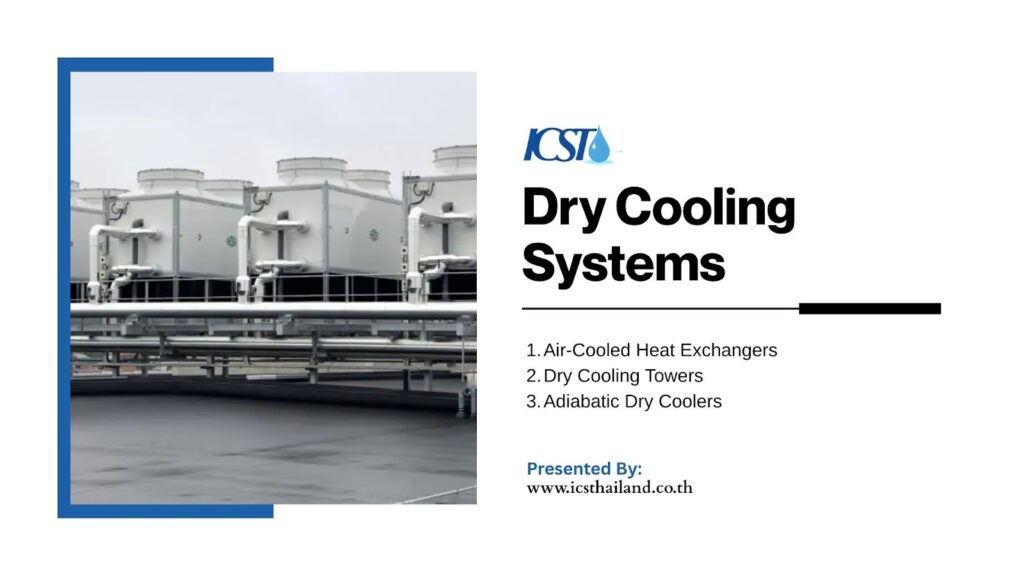
Dry cooling systems reject heat using ambient air — no evaporation and no water consumption involved. This makes them the logical choice for facilities located in water-scarce regions or where strict water-use regulations apply.
Dry coolers often use finned tube heat exchangers and airflow generated by fans to push ambient air across heated surfaces, transferring thermal energy into the atmosphere.
Air-Cooled Heat Exchangers
Air-cooled heat exchangers (ACHEs) are a key component of dry cooling systems, offering a water-free solution for industrial heat rejection. They work by moving a hot process fluid through a series of finned tubes while fans push ambient air over the exterior surfaces, effectively transferring heat from the fluid to the air.
This design makes them invaluable in industries where water conservation is critical.
- Process: Hot fluid flows inside finned tubes as fans force cool ambient air across the outside, dissipating heat into the atmosphere.
- Applications: Commonly used in oil and gas processing, power generation, and chemical plants.
- Benefits: Eliminates the need for cooling water, which simplifies operations and reduces environmental impact.
Dry Cooling Towers
Dry cooling towers function similarly to evaporative towers in structure but replace evaporation with air-to-fluid heat exchange. Hot fluid circulates through bundles of finned tubes inside the tower, and large fans draw air through the bundle.
Their efficiency drops in high ambient temperature conditions, which is the primary trade-off compared to evaporative towers. However, in cooler climates or water-limited environments, they perform reliably and with minimal maintenance demands.
Adiabatic Dry Coolers
Adiabatic dry coolers offer a smart middle-ground between purely dry and fully evaporative systems. They boost performance by pre-cooling the intake air with an evaporative mist, which enhances heat rejection efficiency, especially during hot weather. This method provides a balance between high performance and water conservation.
- Improved Efficiency: Pre-cools incoming air by evaporating water upstream of the heat exchanger coil.
- Reduced Water Use: Consumes significantly less water than traditional evaporative towers.
- Peak Performance: Achieves better heat rejection than standard dry coolers in high ambient temperatures.
- Clean Operation: The process fluid remains in a closed loop, free from direct contact with water.
Fluid Coolers
Fluid coolers reject heat from process fluids using a combination of coils, water, and airflow. They serve as an intermediate solution between fully evaporative and fully dry systems.
Fluid coolers reject heat from process fluids using coils and airflow, offering a contained and controllable method of heat management.
Closed-Loop Fluid Coolers
In a closed-loop fluid cooler, the process fluid circulates entirely within a sealed system. The cooler rejects heat by spraying water over external coils or by using dry airflow, depending on the operating mode.
The benefits are significant. The process fluid remains clean and uncontaminated throughout the cycle. This protects sensitive equipment, reduces chemical treatment costs, and extends the service life of both the fluid and the system components. Closed-loop fluid coolers are widely used in manufacturing, plastics processing, and industrial HVAC.
Open-Loop Fluid Coolers
In an open-loop fluid cooler, process water directly meets the heat exchanger and cooling air. This direct contact maximizes heat transfer efficiency but requires careful water quality management to prevent contamination and scaling. These systems are highly effective in specific industrial settings.
- Heat Transfer: Water comes into direct contact with heat exchanger surfaces and cooling air.
- Water Management: Requires ongoing water treatment to manage quality.
- Best For: Large-scale manufacturing and industrial processes where water treatment is already integrated into the workflow.
Hybrid Cooling Systems
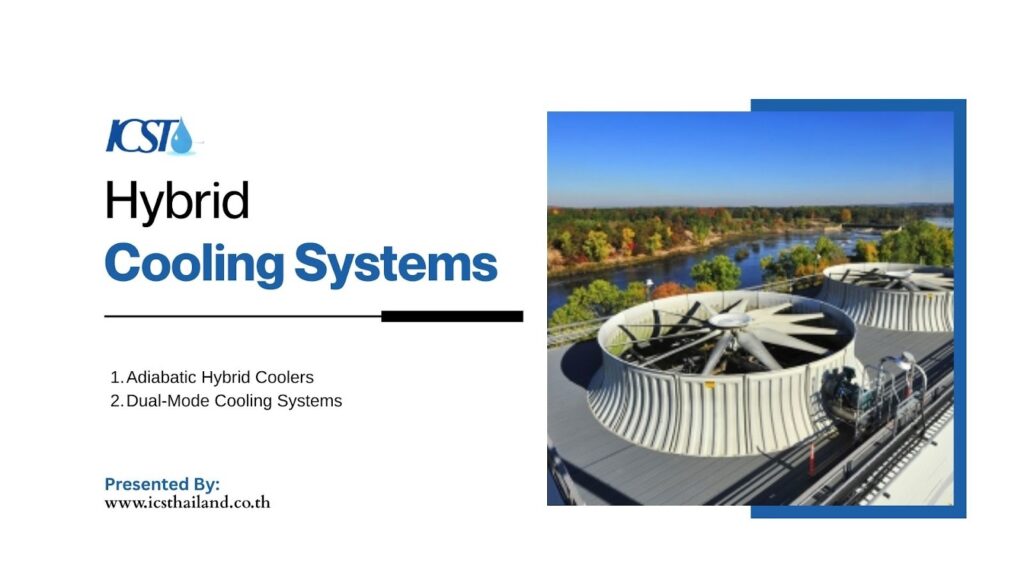
Hybrid cooling represents the next evolution in industrial thermal management. Hybrid cooling combines dry cooling and evaporative cooling to improve efficiency while reducing water consumption, addressing the core limitations of both approaches.
During cooler ambient conditions, the system operates in dry mode. When temperatures rise, and dry cooling alone cannot meet the required heat rejection load, the system activates evaporative assistance. The result is a flexible, high-efficiency system that adapts to seasonal and load variations.
Adiabatic Hybrid Coolers
Adiabatic hybrid coolers improve efficiency by pre-cooling the air before it reaches the dry heat exchanger. They spray a fine mist of water into the inlet air, lowering its temperature and increasing the system’s heat rejection capacity. This process occurs without any direct water contact with the process fluid, preventing contamination.
- Selective Water Use: These systems only consume water when ambient temperatures rise above a set point, making them far more water-efficient than traditional evaporative towers annually.
- Enhanced Capacity: By reducing the air temperature, the cooler can reject more heat, ensuring reliable performance even on hot days.
- Clean Operation: The process fluid remains in a closed loop, eliminating the risk of contamination from airborne particles or water treatment chemicals.
Dual-Mode Cooling Systems
Dual-mode systems take hybrid cooling further by engineering explicit switching between dry and evaporative operating modes. Sensors monitor ambient temperature and system load in real time. When dry mode is sufficient, the system runs without water. When demand increases, the system activates evaporative cooling automatically.
This intelligent switching reduces annual water consumption substantially while maintaining peak cooling performance throughout the year. Dual-mode systems are increasingly standard in modern energy-efficient industrial facilities and large data center cooling infrastructure.
Comparison of Industrial Cooling Systems
The table below provides a clear side-by-side overview of the main types of industrial cooling systems across the key performance and application criteria.
| Cooling System | Water Usage | Efficiency | Typical Applications |
| Evaporative Tower | High | Very High | Power plants, refineries |
| Dry Cooling | None | Moderate | Data centers, water-scarce regions |
| Fluid Cooler | Low | High | Industrial process cooling |
| Hybrid Cooling | Moderate | Very High | Modern energy-efficient facilities |
This comparison highlights the core trade-offs at play. High-efficiency systems typically require more water. Water-free systems sacrifice some thermal performance. Hybrid systems occupy the most balanced position, offering near-top efficiency at a controlled water cost.
Factors That Influence Cooling System Selection
Selecting the right cooling technology is not simply a matter of performance specifications. Multiple operational and environmental factors shape the final decision. What are the variables that matter most? Here are the five most critical ones.
Water Availability
Facilities in water-abundant regions can leverage the high efficiency of evaporative towers. Facilities in arid climates or regions with strict water withdrawal regulations need dry or adiabatic options to remain compliant and operational.
Energy Efficiency
Dry cooling systems consume more fan energy to achieve the same heat rejection that evaporative systems accomplish with less. Hybrid systems optimize this trade-off by minimizing fan load during mild conditions.
Environmental Conditions
Ambient temperature, humidity, and altitude all directly affect cooling system performance. High ambient temperatures reduce dry cooler effectiveness. High humidity limits evaporative efficiency. Site-specific climate data must inform the selection process.
Maintenance Requirements
Open circuit systems require regular water treatment, biological control, and mechanical inspection. Closed-loop and dry systems have lower maintenance burdens, which translates to reduced lifecycle costs in many applications.
Future Trends in Industrial Cooling Technologies
The industrial cooling industry is evolving rapidly, driven by the need for greater efficiency, sustainability, and adaptability. Innovations are focused on minimizing environmental impact while maximizing performance.
Here are some of the key trends shaping the next generation of industrial cooling.
- Hybrid Cooling Adoption: As water scarcity becomes a global concern and energy costs rise, hybrid cooling systems are gaining rapid adoption across sectors that previously relied on traditional evaporative towers. Their ability to reduce water consumption without sacrificing efficiency makes them the technology of choice for new construction.
- Energy-Efficient Designs: Variable speed drives, optimized fan blade geometries, and advanced heat exchanger materials are reducing the energy consumption of cooling systems across all categories. Manufacturers are designing systems that deliver more cooling per kilowatt-hour than previous generations.
- Water-Saving Cooling Systems: Adiabatic pre-coolers, advanced drift eliminators, and intelligent water recirculation controls are reducing water consumption in evaporative systems without reducing their thermal output.
- Smart Cooling Controls: Digital monitoring platforms now integrate sensor arrays, predictive analytics, and automated control systems to optimize cooling performance in real time. These systems reduce energy waste, extend equipment life, and provide data-driven maintenance scheduling.
Conclusion
Understanding the full range of types of industrial cooling systems is the first step toward making an informed infrastructure decision. From the high-output performance of an evaporative tower to the water-free operation of dry cooling, from the contained precision of a fluid cooler to the adaptive intelligence of hybrid cooling — each technology serves a specific set of conditions and requirements.
The right system reduces energy costs, conserves water, extends equipment life, and keeps critical processes running without interruption. No single solution fits every facility, which is why a thorough understanding of cooling classification, site conditions, and process loads is essential before any specification is finalized.
Use this guide as your foundation for understanding the different types of industrial cooling systems. When you’re ready to design a system tailored to your facility’s unique needs, our team of qualified engineers is here to help.
Contact ICST today to build a cooling system that delivers unmatched performance and long-term operational value.
Frequently Asked Questions
What are the main types of industrial cooling systems?
The four main types of industrial cooling systems are evaporative cooling systems, dry cooling systems, fluid cooler systems, and hybrid cooling systems. Each category differs in heat rejection method, water usage, and suitability for specific industrial applications.
What is the difference between dry cooling and evaporative cooling?
Evaporative cooling uses water evaporation to remove heat, achieving very high efficiency but consuming significant water volumes. Dry cooling uses ambient air as the heat exchange medium, requiring no water but delivering somewhat lower thermal performance, particularly in high ambient temperatures.
What is a fluid cooler used for?
A fluid cooler is used to reject heat from process fluids in a controlled, contained manner. Closed-loop fluid coolers are common in manufacturing, plastics processing, and industrial HVAC, where protecting the process fluid from contamination is a priority.
What are hybrid cooling systems?
Hybrid cooling systems combine dry cooling and evaporative cooling technologies to maximize efficiency while minimizing water consumption. They switch between operating modes based on ambient temperature and system load, making them highly adaptable to varying seasonal conditions.
Which cooling system is most energy efficient?
Evaporative cooling towers and hybrid cooling systems achieve the highest energy efficiency ratings. Hybrid systems offer a practical advantage by maintaining near-evaporative efficiency during peak conditions while reducing energy and water use during cooler periods.