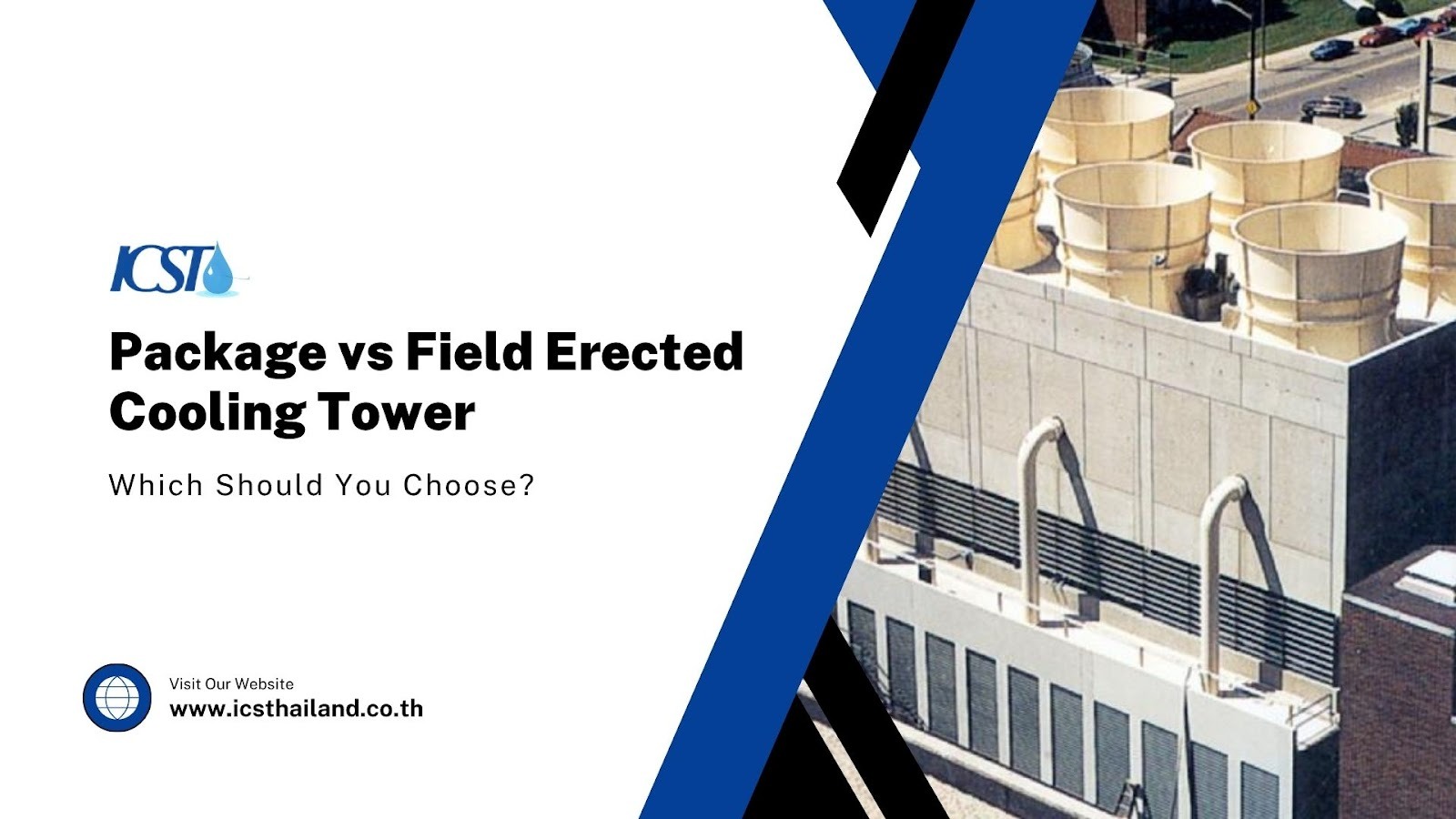
Need a quick comparison? A package cooling tower is a factory-assembled unit that offers a fast installation time, but it has a lower overall capacity. A field-erected tower requires on-site construction and features a custom design to handle massive heat rejection loads. Your decision ultimately depends on your required tower capacity, budget, and whether your application is for commercial or heavy industrial use.
Selecting the correct cooling system directly impacts your operational efficiency and bottom line. Plant managers and engineers must carefully evaluate their specific heat rejection requirements before making a capital investment. The debate over a package vs field erected cooling tower is a critical starting point for any facility upgrade or new construction.
What Are Package Cooling Towers?
Package cooling towers are modular units built in a manufacturing facility. The manufacturer delivers these units as complete systems directly to the job site. They typically utilize a mechanical draft design to pull or push air through the system.
Key Features of Package Cooling Towers
These modular systems offer specific engineering traits. How do they benefit modern facilities? The answer lies in their standardized approach.
- Compact size: They fit easily into restricted urban spaces or rooftop installations.
- Standardized design: The uniform manufacturing process ensures predictable performance and quick replacement parts.
- Multi-cell scalability: Facilities can add more units side-by-side to increase cooling capability over time.
Typical Applications
Many sectors rely heavily on package towers for their daily operations. Where do you see them most often? Look at facilities with moderate cooling demands.
- HVAC systems for hospitals, malls, and large office buildings.
- Small-to-medium industrial manufacturing plants.
- Data centers that require modular redundancy to prevent system failures.
What Are Field-Erected Cooling Towers?
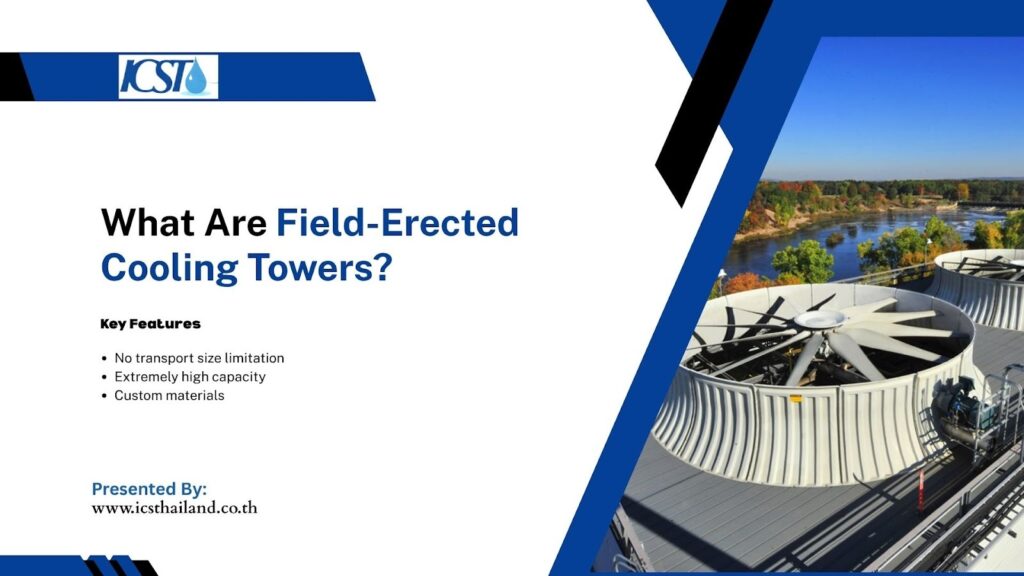
A field-erected cooling tower is a massive structure built piece-by-piece at the final installation site. Engineers create a completely custom blueprint for the specific project requirements. Contractors then ship raw materials and assemble the entire system from the ground up.
Key Features of Field-Erected Towers
These massive structures dominate heavy industrial skylines. What makes them so powerful? They break the boundaries of standard manufacturing.
- No transport size limitation: Builders construct them on-site, removing highway shipping constraints.
- Extremely high capacity: They process massive volumes of water for heavy industrial loads.
- Custom materials: Engineers select fiberglass reinforced plastic (FRP), concrete, or steel based on the specific environment.
Typical Applications
Heavy industries demand continuous, high-volume heat rejection. Which facilities depend on these massive structures? The most energy-intensive sectors use them daily.
- Power generation plants require massive cooling capacity.
- Oil refineries and petrochemical processing facilities.
- Heavy manufacturing and steel production plants.
Package vs Field Erected Cooling Towers (Core Comparison)
Side-by-Side Comparison
| Feature | Package Cooling Tower | Field-Erected Cooling Tower |
| Installation | Factory assembled, quick setup | Built on-site, longer installation |
| Capacity | Limited by transport constraints | Very high, infinitely scalable |
| Customization | Standardized modules | Fully customized engineering |
| Cost | Lower initial capital cost | Higher initial capital investment |
| Efficiency at Scale | Less efficient for massive loads | Highly efficient for large plants |
| Maintenance | Easier access, modular repair | Complex but highly durable |
| Best Use Case | Commercial and small industry | Heavy industry and power plants |
Key Decision Factors: Which One Is Right for You?
1. Cooling Load and Tower Capacity
Your required cooling load dictates your options. Facilities needing less than 1400 tons of cooling typically use a package tower. Plants requiring 5000 tons or more almost always require a field-erected system to handle the immense thermal load efficiently.
2. Installation Time and Project Deadlines
Your project schedule plays a massive role in this choice. A factory-assembled unit allows for rapid deployment, often taking only days to connect. A field-erected tower demands a lengthy construction timeline that can span several months.
3. Budget and Total Cost of Ownership
You must evaluate both capital expenditure (CapEx) and operational expenditure (OpEx). Package units have a lower initial CapEx but can cost more to operate at a massive scale. Field-erected towers require a massive initial investment but offer superior long-term return on investment (ROI) through high operational efficiency.
4. Space and Site Conditions
The physical footprint of your site limits your options. Urban environments and rooftops favor the compact nature of a package package vs field erected cooling tower. Industrial environments with ample ground space easily accommodate the large structural requirements of field-erected models.
5. Customization and Process Needs
Some industrial processes require highly specific cooling parameters. A custom design allows engineers to tailor a field-erected tower exactly to the chemical and thermal demands of the process. Package towers offer less flexibility for highly specialized process integration.
Advantages and Limitations of Each Tower Type
Advantages of Package Cooling Towers
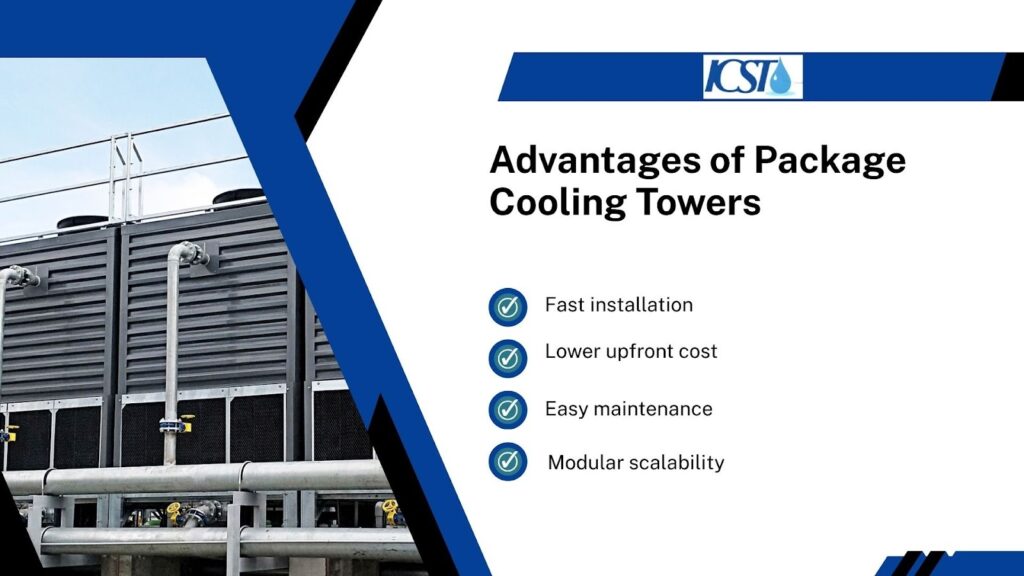
Modular systems provide excellent benefits for many commercial users. Why are they so popular in the HVAC industry? They offer a streamlined approach to heat rejection.
- Fast installation: The pre-assembled nature dramatically reduces site labor.
- Lower upfront cost: Standardized manufacturing keeps the purchase price low.
- Easy maintenance: Technicians can easily access standard components.
- Modular scalability: You can add adjacent cells as your facility grows.
Limitations of Package Cooling Towers
Despite their popularity, modular units have strict physical boundaries. Where do these systems fall short? They simply cannot handle every industrial scenario.
- Capacity limitations: They cannot handle extreme industrial heat loads efficiently.
- Less efficient at large scale: Running dozens of small fans uses more power than one massive fan.
- Transport size constraints: Highway shipping laws restrict their maximum dimensions.
Advantages of Field-Erected Cooling Towers
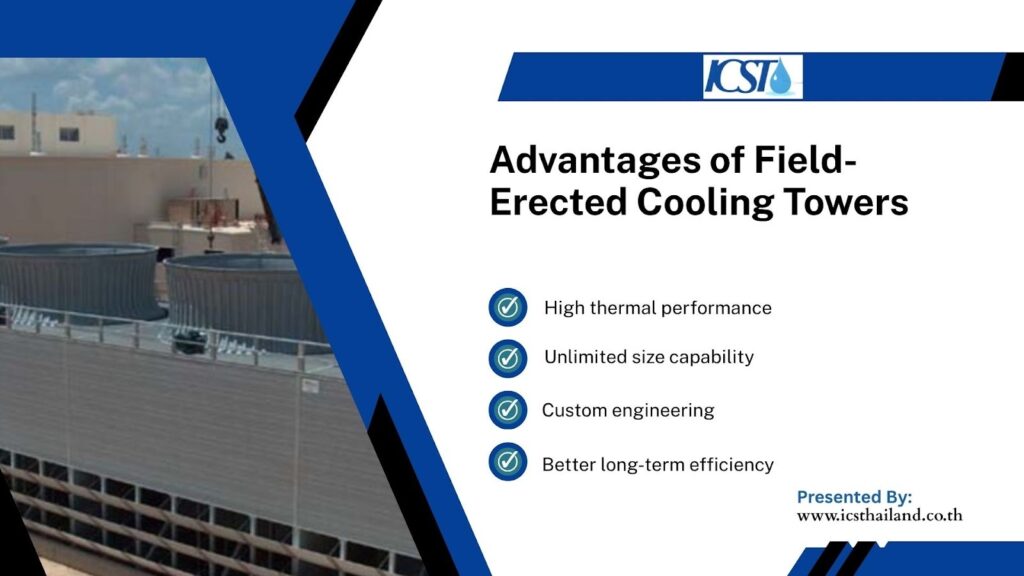
Heavy industry relies on the sheer power of on-site builds. What makes them the ultimate choice for power plants? They deliver unmatched performance.
- High thermal performance: They process millions of gallons of water daily.
- Unlimited size capability: Builders can scale the structure to any required dimension.
- Custom engineering: Designers match every component to the exact site conditions.
- Better long-term efficiency: Large fan systems consume less energy per ton of cooling.
Limitations of Field-Erected Cooling Towers
Building a custom structure presents significant logistical challenges. What hurdles will you face with this route? The commitment is substantial.
- High initial cost: Custom engineering and extensive site labor require a large budget.
- Longer installation time: Construction delays can impact the overall facility launch.
- Requires skilled engineering: You must hire specialized contractors for the build.
Real-World Use Cases (Industry-Based Selection)
When to Choose Package Cooling Towers
Package cooling towers are ideal when you have:
- A tight project deadline
- Limited space
- Standardized cooling needs
Their factory-assembled design simplifies logistics and ensures quick installation. This makes them a popular choice for commercial and light industrial projects where speed and efficiency are top priorities.
- Scenario: A commercial developer is building a new shopping mall with a strict opening deadline and limited rooftop space.
- Solution: They chose a factory-assembled package tower.
- Outcome: The tower is installed quickly, ensuring the HVAC system is operational before the mall’s grand opening.
When to Choose Field-Erected Towers
Field-erected towers are the answer when your industrial operation is large-scale and has unique, demanding cooling requirements. If you’re dealing with extreme heat loads and harsh operating conditions, like in a power plant or refinery, these custom-built structures offer the performance and capacity you need.
- Choose a field-erected tower if: Your facility is expanding, and you need to meet future cooling demands without compromising performance.
- For example: A petrochemical plant planning to double its processing capacity would opt for a field-erected tower.
- The result: The tower’s custom design and massive capacity can handle the specific cooling needs of volatile chemical processes in a harsh environment.
Expert Recommendation: How to Make the Final Decision
To select the right cooling tower for your needs, you need a structured decision-making process. Here are four key criteria to weigh:
- Load Size: First, determine your precise tonnage and heat rejection requirements.
- Industry Type: While commercial HVAC systems often use package units, heavy industries typically require the larger capacity of field-erected towers.
- Budget: Analyze your available capital expenditure (CapEx) against what you can afford for long-term operational expenditure (OpEx).
- Timeline: Consider how quickly your cooling system needs to be up and running.
Before making a final purchase, we strongly recommend consulting with certified cooling tower engineers. When debating between a package vs field erected cooling tower, they can run detailed thermal performance models to ensure your chosen system meets your facility’s operational goals.
Ready to find the perfect cooling solution? Contact ICST for a free consultation on your new cooling tower project today
Frequently Asked Questions
What is the main difference between package and field-erected cooling towers?
The main difference lies in assembly and total capacity. Manufacturers build package towers in a factory and ship them in modular units. Contractors build field-erected towers entirely on the job site to achieve much greater heat-rejection capabilities.
Which cooling tower is more efficient for large industries?
A field-erected cooling tower is significantly more efficient for large industries. The custom engineering allows for massive fan sizes and optimized fill media. This reduces the total energy consumed per ton of cooling when handling massive water volumes.
Are package cooling towers suitable for industrial use?
Yes, package cooling towers are suitable for light to medium industrial use. Many manufacturing plants use them successfully. However, they have a strict capacity limit, making them unsuitable for heavy industries like power generation or oil refining.
Why are field-erected cooling towers more expensive?
They are more expensive because they require custom engineering and extensive on-site labor. The materials are specifically chosen for the project, and the construction process involves heavy machinery and specialized contractors over several months.
How do I choose the right cooling tower for my plant?
You choose the right cooling tower by evaluating your specific decision factors. Analyze your tower capacity needs, budget constraints, and available physical space. A careful comparison of a package vs field erected cooling tower will guide you to the correct custom design or factory-assembled solution.