Cooling tower piping design ensures hydraulic stability by optimizing pipe sizing, reverse return layouts, and flow control. It prevents pump cavitation, water hammer, and uneven flow distribution, enhancing cooling system performance.
Reverse return piping balances hydraulic resistance across cells, while anti-vortex designs and slow-closing valves protect against surges and air pockets. These measures improve energy efficiency, reduce operational costs, and ensure reliable, long-term cooling tower operation. Proper design is critical for achieving peak performance and maintaining system reliability.
This comprehensive guide serves as your blueprint for achieving absolute hydraulic stability. You will learn how to navigate the complexities of open-loop hydraulics, apply exact pipe sizing parameters, and implement robust reverse return distribution networks. We will also explore essential strategies for mitigating water hammer and protecting your structural integrity from thermal expansion.
The Open-Loop Hydraulic Dilemma: Static vs. Friction Head
Designing a piping system for a cooling tower requires a distinct approach to fluid mechanics. Engineers must carefully account for the unique challenges of open-loop hydraulics to ensure the entire system can operate correctly over its lifespan.
The Open Circuit Reality
Unlike a closed-loop water-cooled chiller system, where static heads cancel out, an open cooling system presents a distinct challenge. The condenser water pumps must overcome both physical elevation changes, known as static lift, and friction head losses. You must calculate these pressure drop factors meticulously to select standard equipment that delivers the required cooling capacity without consuming more energy than necessary.
The Siphon Draw Phenomenon
Efficient designs manage sub-atmospheric pressures in the downcomer piping to establish a stable siphon. This siphon effect helps pull water down from the cooling tower return pipework, which minimizes unnecessary pump brake horsepower. Engineers must balance this siphon carefully to prevent air from breaking the vacuum and disrupting the cooling process.
The P-F Interval Connection
Your cooling tower piping layout must accommodate non-invasive diagnostic tools during the design phase. You should create straight runs that allow maintenance teams to install ultrasonic transit-time flow meters easily. This proactive flow control approach ensures you can monitor thermal efficiency and system performance accurately over the long term.
Fluid Velocity Limits and Pipe Sizing Parameters
The foundational rule of hydraulic stability is precise pipe sizing. You must size your piping by fluid velocity and pressure drop, never simply by matching the physical flange size of the pump.
To prevent inner-pipe erosion, severe water hammer, and excessive operational energy costs, follow this recommended pipe sizing velocity matrix:
| Piping Section | Optimal Fluid Velocity Range | Target Frictional Head Loss | Primary Engineering Rationale |
| Pump Suction Line | 1.2 to 1.5 m/s | ≤1.5 m/100m | Maximizes NPSH to eliminate pump impeller cavitation. |
| Pump Discharge / Header | 2.1 to 2.7 m/s | 2.0 to 4.0 m/100m | Balances initial material costs with long-term pump energy costs. |
| Multi-Cell Equalizer | 0.6 to 0.9 m/s | Minimal | Permits passive gravity equalization to stop basin overflows. |
| Drain & Blowdown Lines | 1.5 to 2.0 m/s | Variable | Facilitates rapid drainage and effective suspension of settled solids. |
Multi-Cell Layouts: Implementing Reverse Return Topology
When you operate multiple cooling tower cells, the water flow must remain perfectly balanced across different configurations. Improper piping layouts lead to flooded basins in some cells and starved sumps in others.
The Direct-Return Problem
In standard direct-return piping systems, the cell closest to the supply side experiences the lowest hydraulic resistance. This path of least resistance creates a massive, uneven flow distribution. The closest cell overflows while the furthest cell receives inadequate fresh water, drastically reducing overall heat transfer.
The Reverse Return Solution
You must implement a reverse return topology for multi-cell installations. Design piping networks so that the first cell filled is the last returned to the pump. This configuration inherently equalizes the pipe run lengths and friction elements for all cells. The result is an energy-efficient, self-balancing hydraulic network that requires minimal manual tuning with balancing valves.
Dynamic Basin Balancing
Even with perfectly balanced flow, local pressure variations frequently occur on the condenser side. You should utilize a shared equalizer pipe positioned at the absolute lowest point of the sumps.
This large-diameter pipe neutralizes variations passively, keeping the water temperature and volume uniform across all connected basins. Note that equilizer pipework insulation generally requires specific attention to prevent condensation.
Pump Suction Geometry: Protecting Net Positive Suction Head
The suction side of your condenser pump is the most critical segment of your cooling tower piping. Poor pump suction geometry will destroy a pump rapidly through cavitation and extreme mechanical vibration.
Eliminating Air Pockets
Horizontal pump suction lines must use flat-on-top eccentric reducers rather than concentric variants. Concentric fittings trap air pockets at the top of the rigid material. These trapped air pockets eventually collapse into the pump, causing severe priming failures, flow disruption, and internal mechanical damage.
The Straight-Run Mandate
Turbulence at the pump inlet drastically reduces energy efficiency. You must ensure an uninterrupted straight pipe run immediately before the pump inlet. Aim for a length of at least five to ten times the nominal pipe diameter. This straight run eliminates turbulent fluid profiles and ensures a smooth, undisturbed flow into the impeller.
Vortex Breaker Design
As warm water leaves the cooling tower basin, it can create a swirling vortex that pulls air down into the piping. You must integrate anti-vortex baffle geometries within the cold water basin outlet. These vortex breakers stop air from spinning into the suction line, preserving your NPSH available and protecting the internal pump components.
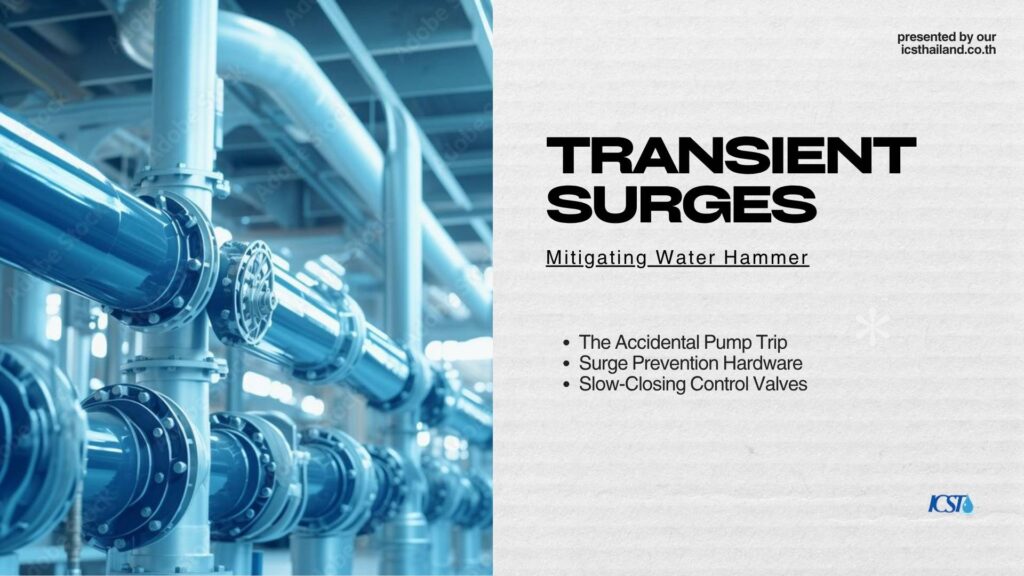
Transient Surges: Mitigating Water Hammer
Hydraulic shocks can rupture pipework connections and destroy expensive isolation valves. You must engineer your system to handle sudden changes in fluid momentum gracefully, especially in high-pressure applications.
The Accidental Pump Trip
An abrupt power failure stalls the condenser pumps instantly. The moving water column continues forward due to momentum, causing water column separation. When the flow reverses and the columns slam back together, it generates massive pressure spikes known as water hammer.
Surge Prevention Hardware
You must install specific hardware to absorb these transient surges. Size fast-acting, non-slam check valves on all pump discharge lines. Additionally, integrate vacuum breakers at high points in the system to cushion fluid columns and prevent vacuum collapse during unexpected shutdowns.
Slow-Closing Control Valves
Rapid valve actuation is a primary cause of kinetic energy spikes. Configure motorized butterfly isolation valves at tower inlets to cycle slowly. A slow closing time allows the hydraulic energy to dissipate safely through the distribution network without causing stress fractures in the carbon steel piping.
Stress Mitigation: Thermal Expansion and Vibration Isolation
Piping systems are dynamic structures that move, grow, and vibrate under operational loads. Your design phase must account for these stresses to protect the cooling tower and its surrounding framework.
Calculating Thermal Stress
Cooling water temperatures shift dramatically from cold standby states to hot water return loads. These temperature changes cause physical pipe growth. You must calculate this thermal expansion carefully and size expansion loops or expansion joints to absorb the movement without stressing the rigid material.
Structural Decoupling
Heavy header pipe runs impose significant structural loads. You must anchor these pipes to independent structural steel supports to prevent sagging. Never bear the weight of the piping directly on the cooling tower casing. Independent supports prevent the warping and cracking of the fiberglass material-covered frames.
Vibration Isolation
Pumps generate mechanical resonance that travels easily through carbon steel pipes. Deploy braided stainless steel or elastomeric flexible connectors directly at the pump interfaces. These connectors decouple the vibration, preventing it from transferring into the tower piping layout and causing long-term metal fatigue.
Precision Instrumentation and Flow Measurement
Accurate data allows plant operators to run various systems at peak efficiency. Strategic placement of sensors is vital for reliable system monitoring and proper chemical treatment.
Flow Meter Placements
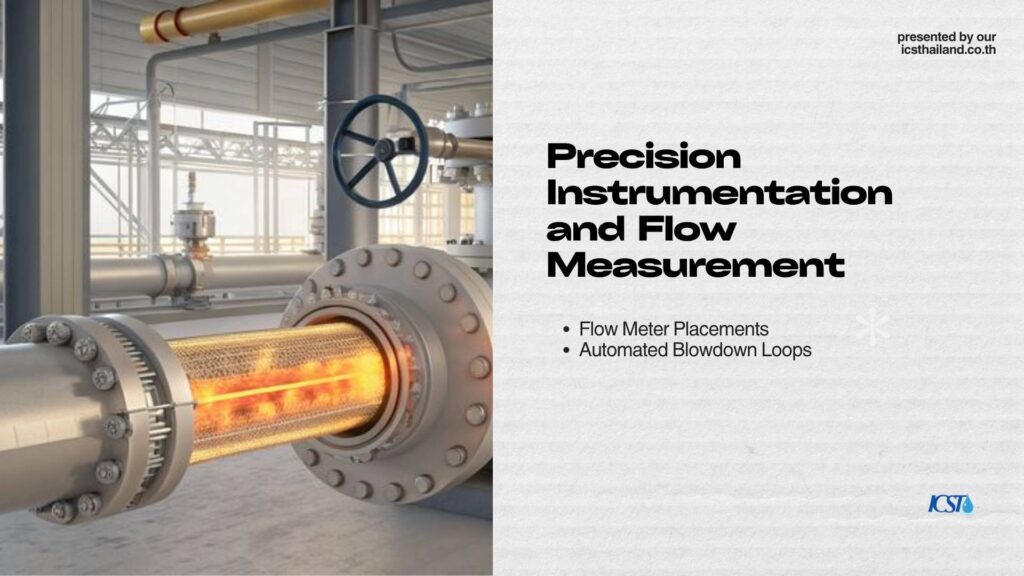
Accurate flow measurement requires undisturbed, laminar fluid flow. Position your electromagnetic or turbine flow meters along a straight pipe section. Ensure you leave at least ten pipe diameters downstream and five diameters upstream of any valve or fitting to secure precise, reliable readings.
Automated Blowdown Loops
Maintaining proper water quality requires consistent monitoring to prevent biological growth and scale buildup. Place an inline conductivity sensor in the main return header. This sensor should actuate a motorized blowdown valve automatically whenever dissolved solids exceed established thresholds, ensuring optimal heat exchange at all times.
Optimize Your Industrial Plant Today
Flawless fluid dynamics start at the drawing board. An inefficient piping layout will silently drain your plant efficiency, wear out your expensive components, and destroy your pump impellers.
At International Cooling Solutions (Thailand), our mechanical engineering team delivers precision, site-specific cooling tower piping designs optimized for true industrial reliability. We ensure your system masters every aspect of fluid dynamics, from thermal expansion mitigation to reverse return layouts.
Contact our Bangkok engineering office today for a comprehensive hydraulic review of your plant.
Frequently Asked Questions (FAQs)
What is cooling tower piping design, and why is it important?
Cooling tower piping design involves creating efficient layouts for water flow in cooling systems. It ensures hydraulic stability, prevents pump cavitation, and optimizes energy efficiency. Proper design minimizes pressure drops, balances flow distribution, and enhances system performance. By addressing factors like pipe sizing, reverse return layouts, and thermal expansion, it ensures the cooling process operates reliably and cost-effectively.
How does reverse return piping improve system efficiency?
Reverse return piping balances water flow by equalizing pipe lengths and friction losses across all cooling tower cells. Unlike direct-return systems, it prevents uneven flow distribution, ensuring each cell receives adequate water. This self-balancing design reduces energy consumption, enhances heat transfer, and eliminates the need for frequent manual adjustments, making it a cornerstone of efficient cooling tower piping layouts.
What are the best practices for pump suction line design?
To optimize pump suction, use flat-on-top eccentric reducers to prevent air pockets and ensure smooth water flow. Maintain a straight pipe run of 5–10 times the pipe diameter before the pump to eliminate turbulence. Incorporate vortex breakers in the basin outlet to stop air from entering the suction line. These practices protect the pump’s net positive suction head (NPSH) and improve system reliability.
How can water hammer be prevented in cooling tower piping systems?
Water hammer occurs due to sudden pressure surges. Prevent it by installing non-slam check valves on pump discharge lines and vacuum breakers to cushion fluid columns. Use slow-closing motorized isolation valves to dissipate kinetic energy gradually. These measures protect the piping system from damage, ensuring smooth operation and extending the lifespan of components.
Why is pipe sizing critical for cooling tower efficiency?
Pipe sizing directly impacts fluid velocity, pressure drop, and energy efficiency. Oversized pipes increase costs, while undersized ones cause erosion and water hammer. Follow velocity guidelines: 1.2–1.5 m/s for suction lines and 2.1–2.7 m/s for discharge lines. Proper sizing ensures optimal flow, prevents pump cavitation, and maintains hydraulic stability, enhancing the cooling system’s overall performance.