A cooling tower repair scope of work is a written document that defines what a contractor will inspect, repair, replace, and hand over. When every bidder prices the same scope, you can compare quotes line by line instead of guessing what each price includes.
A good scope names the tower and cell, records current condition, splits the work into packages, assigns responsibilities, and sets the evidence needed for sign-off. This template gives industrial maintenance, engineering, and procurement teams that run industrial cooling towers a copyable format so repair decisions rest on clear evidence.
Why Comparable Quotes Need One Scope
Two contractors can quote the same tower and return very different prices. Often the gap comes from scope, not from rates.
These are the gaps that appear most often when teams collect quotes after a verbal site walk:
- Different assumptions: One bidder prices fill media replacement. Another prices cleaning only.
- Hidden exclusions: Access, lifting, and waste handling sit outside the base price.
- Unclear boundaries: Nobody states who isolates power, who drains the basin, or who contacts the water treatment provider.
- Weak acceptance terms: “Repair complete” means something different to each party.
A defined scope gives your team three things:
- It closes these gaps before purchase.
- It keeps repair costs and maintenance costs visible, so a lower price does not hide missing work.
- It leaves a clear record if site conditions change during the work.
The stakes are practical:
- Heat removal: A cooling tower removes heat from process water. That heat transfer supports heat exchangers, chillers, and the production process behind them.
- Wide use: Cooling towers play a critical role in industrial operations. Large industrial towers also serve commercial buildings and data centers.
- Efficiency risk: A tower that falls behind lowers heat transfer efficiency and system efficiency. Energy costs and energy consumption can rise.
- Deferred maintenance: Delays can lead to more energy use and safety risks.
- Routine maintenance: Inspection, cleaning and lubrication belong to cooling tower maintenance, and routine inspections catch corrosion and scaling early. A tower maintenance checklist covers this upkeep.
- Repair scope: This guide covers one defined repair. It starts when an inspection finds a defect that needs defined work.
Document the Tower and Its Condition First
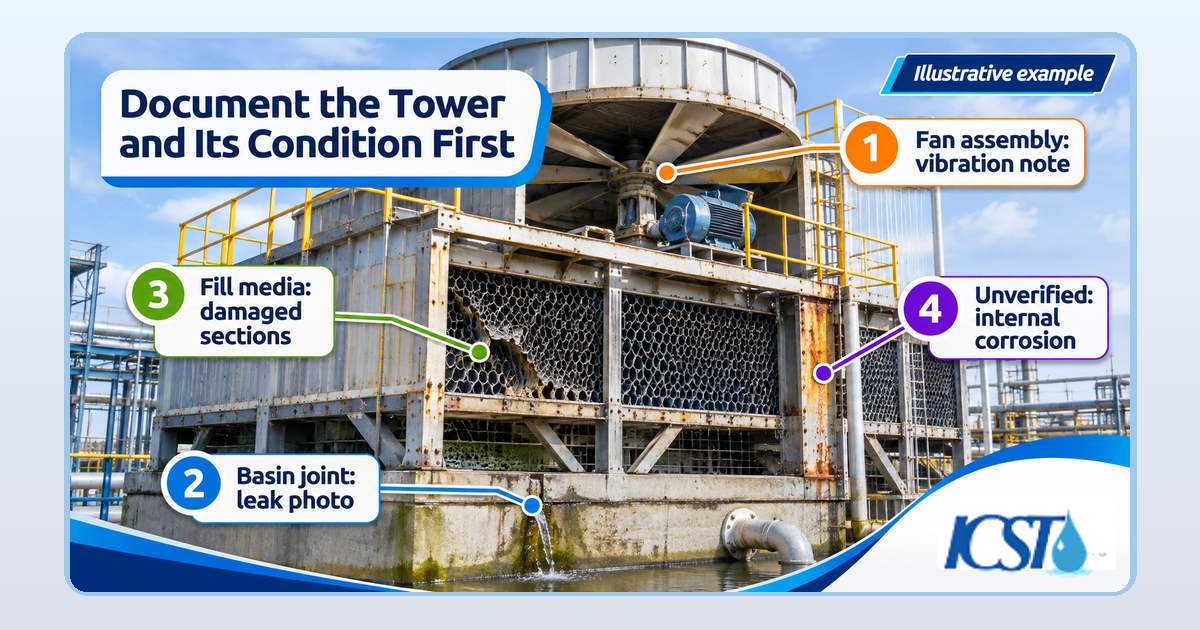
Start with facts about the equipment. A contractor cannot price what they cannot identify.
Collect these details before anyone visits the site:
- Tower and cell identity: Record the tower tag, cell number, manufacturer, model, and the cooling tower system and wider cooling system that the cell serves.
- Operating context: Note the process cooling duty, water source, seasonal limits, and normal operating range. In Thailand’s hot, humid climate, plants often keep towers in continuous operation, so outage windows are tight.
- Site constraints: List crane access, work-at-height limits, shutdown windows, and confined space entry rules that your own site procedures control. Personal protective equipment and lockout/tagout follow those procedures too.
- Observed issue: Describe the warning signs in plain words, such as a vibrating fan, a leaking basin joint, scale buildup, biological growth, or damaged fill media.
- Supporting evidence: Attach dated photos, inspection notes, and past repair records.
- Unverified items: Write down what nobody has confirmed, such as internal corrosion or gearbox oil condition. Label each one as unverified, so contractors price it as provisional work.
- Manufacturer guidance: Check the inspection tips and model-specific manual for your tower. Manufacturers such as SPX publish both.
Define the Work Packages and Boundaries
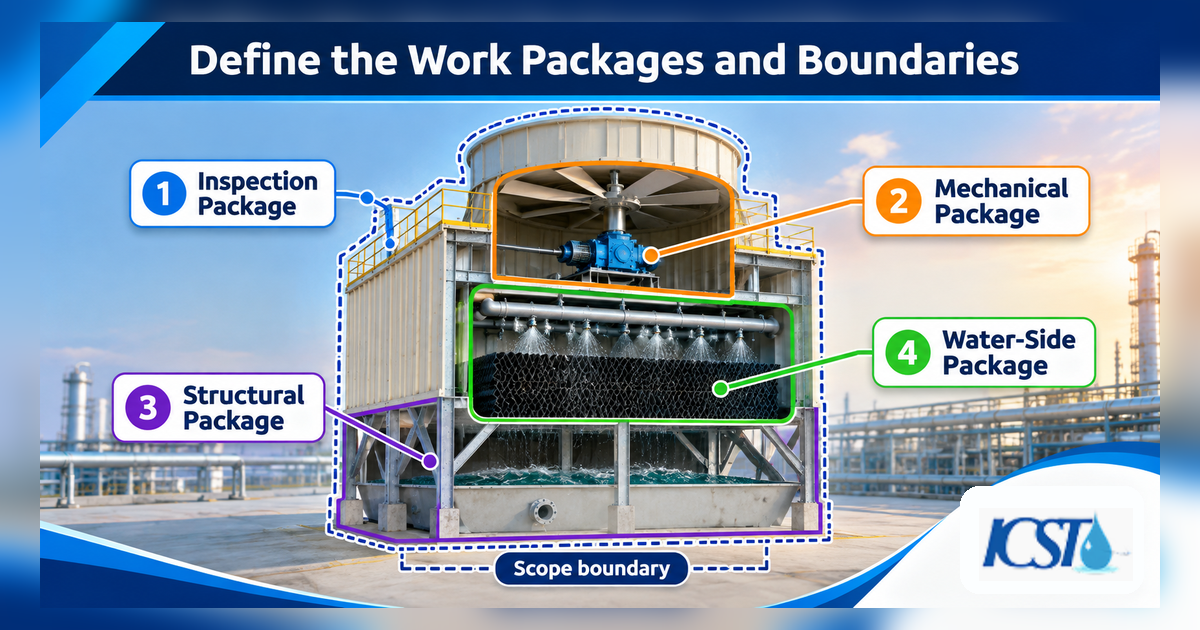
Split the repair into packages. Each package gets its own price, owner, and acceptance check.
Four Work Packages
Repairs usually fit into four packages that match the main tower systems. Adjust them to your cooling tower components. Repair work is often structured into several phases, and inspection comes first.
Inspection Package
- This package covers access, cleaning for inspection, photos, and a written findings list.
- Inspect all components before any repair starts.
- Cleaned heat transfer surfaces and fill media reveal damage that dirt can hide.
Mechanical Package
- This package covers mechanical components such as fan assemblies, drive components, gearbox oil, motor work, and alignment.
- Repairs may include replacing fan motors, reconditioning electrical motors, and checking proper lubrication.
- Fan assemblies are among the highest-wear parts, so inspect them closely.
- State whether each item needs targeted repairs, a mechanical overhaul, or component replacement.
Structural Package
- This package covers structural components such as basin walls, casing, supports, fasteners, and other structural elements.
- Includes structural corrosion, structural deterioration, and any concern about structural integrity.
- Name the method for structural repairs, including sealing basin joints and applying protective coatings.
Water-Side Package
- This package covers damaged fill media, drift eliminators, nozzles, and headers in the water distribution system.
- The water distribution system spreads recirculating water evenly across the fill, and drift eliminators reduce water loss.
- Coordinate with your water treatment program, which controls scale buildup, corrosion, and biological growth.
- Filtration improves the effectiveness of chemical treatment, and automated water treatment can help control chemical costs.
Replacement Parts and Optional Upgrades
- Compatibility: Replacement fill media must match the original thermal and hydraulic design. Ask contractors to confirm that every part fits your tower’s design.
- Optional upgrades: Price high-efficiency motors or modern fan assemblies in a separate line. They should never be hidden inside the base repair.
- Energy claims: Upgrades can improve energy efficiency and operational efficiency and help lower operating costs. Treat any energy savings figure as a claim to verify, and ask for supplier data.
Responsibility Interfaces
Most disputes start at the edges of the scope. Name one owner for each interface below. Your site safety rules decide the procedures, so the scope only records who is responsible.
Client or Site Owner
- The client provides tower access, the shutdown window, drawings, past records, and permits.
- The client approves isolation arrangements under site procedures and every scope change.
Mechanical Contractor
- The mechanical contractor delivers inspection, repair, or replacement work, and waste removal as stated in the quote.
- The mechanical contractor reports findings, photos, and installed part details.
Electrical Contractor
- The electrical contractor handles motor disconnection and reconnection, insulation checks, and control wiring, if these sit outside the mechanical package.
Water Management Provider
- The provider coordinates draining, cleaning, refilling, and treatment restart under the site’s water management program, including Legionella risk management.
- The provider follows the documented program. The CDC recommends a documented water management program for cooling towers, and ASHRAE Standard 188 outlines Legionella risk management requirements.
- The provider keeps in mind that Legionella thrives in warm, nutrient-rich water, with growth favored between about 77°F and 113°F (25°C to 45°C).
- Biocide treatment is one common way to control bacterial growth.
- The provider confirms that water chemistry is ready before the tower returns to service.
- The provider and your site program decide the controls. This template supports coordination only.
Cooling Tower Repair Scope of Work Template
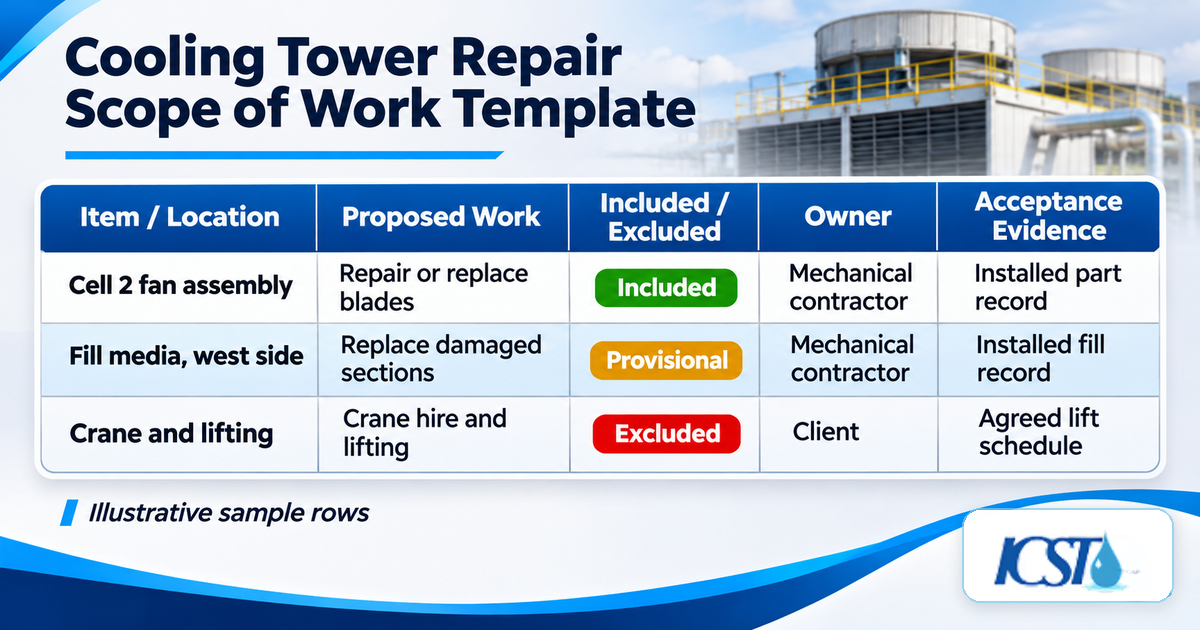
- Copy the table below into your RFQ or quote comparison sheet. For parts pricing, pair it with our parts RFQ checklist.
- Fill one row for each item or location.
- Treat the rows as illustrative samples, and replace them with your own data.
- This is a planning format, not an official OEM form or contract advice.
| Item / Location | Evidence | Proposed Work | Included / Excluded | Owner | Acceptance Evidence | Open Question |
| Cell 2 fan assembly | Photos of blade damage; vibration note | Inspect, then repair or replace blades, and check alignment | Included | Mechanical contractor | Installed part record; alignment readings | Does the hub need replacement? |
| Cell 2 gearbox | Oil leak photo | Drain, inspect, and refill oil | Included; client supplies oil | Mechanical contractor | Oil type and quantity record | Is a full overhaul needed? |
| Cold water basin joint | Photo of leak | Clean and seal joint | Included | Mechanical contractor | Before and after photos; leak check | Is there corrosion under the coating? |
| Fill media, west side | Photos of damaged sections | Replace damaged sections only | Provisional | Mechanical contractor | Installed fill record; photos | Is the fill model still available? |
| Crane and lifting | Site access note | Crane hire and lifting | Excluded | Client | Agreed lift schedule | Who supplies the lifting plan? |
| Drain, refill, and treatment restart | Site water plan | Drain, refill, and restart treatment | Excluded from mechanical price | Water management provider | Water chemistry record | When does treatment restart? |
Follow these rules when you use the table:
- Fill every cell. A blank cell becomes a dispute later.
- Mark each item Included, Excluded, or Provisional.
- Keep one row per item. This lets you compare prices line by line.
- Give every bidder the same table and the same photos.
Compare Quotes and Control Changes
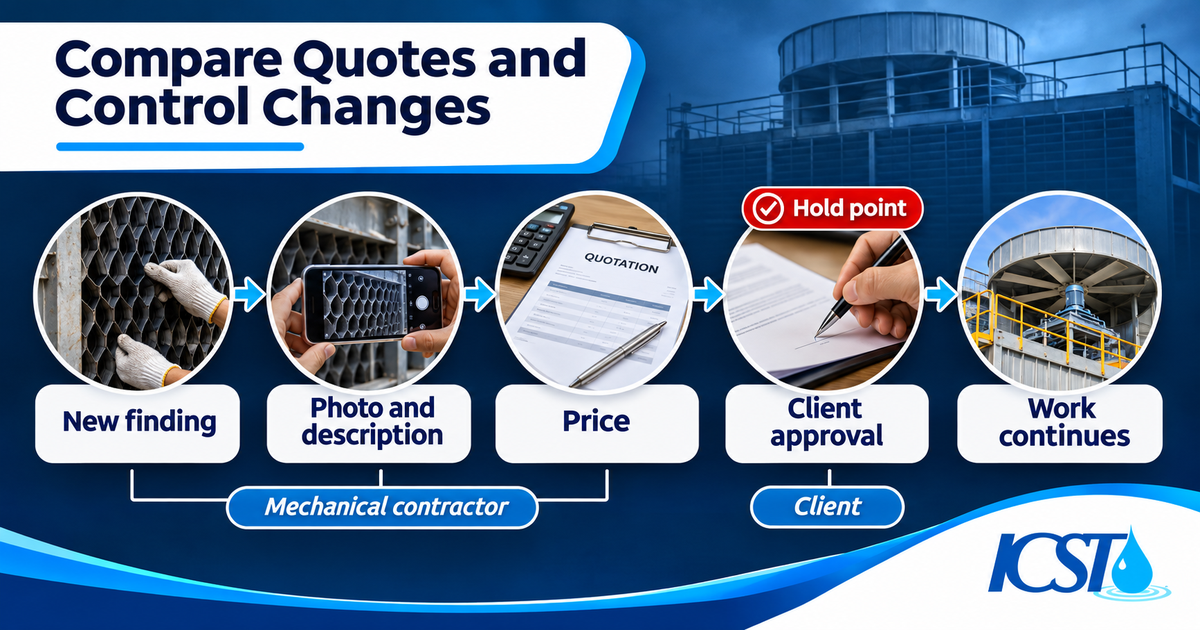
When quotes arrive, line them up against your table. Look for gaps, not only the lowest total.
- Exclusions: Read the excluded list first. It explains most price differences.
- Provisional items: Check what triggers each one and how the contractor will price it, such as by unit rate or by approved quote.
- Parts alternatives: Compare brand, source, lead time, and compatibility. Ask for a written statement of equivalence.
- Outage assumptions: Confirm shutdown duration, working hours, and what happens if parts arrive late. Ask how the repair affects normal operation and cooling capacity during the outage. Treat any promise of zero downtime with caution.
- Repair versus replacement: Repair costs vary with damage type and tower size. Towers are often cited as lasting 15 to 20 years, so age matters. Replacement is preferred when structural damage is severe, so review cooling tower replacement as an option.
- Equipment life: Proper maintenance and a well-scoped repair support equipment life and reliable operation at peak performance.
- Rehabilitation: This means structural and mechanical restoration, and it may include complete component replacement and recommissioning. Price it as a separate scope with its own inspection and testing. Ask contractors to support any equipment lifespan figure in writing.
- Hidden risks: Hidden damage, part availability, and schedule limits can change the job and add operational disruption.
- Change control: Agree in advance that every new finding gets a photo, a written description, a price, and client approval before work continues. This written process protects both sides and keeps costs visible.
- Contract review: Ask your legal or procurement team to review the contract terms.
Handover and Return-to-Service Evidence
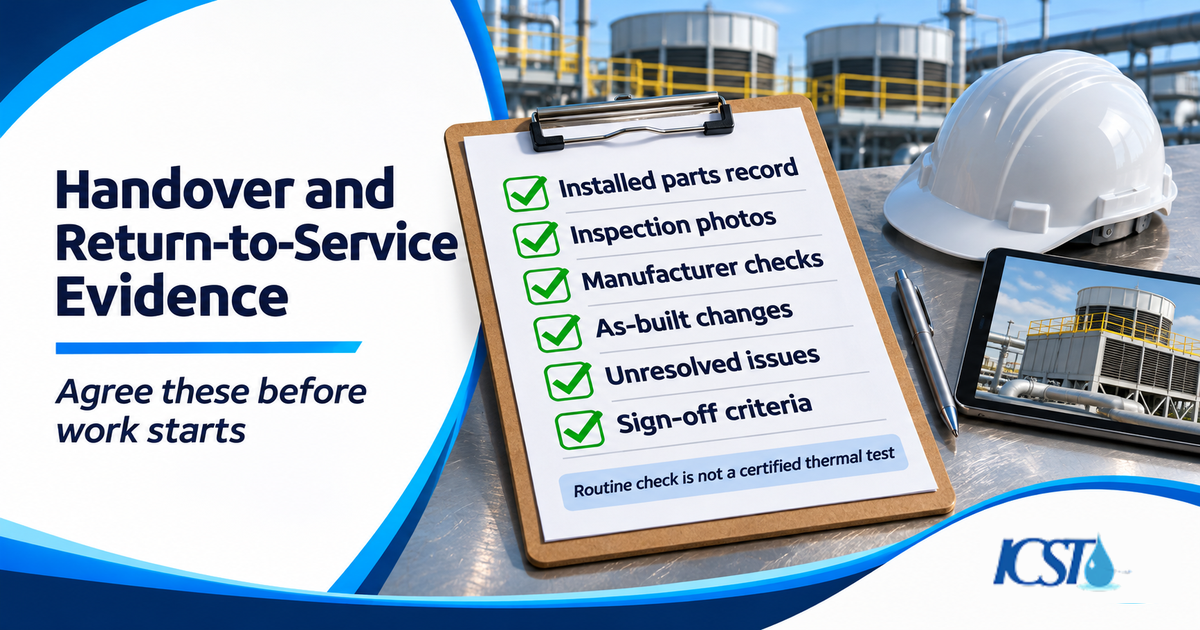
Define the handover pack before work starts. Documentation throughout the repair is necessary for quality assurance, and it tells the contractor what to collect and your team what to accept.
- Installed parts record: Part names, models, quantities, and sources for everything fitted.
- Inspection photos: Dated before-and-after images linked to the table rows.
- Manufacturer checks: Any checks the OEM manual requires for your model, with the recorded results.
- As-built changes: Every change from the original design, such as a different fastener or a modified support.
- Unresolved issues: An open items list with an owner and a target date for each.
- Sign-off criteria: Named signatories and the agreed conditions for acceptance.
- Performance checks: Testing system performance after repairs is important. Agree on the checks and any equipment performance readings before work starts.
- Routine checks: A vibration or leak check shows the work was done properly. It does not prove tower performance.
- Certified testing: Certified performance testing of thermal performance is a separate test, such as a CTI-certified test. Name the test, the tester, and the payer before the repair starts.
Frequently Asked Questions
What should a cooling tower repair scope of work include?
It should include tower and cell identity, observed issues with photos, work packages, included and excluded items, responsibility owners, provisional items, change control rules, and handover evidence. Each row should show who does the work and how your team will accept it. This keeps every contractor quote comparable.
Is a repair scope the same as an annual shutdown plan?
No. An annual shutdown plan belongs to your wider cooling tower maintenance program. It covers routine maintenance and planned maintenance across the whole tower, and proper maintenance stays in that plan. A repair scope covers one defined problem, with its own evidence, price, and acceptance proof. It is also not a preventive maintenance or predictive maintenance calendar.
Who should write the scope?
The maintenance or engineering team should write the first draft, because they know the tower history. Procurement should check that the format works for quote comparison. Contractors can then add questions after a site visit, and the owner updates one shared version for all bidders.
Can I use this template for emergency repairs?
Yes, with a shorter form. Emergency repairs leave little time, so fill in tower identity, evidence, and responsibilities first. Mark everything else as provisional and agree on change control early. Complete the full table after the tower returns to service so your records stay accurate.
Key Takeaways and Next Steps
- Define first: A clear cooling tower repair scope of work turns vague quotes into comparable ones.
- Record evidence: Note tower identity, photos, and unverified items before you ask for prices.
- Split the packages: Give each package an owner and acceptance proof.
- Agree handover proof: Set the evidence and sign-off criteria before work starts.
- Get ICST support: ICST can help your team review a repair scope or inspect a tower before tender.
- More guides: Visit icsthailand.co.th and browse the ICST blog for more cooling tower guides.