Title graphic for "Cooling Tower Parts RFQ Checklist: What Plant Engineers Should Send Before Requesting a Quote" by ICST, featuring a clipboard checklist covering equipment details, dimensions, materials, operating conditions, and timeline.

Cooling Tower Parts RFQ Checklist: What Plant Engineers Should Send Before Requesting a Quote

A cooling tower parts RFQ tells the supplier exactly which replacement part you need and where it will operate. Send the tower make, model, and serial number; the part number or measured dimensions; clear photos or drawings; the current material; the operating conditions; the quantity; and the delivery location and date. When someone modified the…


Title slide titled "Slash Costs and Boost Efficiency Fast: Adiabatic Cooling System" presented by ICST (www.icsthailand.co.th). The right side features framed photographs of industrial modular cooling units installed on a building rooftop.

Adiabatic Cooling System: Industrial Design, Benefits & Cost Efficiency

An adiabatic cooling system is an industrial cooling solution that uses the evaporation of water to pre-cool incoming air before it reaches a heat exchanger, reducing energy use, water consumption, and maintenance costs compared to traditional cooling towers and chillers. As industries face increasing pressure to cut operational costs, this closed-loop technology has become a…

A blue and white title slide featuring the text "NEW COOLING TOWER COST IN ASIA: Price Guide, Budget Breakdown & Cost Factors." The background includes an aerial evening view of a large industrial complex with multiple cooling towers emitting steam against a city skyline. The ICST logo and website are visible.

New Cooling Tower Cost in Asia: Price Guide, Budget Breakdown & Cost Factors (2026)

Asia’s industrial sector is expanding at a pace that few regions can match. Manufacturing hubs, power generation facilities, data centers, and petrochemical plants are scaling up across Southeast Asia, East Asia, and South Asia. Each of these facilities depends on reliable thermal management, and cooling towers sit at the center of that requirement. For project…

Presentation slide titled "IOT COOLING SYSTEM SENSORS: Sustainable Materials Innovation" presented by ICST (www.icsthailand.co.th). Features an image of a technician in safety gear using a handheld digital device to inspect an electrical/cooling system panel.

IoT Cooling System Sensors: 6 Smart Ways to Slash Failures & Costs

IoT cooling system sensors play a critical role in modern facility management by detecting equipment failures before they cause downtime. These wireless devices provide real-time data on temperature, flow rate, humidity, and pressure, closing the blind spots that traditional monitoring methods miss. By combining smart sensors with Internet of Things connectivity, maintenance teams and facility…

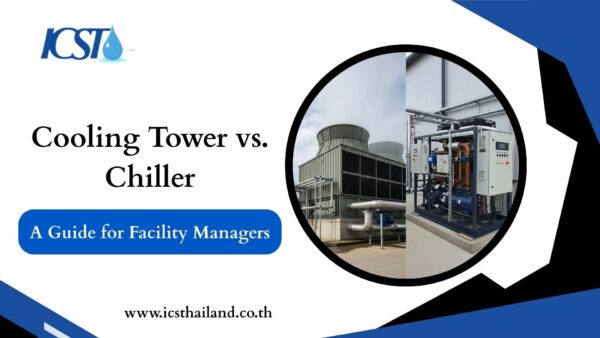
A graphic titled "Cooling Tower vs. Chiller" with a split-screen photo showing a cooling tower on one side and a chiller on the other.

Cooling Tower vs. Chiller: A Guide for Facility Managers

A cooling tower rejects heat from water through evaporation and works best for large-scale heat loads, while a chiller uses a refrigeration cycle to produce chilled water at a precise desired temperature set point, independent of weather. Choosing between them in a cooling tower vs chiller comes down to how much heat you need to…

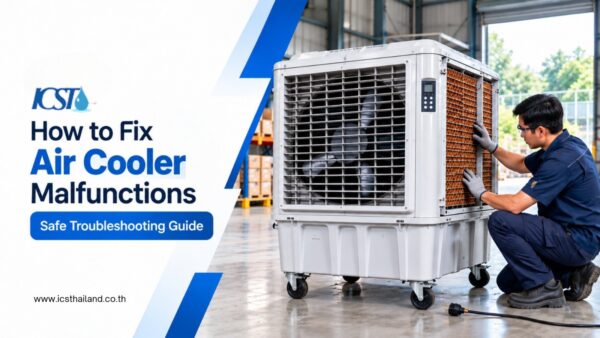
A technician kneeling down to inspect or replace the side cooling pad panel on a large industrial evaporative air cooler inside a warehouse or factory setting. On the left side, bold graphic text reads "How to Fix Air Cooler Malfunctions: Safe Troubleshooting Guide" alongside the ICST logo.

How to Fix Air Cooler Malfunctions: A Safe Troubleshooting Guide

When an industrial air cooler starts blowing warm air, leaking, or making noise, the cause is usually found in a few places: the cooling pads, the water supply, the water pump, or the fan. This guide explains common air cooler malfunctions, what usually causes them, and which checks can be done safely on site. It…

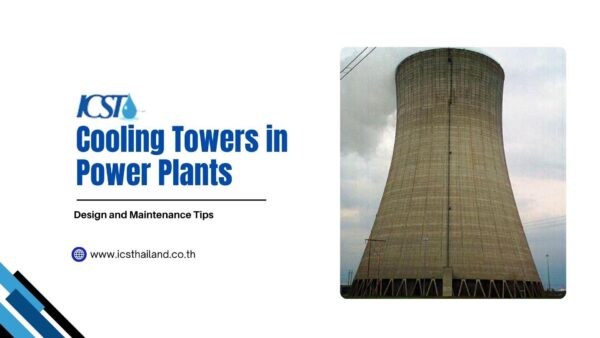
Title graphic reading "Cooling Towers in Power Plants: Design and Maintenance Tips" by ICST, featuring a photograph of a large, concrete natural draft hyperbolic cooling tower. Website: www.icsthailand.co.th.

Cooling Towers in Power Plants: Design and Maintenance Tips

Cooling towers in power plants reject the massive waste heat generated during electricity production, keeping steam condensers under vacuum so turbines run at rated efficiency. Two primary designs dominate this application: natural draft cooling towers, which rely on natural convection and moist air buoyancy to move air without fans, and mechanical draft cooling towers, which…

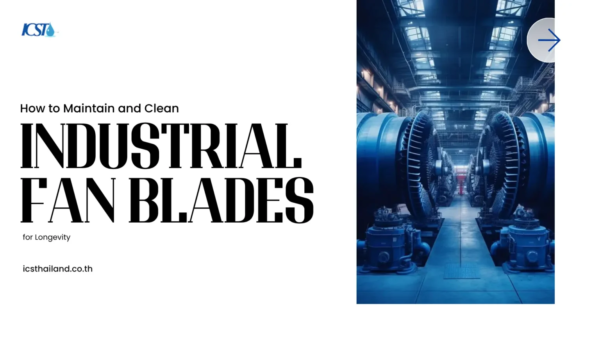
An industrial guide on how to maintain and clean industrial fan blades for longevity, paired with a photo of heavy-duty industrial blowers lined up inside a large manufacturing facility.

How to Maintain and Clean Industrial Fan Blades for Longevity

Maintaining industrial fan blades means removing particulate buildup, inspecting for fatigue cracks, and running dynamic balancing checks to keep aerodynamic profiles intact. If left unmanaged, dust and debris buildup creates weight imbalances that stress bearings, causing vibration and eventual blade failure. This guide covers the professional protocols for cleaning, inspecting, and maintaining industrial fan blades…

A promotional graphic titled "Types of Industrial Fan Blades: A Complete Selection Guide" by ICST. On the right side, a large metallic industrial fan impeller with multiple curved fan blades attached to a central circular hub is framed inside a rounded blue border. The bottom of the graphic displays the website URL "www.icsthailand.co.th" alongside a web icon.

Types of Industrial Fan Blades: A Complete Selection Guide

Types of industrial fan blades fall into two broad categories based on how they move air. Centrifugal designs, including airfoil, backward inclined, radial, and forward curved blades, pull air in and push it out at an angle. Axial designs, including propeller, tubeaxial, and vaneaxial blades, push air straight through parallel to the shaft. Each of…

Presentation title slide titled "Environmental Impact of Cooling Towers and How to Minimize It" presented by ICST (www.icsthailand.co.th). The left side features a framed photograph of industrial cooling towers emitting vapor plumes at sunset near a body of water.

Environmental Impact of Cooling Towers and How to Minimize It

The environmental impact of cooling towers is often overlooked, even though these systems form the backbone of heat rejection in industries such as power generation, large-scale manufacturing, and expansive commercial complexes like cinema halls. Cooling towers consume large volumes of water, use significant energy, and can affect nearby air and water quality if left unmanaged.…