
Maintaining industrial fan blades means removing particulate buildup, inspecting for fatigue cracks, and running dynamic balancing checks to keep aerodynamic profiles intact. If left unmanaged, dust and debris buildup creates weight imbalances that stress bearings, causing vibration and eventual blade failure.
This guide covers the professional protocols for cleaning, inspecting, and maintaining industrial fan blades to optimize performance and extend asset lifespan across both axial and centrifugal ventilation systems.
Why Maintenance Matters for Industrial Fan Blades
Accumulated dust or material buildup on fan blades disrupts calibrated air movement, forcing the motor to draw more amperage to maintain performance standards. Routine preventative maintenance prevents high operational costs and emergency interventions:
- Energy Efficiency: Clean, efficient aerodynamic profiles reduce mechanical resistance and electrical power consumption.
- Durability and Component Longevity: Minimizing particle weight distribution imbalances protects the fan assembly from premature component degradation.
- Uninterrupted Production: Scheduled maintenance windows eliminate costly unplanned operational downtime in industrial ventilation systems.
- Structural Safety: Addressing blade stress points limits heavy structural vibration that threatens nearby system components, bearings, and plant personnel.
Understanding Your Industrial Fan Blades: Types & Characteristics
Blade shape and pitch affect airflow, pressure generation, efficiency, noise, vibration, and motor power draw, making blade design a central factor in overall system performance. Fan blades typically range from 2 to 16, depending on the fan type and airflow requirements. CFD (Computational Fluid Dynamics) software enhances precision in fan blade design, allowing engineers to model airflow behavior before manufacturing.
Common Blade Materials
Blade material is matched to environmental conditions to ensure durability and efficiency. Steel, aluminum, and fiberglass-reinforced plastic (FRP) each solve different durability and corrosion challenges.
- Steel (Carbon and Stainless): Deployed in heavy-duty, high-stress applications for its strength and impact resistance, though vulnerable to surface corrosion if protective coatings wear thin.
- Aluminum: Aluminum alloys are lightweight and strong, provide excellent corrosion resistance, and work well for standard spark-resistant or damp environments.
- Fiberglass and Composites: Fiber Reinforced Polymers (FRP) are popular for durability, suited to chemically aggressive, high-moisture environments, though sensitive to coarse abrasive cleaners.
Advanced materials improve fan blade efficiency and lifespan, which is why material selection deserves the same engineering attention as blade shape and pitch.
Common Fan Blade Formats
Understanding the aerodynamic cross-section and physical shape of your blades is a critical factor during the blade selection process. Different blade design profiles perform vastly differently across high-pressure applications:
| Fan Type | Aerodynamic Sub-Types | Primary Operational Use | Maintenance Focus |
| Axial Fans | Deploys propeller blades, tubeaxial, and vaneaxial designs | High airflow output, moving large volumes of air at low to medium static pressure | Leading-edge erosion and uniform surface cleaning |
| Centrifugal Fans | Includes backward inclined, forward curved blades, and radial blades | High static pressure applications, dust collection, and moving denser air | Material packing inside curve pockets; root stress cracking |
Centrifugal fan blades generate high pressure for forcing air through ductwork, and typically range from 200 to 1200 mm in diameter depending on the application’s airflow and pressure requirements.
For a full breakdown of each blade type’s efficiency, pressure rating, and best-fit applications, see our complete guide to industrial fan blade types.
Why Blade Type and Configuration Matters
- Propeller Fans: These units utilize a distinct blade pitch and angle to push air parallel to the shaft rotation. They are highly cost-effective for moving high volumes of free air but cannot handle high-pressure restrictions.
- Forward Curved Designs: These configurations feature more blades spaced closely together. While they offer high performance in a compact size, they are typically suitable only for clean air applications as their curved pockets catch debris easily.
- Radial Blades: Featuring a rugged, flat design, these are commonly used for heavy material handling because they reject material buildup using centrifugal force, though they are generally noisier and yield lower efficiency.
- Backward Inclined Designs: These provide high efficiency and produce less noise under variable loads, making them the preferred choice for large-scale industrial ventilation systems.
Pre-Maintenance Safety & Tools Checklist
Industrial maintenance requires absolute adherence to safety protocols. Do not compromise on setup preparation.

1. Safety Protocols
- Lockout/Tagout (LOTO): De-energize, lock, and tag the primary electrical isolation switch. Never rely on software stops or control panel switches alone.
- Personal Protective Equipment (PPE): Safety glasses or full-face shields, cut-resistant/chemical-resistant gloves, dust masks or respirators (depending on the processed particulate matter), and steel-toe footwear.
2. Required Equipment
- Cleaning Materials: Mild industrial detergents, material-compatible degreasers, and specialized solvents.
- Mechanical Tools: Soft-bristle brushes, plastic scrapers, industrial wet/dry vacuums, microfibers, and compressed air lines.
- Inspection Instruments: High-luminescence inspection lights, borescopes, and calibrated torque wrenches.
Step-by-Step Guide to Cleaning Industrial Fan Blades
Follow this chronological procedural sequence to safely clear contamination without altering the physical balance of the impeller.
1. Initial Assessment & Dry Debris Removal:
Visually inspect the impeller assembly for heavy build-up. Use an industrial vacuum cleaner equipped with a brush attachment or soft manual brushes to remove loose dust and dry particulate matter. Avoid using metal wire brushes on aluminum or composite blades to prevent surface scoring.
2. Cleaning Agent Selection & Compatibility Test:
Select an agent based on the contaminant profile (e.g., mild detergent for standard dust, heavy-duty alkaline degreasers for oil or grease mist).
Pro Tip: Always test chemical solutions on a small, unexposed section of the metal blades to verify it will not strip protective zinc or epoxy coatings.
3. Application & Agitation:
Apply the solution evenly across the blade profiles via a spray applicator or saturated cloth. Allow sufficient dwell time for the chemistry to emulsify the grime. Use plastic scrapers or medium-stiff non-metallic brushes to break loose stubborn, packed residues.
4. Rinse & Complete Dehydration:
Wipe down or rinse surfaces thoroughly with clean water to remove all chemical residues, which could otherwise accelerate localized chemical corrosion. Dry the fan blades immediately using clean microfiber cloths or dry compressed air lines to ensure a smooth surface finish.
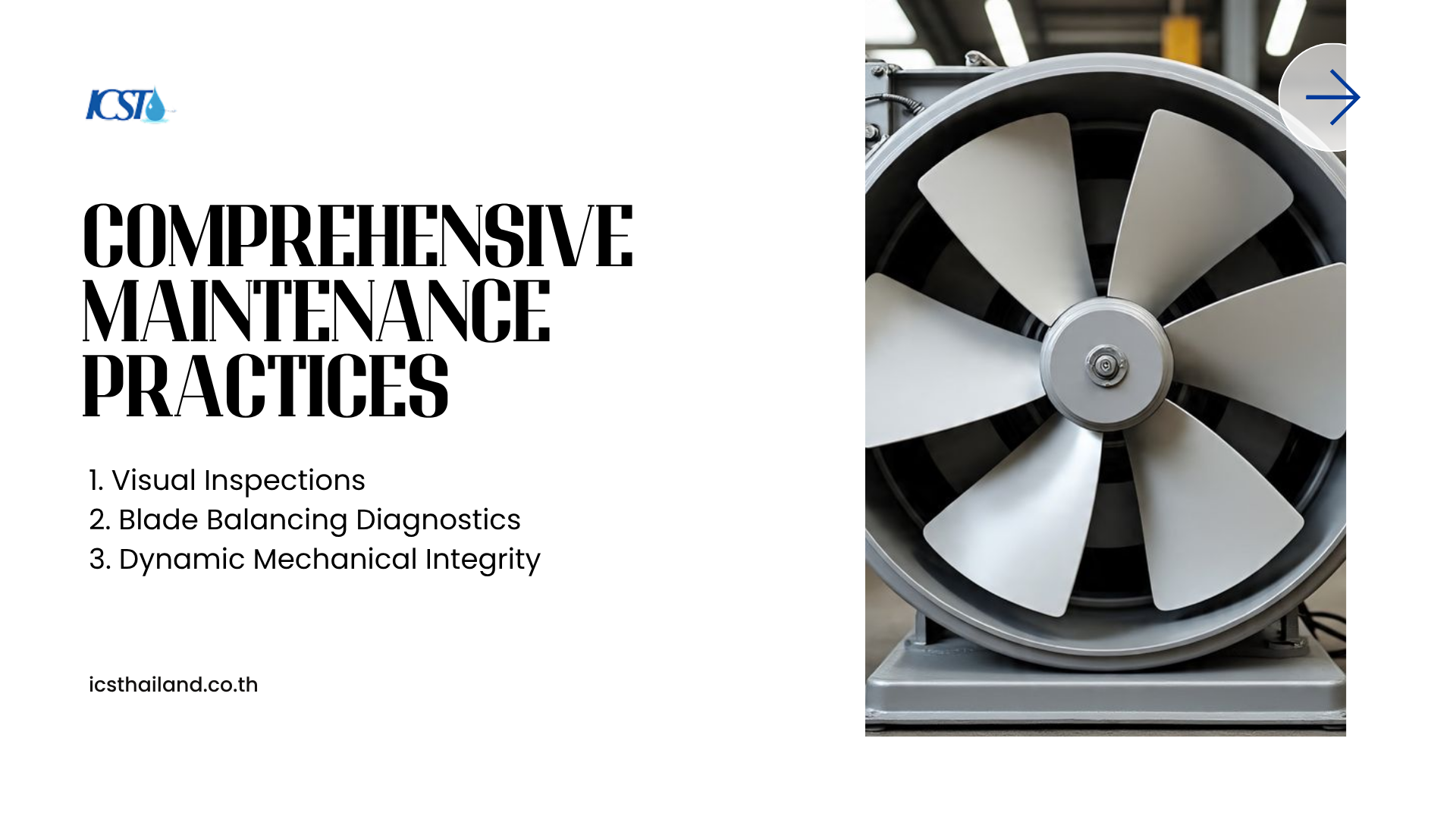
Comprehensive Maintenance Practices
Cleaning alone does not guarantee long-term operational health in the industry. A comprehensive preventative plan must integrate deeper mechanical evaluations.
1. Visual Inspections
Inspect the leading and trailing edges of each blade for signs of pitting, material erosion, or microscopic fatigue cracks. Pay close attention to the blade root—the high-stress point where the blade meets the central hub assembly.
2. Blade Balancing Diagnostics
Even minor variations in material thickness across opposing blades generate asymmetric forces during rotation.
Signs of Fan Impeller Imbalance: High-frequency structural vibration, anomalous low-frequency humming or rumbling noise, premature bearing failures, or anchor bolts backing out of concrete foundations.
3. Dynamic Mechanical Integrity
- Bearing Lubrication: Purge and replenish bearing grease channels using the exact manufacturer-specified grease weight. Avoid over-lubricating, which ruptures internal seals and attracts abrasive dust.
- Belt & Pulley Alignment: For belt-driven systems, use laser alignment tools to check pulley parallel tolerance. Adjust the adjustable belt tensioners to prevent slippage and parasitic power losses.
- Hardware Torque Verification: Use a calibrated torque wrench set to the manufacturer-specified value, confirming that hub retention bolts, shaft keys, and structural housing fasteners match the required bolt diameter and torque footprint.
Troubleshooting Common Industrial Fan Failures
| Symptom | Probable Mechanical Cause | Corrective Action Path |
| Severe Vibration | • Impeller material accumulation • Blade fatigue/deformation • Worn bearings • Structural misalignment | • Complete comprehensive cleaning protocol • Execute dynamic field balancing • Inspect and replace bearings if tolerances are breached |
| Degraded Airflow / Pressure | • Heavily fouled fan blade profiles • Clogged intake filters or obstructed duct screens • Incorrect motor direction of rotation | • Perform deep cleaning cycle • Clear ductwork obstructions and replace filters • Reverse electrical phase wiring if rotation is backwards |
| Atypical Audible Noise | • Mechanical grinding (dry bearings) • Squealing (slipping drive belts) • Metal-on-metal rattling (blade housing contact) | • Lubricate or replace failed bearings • Adjust belt tension or replace belts • Re-center the wheel assembly inside the housing to ensure quiet operations |
When to Engage Certified Field Engineers
While regular cleaning cycles can, in most cases, be managed internally by certified plant maintenance technicians, specific performance issues require precision tools and expert advice:
- Performing specialized spectral vibration analysis.
- Executing multi-plane dynamic field balancing using computerized diagnostic equipment to ensure smooth operation.
- Repairing structural cracks or replacing warped structural elements.
- Re-commissioning large-scale exhaust systems to verify compliance with engineering specifications.
Conclusion
Proactive maintenance of industrial fan blades protects your plant’s bottom line, not just your checklist. Regular cleaning removes grease and particulate buildup, reduces energy draw, and prevents structural vibration.
Combining cleaning cycles with hub torque checks and bearing inspections keeps your equipment running as engineered.
Don’t wait for an unbalanced wheel or a fractured root to compromise your facility’s safety. Consult our specialized field engineers to book a precision dynamic balancing diagnostic for your industrial fan blades at ICST.
Frequently Asked Questions
How do you clean industrial fan blades?
Remove dry particulate matter with an industrial vacuum or soft-bristle brush. Apply a material-compatible industrial degreaser or mild detergent solution, allow it to sit, agitate stubborn build-up with a plastic scraper, rinse thoroughly, and dry completely with compressed air to prevent rust.
What does standard industrial fan maintenance involve?
A complete regimen includes regular aerodynamic surface cleaning, structural checks for cracks or erosion, verified bearing lubrication schedules, belt tension adjustments, and dynamic balance inspections.
Can you make industrial fan blades completely dust-proof?
No, total prevention isn’t possible in a dusty environment. Applying hydrophobic or specialized anti-static epoxy powder coatings minimizes particulate adhesion, which extends the time required between manual cleaning intervals. Facilities in high-particulate environments still need a fixed inspection schedule regardless of coating type.
Is it safe to clean fan blades if the motor circuit breaker is switched off?
No. You must follow full Lockout/Tagout (LOTO) protocols at the primary electrical isolation point. Switching the fan off at a control station leaves the system vulnerable to accidental remote startup or electric shock from residual capacitor charges, which makes breaker-only shutdown insufficient for safe access.
What are the main indicators of an unbalanced fan wheel?
Look for localized structural vibration that transfers into surrounding ductwork, unexpected rumbles or deep rhythmic noise, rapid wear on mechanical bearings, or physical shifting of the fan base mountings. Any of these signs on industrial fan blades warrants a dynamic balancing inspection before the imbalance worsens.