
Selecting the right cooling tower is not a simple task. Industrial operations depend on consistent temperature control to maintain efficiency and prevent costly equipment failures. A poorly chosen system can lead to energy waste, frequent breakdowns, and operational delays that impact your bottom line.
Cooling tower selection requires careful evaluation of multiple technical and operational factors. Different industries have unique application requirements, and what works for a power plant may not suit a chemical processing facility. Understanding selection criteria such as cooling capacity, environmental conditions, and material durability helps you make an informed decision that supports long-term performance.
This guide walks you through the essential considerations for choosing a cooling tower that meets your specific needs. You will learn how to assess cooling capacity needs, evaluate different tower types, and avoid common mistakes that compromise system reliability.
Why Proper Cooling Tower Selection Matters
Choosing the correct cooling tower directly affects your facility’s operational performance and financial efficiency. A well-matched system ensures that processes run smoothly, equipment lasts longer, and energy consumption remains controlled.
Here is why cooling tower selection plays a critical role in industrial operations:
- Improves energy efficiency and reduces operating costs: An appropriately sized tower uses less power to achieve the required cooling performance.
- Ensures consistent process temperature control: Proper heat rejection maintains stable operating conditions, preventing production issues.
- Extends equipment lifespan: Reliable cooling reduces thermal stress on machinery, minimizing wear and tear.
- Reduces maintenance and downtime: A system designed for your specific conditions requires fewer repairs and experiences fewer unexpected failures.
- Improves water usage efficiency: Advanced designs optimize water consumption, reducing waste and lowering treatment costs.
Incorrect selection leads to inefficiencies that compound over time. An undersized tower struggles to meet cooling demands, forcing equipment to work harder and increasing energy bills. An oversized system wastes resources and adds unnecessary capital costs. The right choice balances capacity, efficiency, and long-term reliability.
Discover the Best Cooling Tower Types for Your Needs
Cooling towers come in several configurations, each designed to meet specific operational needs. Recognizing the differences between these systems helps you identify which design aligns with your facility’s requirements.
Open-Circuit Cooling Towers
Open-circuit cooling towers operate by directly exposing process water to air. Water circulates through the tower, where it comes into contact with airflow that removes heat through evaporation. This design is widely used in HVAC systems, industrial manufacturing, and power generation.
These towers are cost-effective and relatively simple to maintain. However, water quality must be managed carefully to prevent contamination and scaling. Applications where water purity is less critical benefit most from this design.
Closed-Circuit Cooling Towers
Closed-circuit cooling towers separate process water from the cooling air. Water circulates through a heat exchanger, where it transfers heat to a separate water stream that evaporates and cools the system. This design protects process water from contamination and reduces evaporative losses.
- Ideal for industries needing high water purity: Closed-circuit systems are preferred in sectors like chemical processing and pharmaceutical manufacturing.
- Promotes water conservation: They are a good choice for facilities in areas with limited water access.
Natural Draft vs Mechanical Draft Towers
Natural draft towers rely on buoyancy to move air through the structure. Warm, moist air rises naturally, drawing in cooler air from the base. These towers are large and typically used in power plants where space is not a constraint.
Mechanical draft towers use fans to force or induce airflow. This design offers greater control over cooling performance and works well in applications where precise temperature regulation is required. Most industrial and commercial facilities use mechanical draft systems due to their flexibility and efficiency.
Crossflow vs Counterflow Designs
Crossflow towers allow air to move horizontally across falling water, creating a compact design that fits well in space-limited environments. Maintenance access is easier, as fill media can be inspected without shutting down the entire system.
Counterflow towers direct air upward through descending water, maximizing heat transfer efficiency. This design uses less water and achieves better thermal performance, making it ideal for applications requiring high cooling efficiency.
Key takeaways:
- Choose open systems for cost-effective cooling where water quality is less critical.
- Select closed systems when contamination control and water conservation are priorities.
- Use mechanical draft towers when precise airflow control is necessary.
- Opt for counterflow designs to maximize thermal efficiency in high-demand applications.
Key Factors to Consider in Cooling Tower Selection
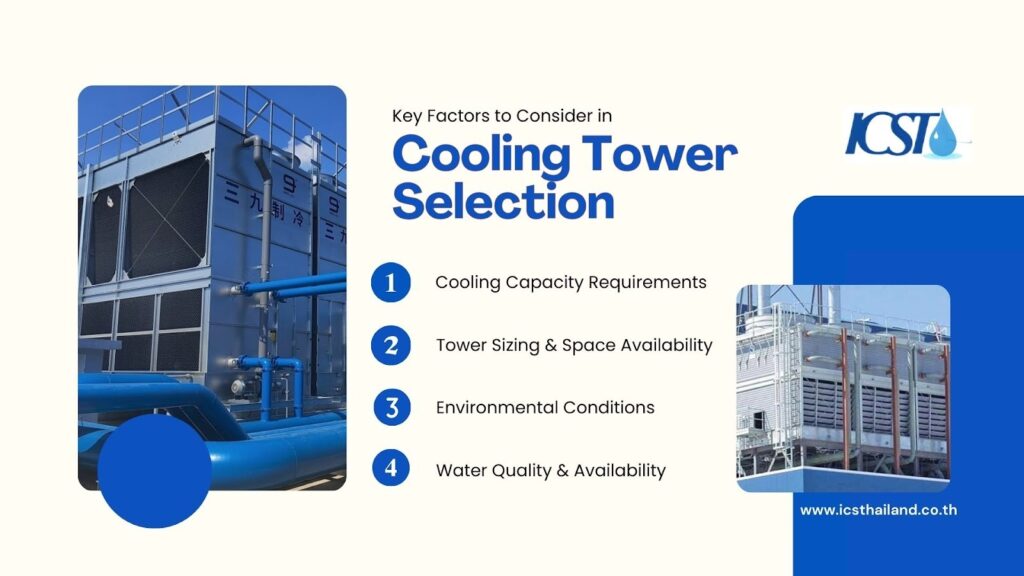
Choosing the right cooling tower depends on understanding the technical demands of your operation. Each facility has unique requirements that influence which system will deliver the best performance.
Cooling Capacity Requirements
Determining the correct cooling capacity ensures that your system handles the heat load without overworking or wasting energy. Undersizing leads to inadequate cooling, while oversizing increases capital and operating expenses unnecessarily.
Accurately calculating cooling capacity needs requires an assessment of several factors:
- Total heat load (kW or tons of refrigeration): The amount of heat your system must remove.
- Required temperature range and approach: The difference between inlet and outlet water temperatures, and how close the outlet temperature comes to the ambient wet-bulb temperature.
- System water flow rate: The volume of water circulating through the tower, which affects heat transfer efficiency.
- Future capacity requirements: Anticipating growth or increased production demands helps avoid premature upgrades
Consulting with a cooling engineer ensures that capacity calculations account for all operational variables.
Tower Sizing & Space Availability
Physical constraints influence which cooling tower designs will fit your facility. A system that performs well on paper may not be practical if it cannot be installed in the available space.
Before finalizing your selection, evaluate tower sizing considerations:
- Available footprint: The ground or rooftop area where the tower will be installed. Accurately measure this space to ensure the chosen unit fits comfortably, leaving enough clearance for maintenance access and proper airflow, which is critical for efficiency.
- Height limitations: Local zoning laws, aviation regulations, or your building’s structural design may impose height restrictions. Confirming these limits early in the process will help narrow down suitable tower models and prevent costly redesigns.
- Rooftop vs. ground installation: Rooftop systems are great for saving valuable ground space, but require a structural analysis to confirm the roof can handle the operational weight..
- Structural load capacity: This refers to the total operational weight, including the tower itself, the water it holds, and all mechanical parts. A structural engineer must verify that the proposed installation site—whether a rooftop or a concrete pad on the ground—can safely support this load without compromising structural integrity.
Working with an experienced provider helps you identify solutions that fit within your site’s physical constraints without sacrificing performance.
Climate & Environmental Conditions
Cooling tower performance varies based on local climate conditions. A system optimized for a humid coastal environment will not perform the same way in a dry, high-altitude region.
Understanding how climate affects cooling efficiency helps you select a system that maintains consistent performance year-round:
- Ambient wet-bulb temperature: The lower the wet-bulb temperature, the more effectively a tower can cool water.
- Humidity levels: High humidity reduces evaporative cooling efficiency, requiring larger towers or enhanced designs.
- Seasonal temperature variation: Facilities in regions with extreme temperature swings may need systems with variable-speed fans or additional capacity.
- Wind exposure conditions: Strong winds can disrupt airflow patterns, affecting cooling efficiency.
Climate data from your region should be integrated into system design to ensure reliable operation under all conditions.
Water Quality & Availability
Water chemistry directly impacts cooling tower performance and longevity. Poor water quality accelerates corrosion, scaling, and biological growth, leading to higher maintenance costs and reduced efficiency.
Before selecting a tower, assess water-related factors:
- Scaling and fouling risk: Hard water with high mineral content can form deposits that reduce heat transfer efficiency.
- Biological growth potential: Warm, stagnant water encourages algae and bacteria growth, which requires chemical treatment.
- Water treatment requirements: Some systems demand more rigorous water conditioning than others.
- Water scarcity considerations: In regions with limited water availability, closed-loop systems or hybrid designs reduce consumption.
Choosing a system compatible with your water quality reduces long-term operational challenges.
Industry-Specific Cooling Requirements
Different industries have distinct cooling demands based on their processes, operational priorities, and regulatory requirements. Selecting a system tailored to your sector ensures optimal performance.
HVAC & Commercial Facilities
Commercial buildings rely on cooling towers to maintain comfortable indoor temperatures. These systems must operate quietly, fit within limited space, and provide consistent cooling for HVAC equipment.
Key considerations include:
- Comfort cooling demands: Maintaining stable indoor temperatures for occupants.
- Noise considerations: Towers installed near occupied spaces require sound attenuation features.
- Space limitations: Rooftop installations are common, requiring compact designs that do not exceed structural load limits.
Manufacturing & Industrial Plants
Manufacturing facilities require continuous cooling to support machinery, maintain process temperatures, and prevent overheating. Equipment downtime can halt production, making reliability a top priority.
Critical factors include:
- Continuous process cooling needs: Systems must operate without interruption to support 24/7 production schedules.
- Reliability and redundancy requirements: Backup capacity or parallel systems prevent disruptions caused by equipment failure.
- High thermal loads: Heavy machinery generates significant heat, requiring towers with substantial cooling capacity.
Industry-specific cooling solutions for manufacturing emphasize durability and consistent performance under demanding conditions.
Power Generation Facilities
Power plants generate massive amounts of heat that must be dissipated efficiently. Cooling towers in these facilities handle some of the largest heat rejection loads in any industry.
Key requirements include:
- Large-scale heat rejection: Towers must remove heat from turbines, condensers, and auxiliary systems.
- High-capacity tower systems: Natural draft or large mechanical draft towers provide the necessary cooling power.
- Continuous operation reliability: Unplanned shutdowns result in significant financial losses, making dependable cooling essential.
Power generation facilities typically use custom-engineered towers designed for maximum efficiency and long-term operation.
Performance Metrics That Influence Selection
Evaluating cooling tower performance requires understanding key metrics that determine efficiency and effectiveness. These measurements help you compare different systems and predict long-term operational costs.
Performance factors to assess include:
- Range and approach temperatures: Range measures the temperature drop across the tower, while approach indicates how close the outlet temperature gets to the wet-bulb temperature.
- Thermal performance efficiency: A tower’s ability to remove heat relative to its size and energy consumption.
- Drift loss and water loss: Minimizing water carryover and evaporation reduces operating costs.
- Airflow effectiveness: Proper air distribution ensures maximum heat transfer without excessive energy use.
- Energy consumption levels: Fan and pump energy requirements affect total operating expenses.
Comparing these metrics across different tower designs helps you identify the most cost-effective solution for your facility.
Materials & Construction Options
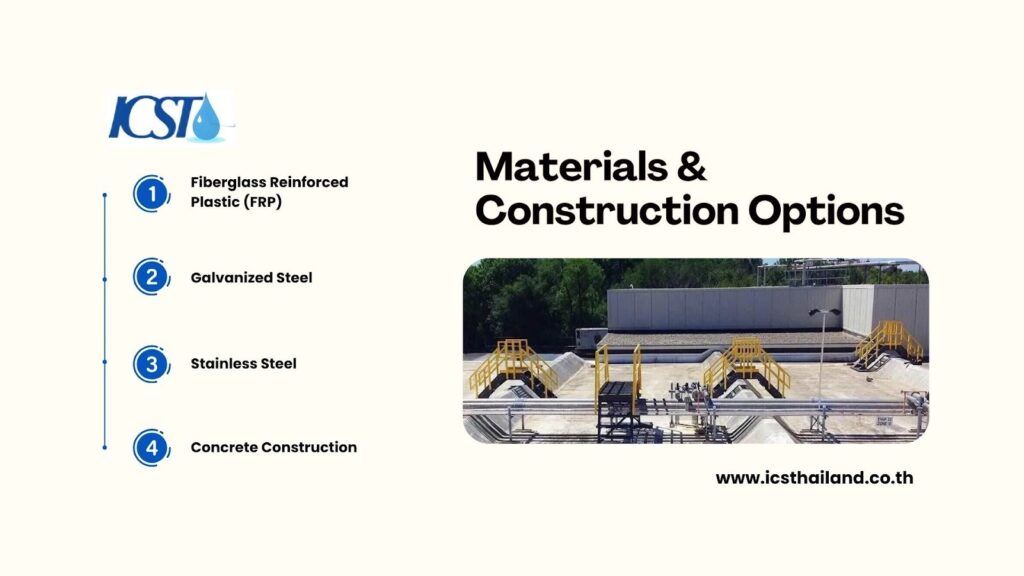
Cooling tower selection greatly depends on the materials used, as they influence durability, corrosion resistance, and compatibility with specific environments. Choosing the right construction materials ensures a longer system lifespan and minimizes maintenance requirements.
Common material options include:
Fiberglass Reinforced Plastic (FRP)
FRP is a lightweight and corrosion-resistant material that’s ideal for moderate environments. Its cost-effectiveness makes it a popular choice for facilities looking to balance performance with budget.
Galvanized Steel
Known for its strength and durability, galvanized steel works well in most industrial applications with regular maintenance. It provides reliable performance in environments where corrosion is not extreme.
Stainless Steel
Stainless steel offers unmatched corrosion resistance, making it perfect for harsh chemical or coastal environments. Its longevity and ability to withstand extreme conditions justify its higher upfront cost.
Concrete Construction
Concrete is commonly used in large natural draft cooling towers due to its long-term structural stability. It excels in providing durability and low maintenance for large-scale installations.
Corrosion Resistance Requirements
Facilities dealing with aggressive chemicals or operating in corrosive climates require advanced materials. Upgrading to corrosion-resistant options ensures safety, efficiency, and longevity of the infrastructure.
Choosing materials that match your operational environment prevents premature degradation and costly repairs.
Top Cooling Tower Mistakes to Avoid at All Costs
Even experienced facility managers can make errors during the cooling tower selection process. Avoiding these common pitfalls ensures better performance and lower operational costs over the life of the unit.
Frequent mistakes include:
- Undersizing cooling capacity: A tower that cannot handle peak loads forces equipment to work harder, increasing energy use and wear.
- Ignoring environmental conditions: Failing to account for local climate, water quality, or seasonal variations leads to inefficient operation.
- Overlooking water treatment needs: Without proper treatment, scaling and corrosion damage components and reduce efficiency.
- Prioritizing upfront cost over lifecycle value: Choosing the cheapest option often results in higher maintenance and energy expenses.
- Poor installation location planning: Placing a tower in a poorly ventilated area or too close to heat sources reduces cooling effectiveness.
Taking the time to evaluate all factors prevents costly mistakes and ensures long-term success.
Expert Tips for Selecting the Right Cooling Tower
Making the right choice requires a combination of technical analysis and practical planning. These strategies help you navigate the selection process with confidence.
Follow these expert recommendations:
- Perform thermal performance calculations – Use engineering data to determine the exact cooling capacity your facility needs.
- Consider lifecycle cost, not purchase price – Energy-efficient systems with higher upfront costs often deliver greater savings over time.
- Consult cooling specialists early – Engaging experts during the planning phase prevents design flaws and ensures optimal system sizing.
- Plan for future expansion – Selecting a tower with extra capacity or a modular design allows for growth without requiring a full replacement.
- Prioritize energy-efficient designs – Features like VFDs and high-efficiency fans reduce operating costs and environmental impact.
A thoughtful approach to cooling tower selection delivers reliable performance and long-term value.
Making the Right Choice for Your Facility
Cooling tower selection is a critical decision that impacts operational efficiency, energy costs, and equipment reliability. By understanding tower sizing, application requirements, and selection criteria, you can ensure your cooling tower selection aligns with the specific needs of your facility.
A well-chosen cooling tower provides consistent performance, reduces energy consumption, and minimizes maintenance challenges. By evaluating cooling capacity needs and considering industry-specific cooling requirements, you can avoid costly mistakes and maximize long-term value.
Partnering with an experienced cooling solutions provider simplifies the selection process and ensures that your system is engineered for optimal performance. Visit the ICST website today to explore our solutions and take the first step toward efficiency and reliability!
Frequently Asked Questions
Which cooling tower type is most efficient?
Counterflow mechanical draft cooling towers are generally the most thermally efficient for industrial applications. However, efficiency depends on proper sizing, airflow design, fill media selection, and energy-efficient fan systems.
How do space limitations affect cooling tower selection?
Available footprint, height restrictions, and structural load capacity all influence the type and configuration of tower you can install. Compact crossflow designs are often used in space-constrained facilities, while larger ground-mounted units allow greater flexibility.
How do you select the right cooling tower?
Select the right cooling tower by calculating your total heat load, required temperature range, system flow rate, and site wet-bulb temperature. Then evaluate tower type, space availability, water quality, and energy efficiency goals to ensure long-term performance and cost-effectiveness.
What factors affect cooling tower selection the most?
The most important factors include:
- Total heat load requirements
- Ambient wet-bulb temperature
- Water quality and availability
- Space and structural limitations
- Industry-specific process demands
- Energy efficiency goals
Balancing these elements ensures long-term performance and cost efficiency.