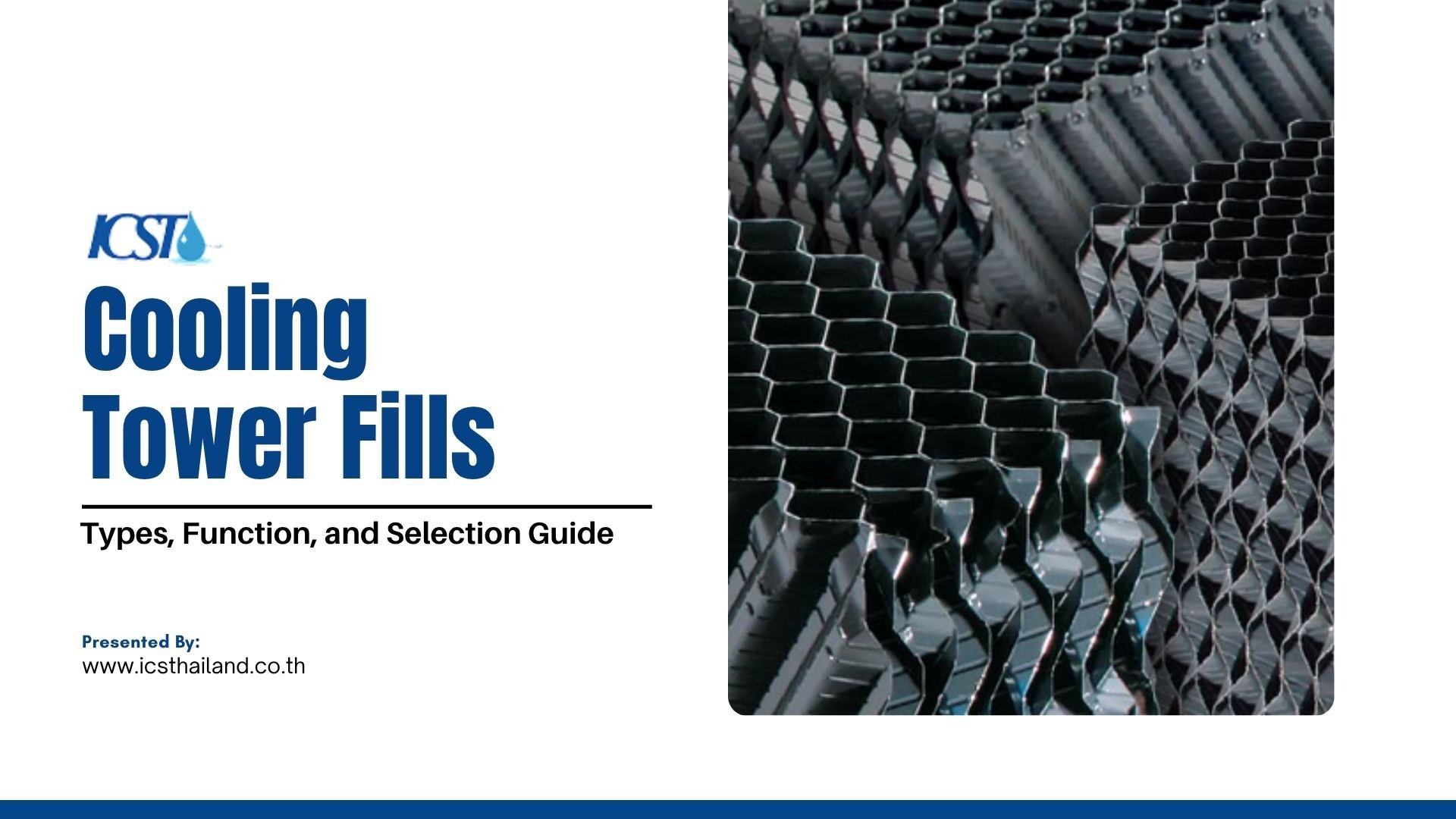
Cooling tower fills are the internal components that maximize contact between water and air inside a cooling tower, using thin fill sheets or splash surfaces to slow water flow and expand its contact surface. This process drives evaporation that cools hot water down to cold water before it recirculates through the system.
Cooling tower fills fall into two main types: film fills and splash fills, each suited to different water quality and space conditions. The right fill media directly affects a cooling tower’s energy use, reliability, and maintenance needs, especially in Thailand’s hot, humid climate.
What Are Cooling Tower Fills?
Cooling tower fills sit inside the tower, between the water distribution system and the air inlet. The fill media located in this zone slows the falling water down so it spreads across a wider contact surface.
This design maximizes how much water touches the incoming air. More contact means faster heat transfer and a more complete evaporation process before the water returns to the system.
Different cooling towers use different fill designs depending on water quality, available space, and cooling demand. Without the right fill, a tower struggles to hit its rated efficiency, which raises energy consumption and increases the risk of downtime.
In Thailand, where temperatures regularly exceed 35°C, the performance of the fill has a direct effect on how reliably an industrial cooling system runs.
Types of Cooling Tower Fills: A Closer Look
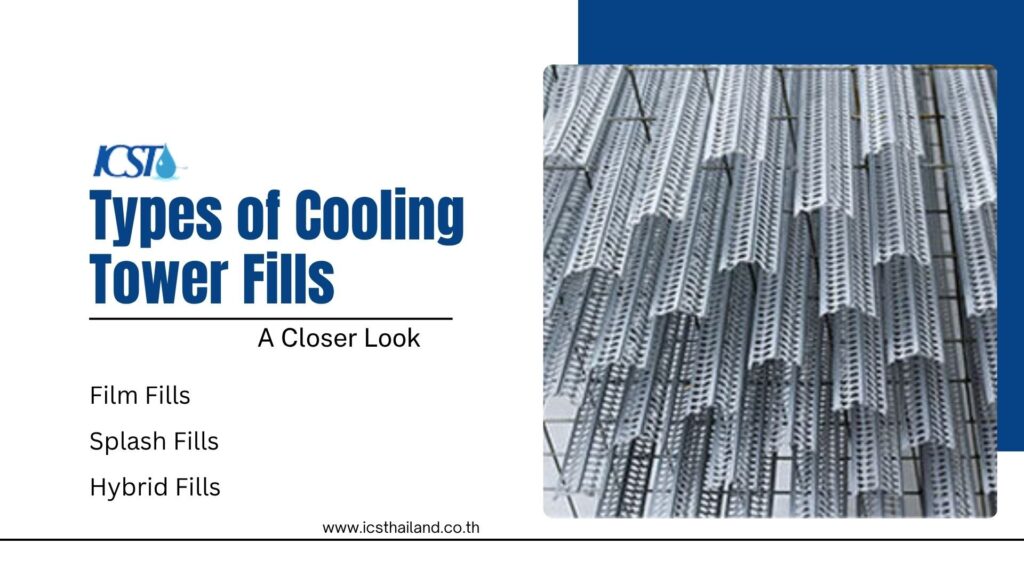
Cooling tower fills come in two main types: film fills and splash fills, each relying on different designs to expose water to air. The right choice depends on water quality and available space.
A. Film Fills
Manufacturers make film fills from hot-pressed PVC fill sheets, sometimes arranged in a tower honeycomb structure to pack more surface area into a compact footprint. Manufacturers also use other plastic sheets for specific chemical or temperature requirements.
As water moves across these thin sheets, it forms a film that spreads across the surface. This film fills the highest efficiency per unit of space, which makes them a strong fit for systems with limited room.
The trade-off is sensitivity to water quality. Film fills scale and clog faster than splash fills when supplied with dirty water, a real concern in Thailand’s mineral-heavy water supply.
B. Splash Fills
Splash fills use stacked layers of PVC or metal to break falling water into droplets. The droplets create turbulence, which exposes more water surface to the airflow moving through the tower.
Splash fills tolerate dirty water and debris far better than film fills, since there are no narrow channels to clog. That durability makes them a better choice for facilities without dedicated water treatment systems.
C. Hybrid Fills
Hybrid fills blend film and splash sections in a single tower. Facility engineers use this combination to balance the efficiency of film fills with the fouling resistance of splash fills, without treating hybrid as a separate primary category.
Key Points to Remember
- Film fills deliver the highest efficiency but need clean water to avoid fouling
- Splash fills tolerate dirty water and debris with less maintenance
- Hybrid fills combine both approaches for mixed requirements
- Material choice (PVC, FRP, or stainless steel) should match local water chemistry and any chemical exposure
How Cooling Tower Fills Work
Cooling tower fills create a large contact surface where hot water meets moving air. As the water spreads across the fill sheets or splash surfaces, some of it evaporates.
That evaporation process pulls heat out of the remaining water, which drops in temperature as it falls. By the time the water reaches the basin, it has gone from hot water to warm water to cold water, ready to recirculate through the system.
Film fills accomplish this by keeping water as a thin film across a packed surface area. Splash fills accomplish the same result by breaking water into droplets that tumble through rising air.
The fill design a tower uses changes how quickly this heat exchange happens, which is why fill selection has a direct effect on overall cooling capacity.
Why Cooling Tower Fills Matter in Thailand
Thailand’s climate presents unique challenges for cooling systems. High temperatures and humidity can reduce cooling efficiency, leading to increased energy use and higher operational costs. Here’s why cooling tower fills are critical in this context:
Poor quality water can further complicate the performance of cooling tower fills. While film fills offer better heat exchange capabilities, they are prone to fouling under lower-quality water conditions, reducing their efficiency. In contrast, modular splash fills are more resilient and can maintain operational efficiency even with poor water conditions, thus minimizing the need for frequent maintenance.
Enhanced Heat Dissipation
Thailand’s hot climate demands efficient heat removal. High-quality fills ensure that water is cooled effectively before recirculation, preventing overheating of machinery.
Energy Efficiency
Poorly designed fills force cooling towers to work harder, consuming more energy. Optimized fills reduce the energy required for cooling, lowering utility bills and carbon footprint.
Adaptation to Humidity
Thailand’s humidity accelerates evaporation, but it also promotes scaling and algae growth. Fills made from corrosion-resistant materials (e.g., PVC or FRP) combat these issues, ensuring long-term reliability.
Industrial Demand
Thailand’s booming manufacturing, automotive, and power sectors rely heavily on cooling systems. Efficient fills are non-negotiable for maintaining productivity in these industries.
How to Select the Right Cooling Tower Fills for Your System

Selecting the ideal fill involves considering several factors:
Material compatibility is crucial. Cooling tower fills can be made of different materials, each with specific properties suited for various applications. The choice of material should be based on the application and water quality, as different materials have distinct temperature resistances and physical properties crucial for optimal performance.
Material Compatibility
Choose fiberglass-reinforced plastic (FRP) or stainless steel for systems that handle process chemicals. Standard PVC works well for typical cooling water without heavy contamination.
Climate Adaptation
Prioritize materials that resist algae and mineral buildup in Thailand’s climate. UV-treated PVC resists degradation from direct sunlight in outdoor installations.
System Requirements
Calculate the required heat transfer rate before setting fill density. Film fills suit compact systems, while splash fills suit larger towers with more available volume.
Budget Considerations
A cheaper fill that fouls quickly costs more over its service life than a higher quality fill built for local water conditions. Long-term maintenance costs usually outweigh the initial price difference.
Cooling Tower Fill Types Compared
Choosing between fill types comes down to five practical factors. The table below lines them up side by side.
| Factor | Film Fills | Splash Fills | Hybrid Fills | Best Fit |
| Efficiency | Highest per square meter | Moderate | High | Film fills for tight spaces |
| Water quality tolerance | Low, needs clean water | High, tolerates dirty water | Moderate to high | Splash fills for untreated water |
| Maintenance frequency | Higher | Lower | Moderate | Splash fills for low maintenance budgets |
| Space required | Compact | Larger footprint | Moderate | Film fills where space is limited |
| Typical material | PVC fill sheets | PVC or metal | Mixed | Match to local water chemistry |
Benefits of High-Quality Cooling Tower Fills
Premium cooling tower fills pay for themselves through measurable operational gains, not just marketing claims.
Lower Energy Costs
Efficient fills reduce the fan and pump power needed to hit target cooling temperatures, which lowers the electricity draw tied to cooling operations.
Extended Equipment Life
Durable fill materials, including FRP and treated PVC, resist the scaling and algae growth that accelerate wear in Thailand’s climate. That resistance stretches replacement cycles and reduces unplanned downtime.
Lower Water and Chemical Use
Efficient heat transfer means less water lost to excess evaporation and less chemical treatment needed to manage fouling, supporting both cost control and sustainability targets.
Consistent Production Uptime
A fill that keeps pace with cooling demand prevents the overheating events that force manufacturing and power generation lines to slow down or shut down entirely.
Common Issues and Solutions
Even well-chosen fills develop problems over time. Catching these early prevents a small issue from becoming a full replacement.
Scaling and Fouling
Mineral deposits and biological growth build up on fill surfaces when water chemistry goes unmanaged, restricting airflow and cutting cooling capacity. A water treatment program with scale inhibitors and biocides controls this buildup before it spreads across the fill pack.
Clogging
Debris entering with the water supply blocks narrow channels in film fills faster than in splash fills, raising pressure drop and reducing performance. Pre-filters installed ahead of the fill catch debris before it ever reaches the fill media.
Corrosion
Aggressive water chemistry or chemical exposure degrades standard PVC and metal components over time, weakening the fill structure. Switching to FRP or stainless steel in these conditions removes the corrosion risk at the material level.
Conclusion
Cooling tower fills decide how efficiently a tower turns hot water into cold water, and that decision affects energy costs, uptime, and maintenance budgets for years. Matching fill type to local water quality and fill media requirements matters more in Thailand’s climate than in almost any other market.
Film and splash fills each solve a different problem, and the right choice comes down to water quality, space, and budget rather than a single universal answer. International Cooling Solutions Thailand designs and installs fill systems matched to local conditions, and can assess an existing tower’s fill performance on request.
Frequently Asked Questions
What are cooling tower fills made of?
Manufacturers typically make cooling tower fills from PVC fill sheets for film fills, or PVC and metal for splash fills. Facilities handling aggressive chemicals often choose FRP or stainless steel instead, since these materials resist corrosion better than standard PVC in harsh water conditions. The right material choice depends on both water chemistry and the type of process fluid the system handles.
What is the difference between film fills and splash fills?
Film fills spread water into a thin layer across packed sheets for maximum contact surface, which gives high efficiency but needs clean water. Splash fills break water into droplets across stacked layers, tolerating dirty water and debris with less maintenance. Facilities with treated water supplies typically choose film fills, while those without treatment often prefer the durability of splash fills.
How often should cooling tower fills be inspected?
Most facilities inspect cooling tower fills every 6 to 12 months for cracks, corrosion, and scaling. Towers running poor quality water or heavy industrial loads often need more frequent checks to catch fouling before it affects cooling capacity. A simple visual check during routine maintenance often catches early warning signs before a full inspection becomes necessary.
Can cooling tower fills be replaced without shutting down the whole system?
Multi-cell towers can often keep running while crews replace fills one cell at a time. Single-cell towers typically require a scheduled shutdown, which is why most facilities plan fill replacement around low-demand periods. Planning replacement during a maintenance window reduces the production impact of taking a single cell tower offline.
Why do cooling tower fills matter in Thailand’s climate?
Thailand’s heat and humidity accelerate both evaporation and fouling, which puts extra strain on fill media. Corrosion-resistant materials and a fill type matched to local water quality reduce maintenance frequency and protect cooling performance year-round. Facilities that select fills without accounting for local conditions typically see faster fouling and shorter service life.