Cooling tower repair and maintenance means inspecting, cleaning, servicing, and restoring tower components so heat rejection stays reliable. It covers the fan, motor, gearbox, fill media, spray nozzles, cold water basin, and water distribution system, plus water treatment to control scale buildup, corrosion, and biological growth.
Cooling towers play a central role in industrial cooling, and well-maintained cooling towers keep the entire system reliable. This guide helps facility managers and plant engineers spot warning signs, run an inspection, follow the repair steps, and decide when a qualified specialist is needed. Our routine cooling tower maintenance page covers regular upkeep.
What Is Cooling Tower Repair and Maintenance
Understanding Cooling Tower Repair
Cooling tower repair finds and corrects faults in structural components, mechanical components, the water distribution system, or fill media. The goal is to restore cooling capacity and stop further damage.
Jobs range from sealing a basin joint to replacing a fan motor, gearbox or worn fill. The scope depends on the damage and the age of the equipment.
What Preventive Maintenance Includes
Preventive maintenance is a scheduled program of inspection, cleaning, lubrication, water treatment and checks of mechanical and electrical components. It finds deterioration early, before it stops the process the tower serves.
- Regular visual and mechanical inspections
- Basin and fill media cleaning
- Water quality testing and chemical treatment
- Fan, motor and gearbox servicing, including lubricating fan motor bearings and fan shafts as the manufacturer specifies
- Drift eliminator and spray nozzle checks
- Reviewing water treatment logs and keeping written records of all maintenance work
Benefits of Routine Maintenance
- Better operational efficiency: clean components and balanced water chemistry keep heat transfer efficiency close to design, which supports system efficiency.
- Longer equipment life: proper maintenance can extend cooling tower life and equipment lifespan, because wear is found early and major components last longer.
- Lower operating costs: fouled surfaces and struggling motors raise energy consumption and energy costs, so a well kept tower helps lower operating costs.
- Less downtime: scheduled work reduces unplanned stops and emergency repairs.
- Better water quality: proper water treatment helps control scale buildup, corrosion and bacterial growth.
- Safer site: a maintained tower reduces health risks from Legionella, as well as structural and electrical risks.
How Cooling Towers Work
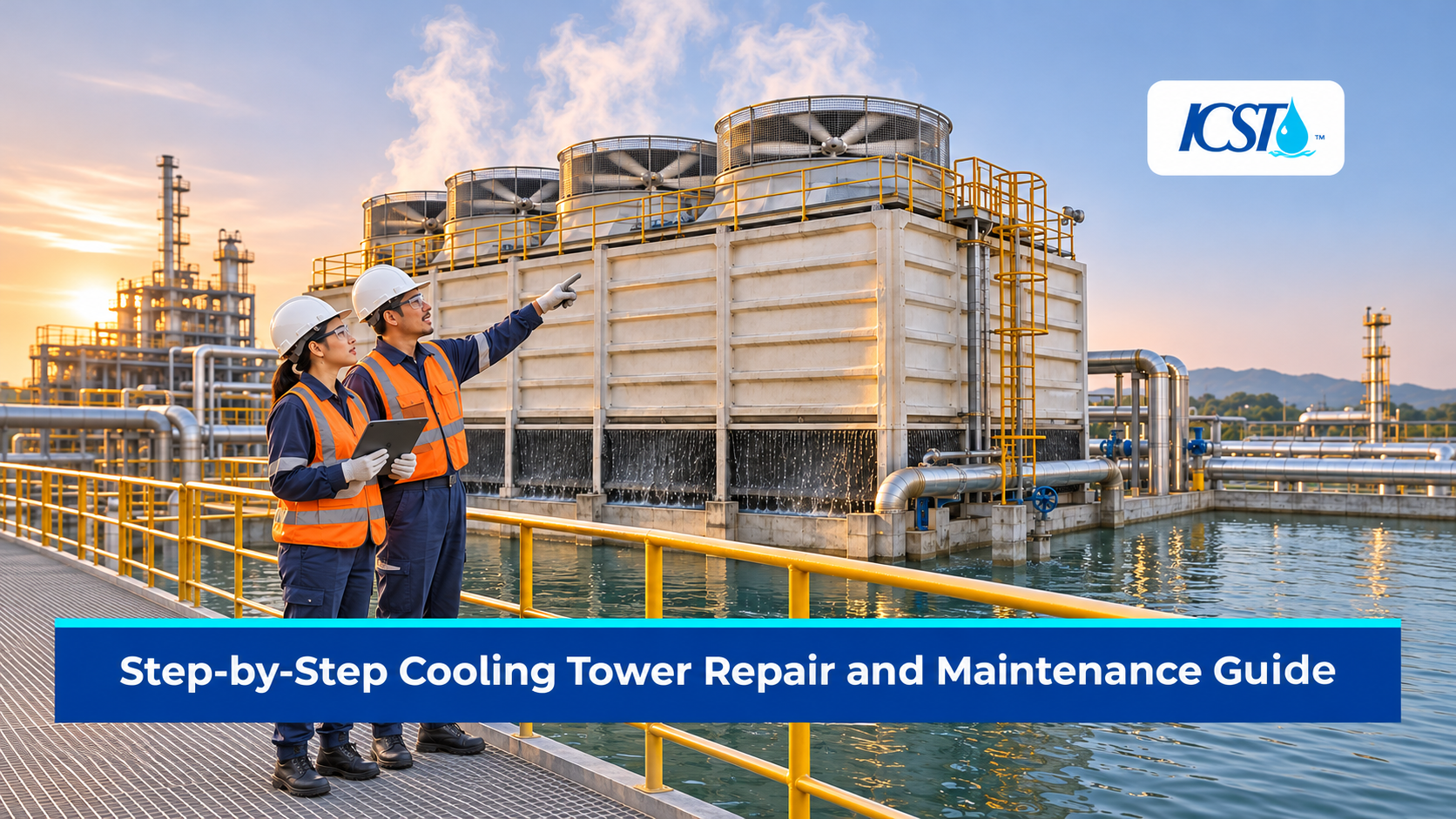
A cooling tower removes heat from recirculating water by evaporation. Warm water returns from heat exchangers and other process equipment and flows over the fill media while air moves through the tower, either by natural draft or mechanical fans. Part of the water evaporates and carries heat away, and the cooled water returns to the cooling system.
Most evaporative cooling towers use this principle, including counterflow cooling towers, where air moves up against the falling water.
This cycle depends on clean tower components, enough airflow and balanced water chemistry. When one part is compromised, the other parts take extra stress.
| Component | Function |
| Fan | Moves air through the tower |
| Motor | Powers the fan; needs lubrication and alignment checks |
| Gearbox | Transmits motor torque to the fan shaft; needs oil checks |
| Fill media | Increases air and water contact for heat transfer |
| Drift eliminators | Capture water droplets leaving with the air |
| Louvers | Guide inlet air and keep water inside the tower |
| Spray nozzles | Spread water evenly over the fill |
| Cold water basin and sump | Collect the cooled water before it returns to the process |
Cooling Tower Performance and Energy Efficiency
Maintenance directly affects cooling tower performance. Clean fill media and even water flow keep heat transfer efficiency high, and correct fan blade pitch with clear louvers protects airflow and thermal performance.
Fouling, blocked nozzles or poor maintenance reduce cooling efficiency, so the tower struggles to reach peak performance. Steady upkeep supports energy efficiency and long term reliability without changing the tower’s design. Sealed joints and good drift eliminators also limit water loss: see our guide to cooling tower water loss.
Warning Signs and Common Causes of Cooling Tower Problems
A tower usually gives warning signs before a serious failure, whether the cause is scale, corrosion or wear on mechanical components. Catching them early limits downtime and repair costs.
| Warning sign | Common cause | Typical action |
| Reduced cooling performance: higher outlet water temperature, process running hotter | Fouled fill, blocked nozzles, low airflow | Inspect fill, nozzles and fan; clean or repair |
| Higher energy costs without a higher load | Scale, dirty fill, struggling motor | Check fill and motor current; review water treatment |
| Visible leaks or a falling basin level | Cracked basin, failed sealant, damaged piping | Locate the leak; seal or repair |
| Vibration | Fan imbalance, worn bearings, gearbox or drive shaft problems | Stop the fan and inspect; call a specialist if it continues |
| Grinding, clanking or squealing | Bearing wear, loose parts, blade contact | Shut down and inspect |
| Rust, pitting or discolouration | Failed coating, poor water chemistry | Treat, recoat or replace corroded parts |
| Slime, algae or odour | Inadequate water treatment | Clean and disinfect under the water treatment program; test the water |
| Uneven spray or dry spots on the fill | Clogged or misaligned nozzles | Clean or replace nozzles; check the headers |
| Little or no airflow | Fan or motor failure | Isolate the tower and inspect fan, motor and drive |
Warm, nutrient rich recirculating water supports bacterial growth, including Legionella. CDC’s cooling tower guidance calls for a water management program with documented monitoring and control: see the CDC Legionella Control Toolkit for cooling towers.
Cooling Tower Inspection Checklist
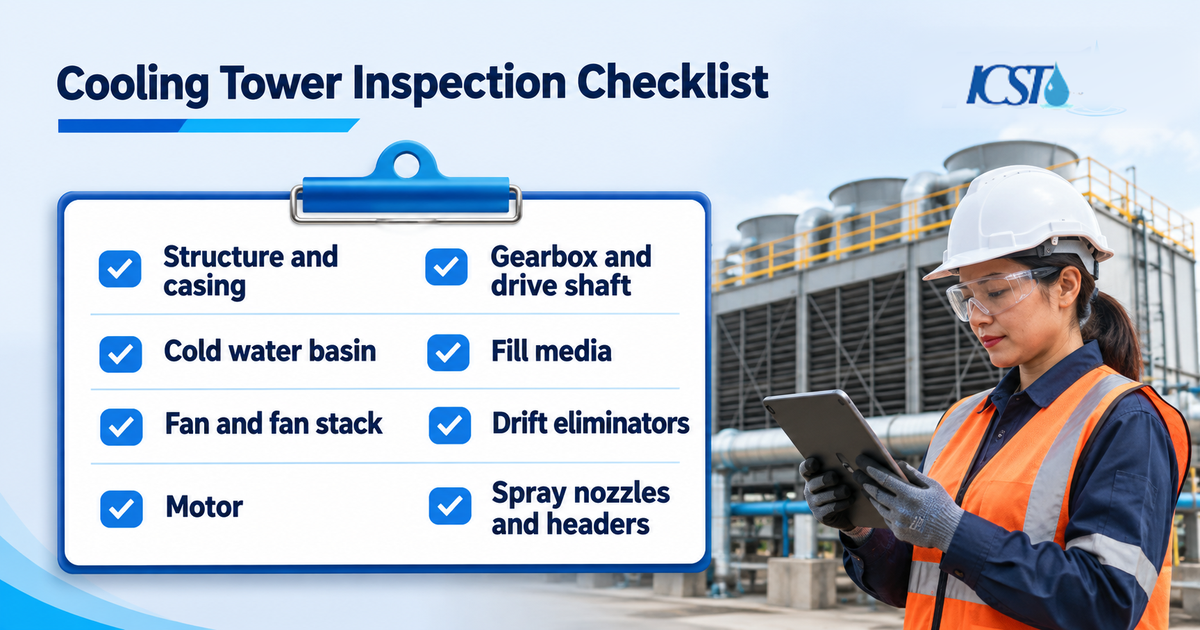
Use this tower maintenance checklist for routine inspections and before any repair. Inspect rotating equipment only when the fan is locked out. How often each item is checked depends on your tower, its operating conditions and the manufacturer’s manual, so set the schedule from your own operation and maintenance manual.
| Area | What to check |
| Structure and casing | Cracks, corrosion, loose or missing fasteners, damaged louvers, safe access |
| Cold water basin | Water level, leaks, sludge and debris, strainers and screens |
| Fan and fan stack | Blade cracks and damage, pitch and tip clearance, hub bolts, unusual noise or vibration |
| Motor | Temperature, current draw against the nameplate, terminals and wiring, lubrication per the motor maker |
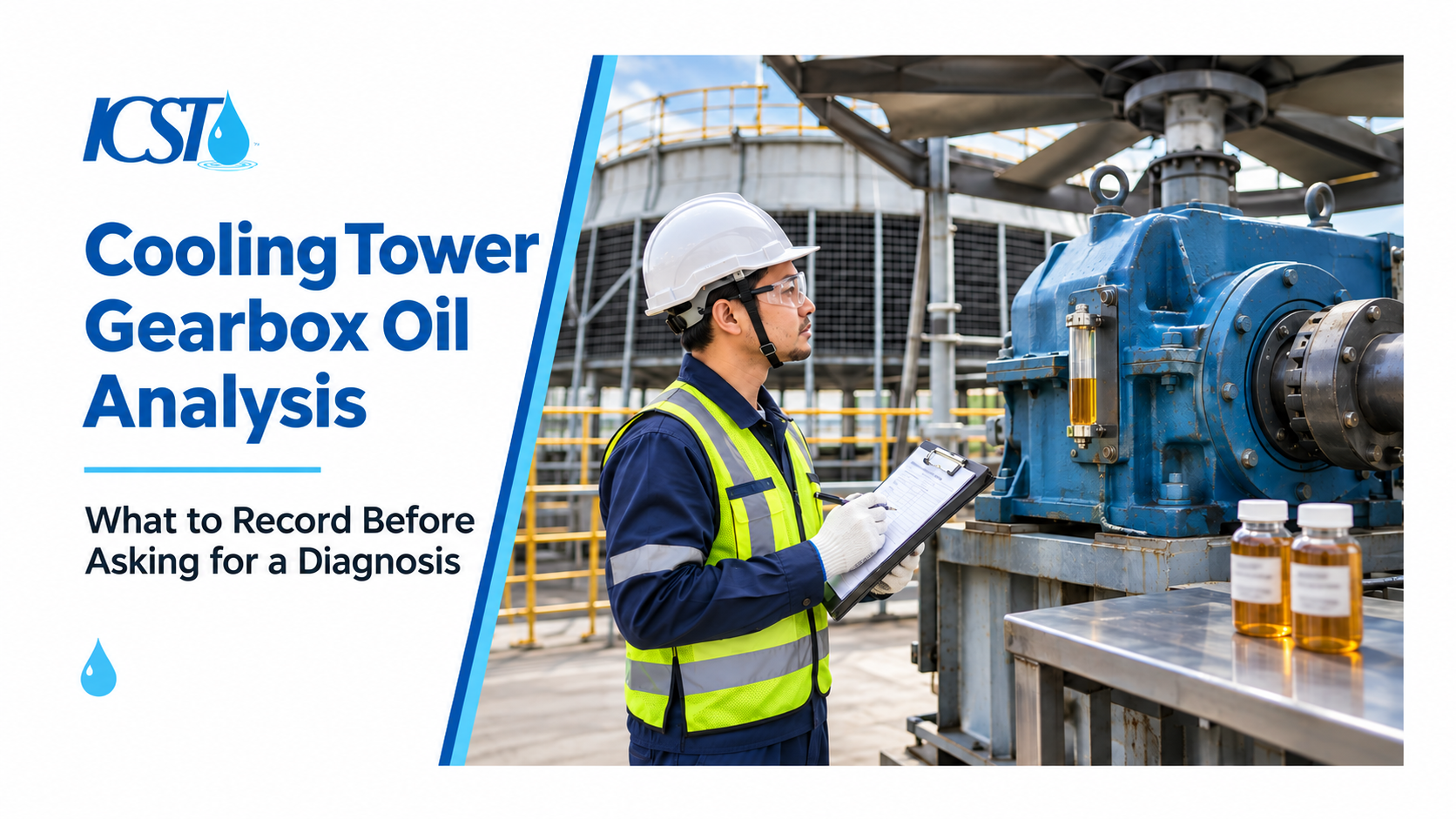
| Gearbox and drive shaft | Oil level and condition, leaks, open breather, shaft or coupling alignment, fasteners |
| Fill media | Fouling, scale, damage, even water flow across the fill |
| Drift eliminators | Cracks, gaps, broken sections, fouling |
| Spray nozzles and headers | Blocked or missing nozzles, uneven spray pattern, header leaks |
| Piping and valves | Leaks, corrosion, valve operation, make-up water float valve |
| Water treatment | Water test results, dosing records, visible slime or algae |
| Records | Date, findings, photos, actions taken, parts replaced |
If an item shows damage you cannot judge safely, stop and read the section on when to call a qualified specialist.
Step-by-Step Cooling Tower Repair Process
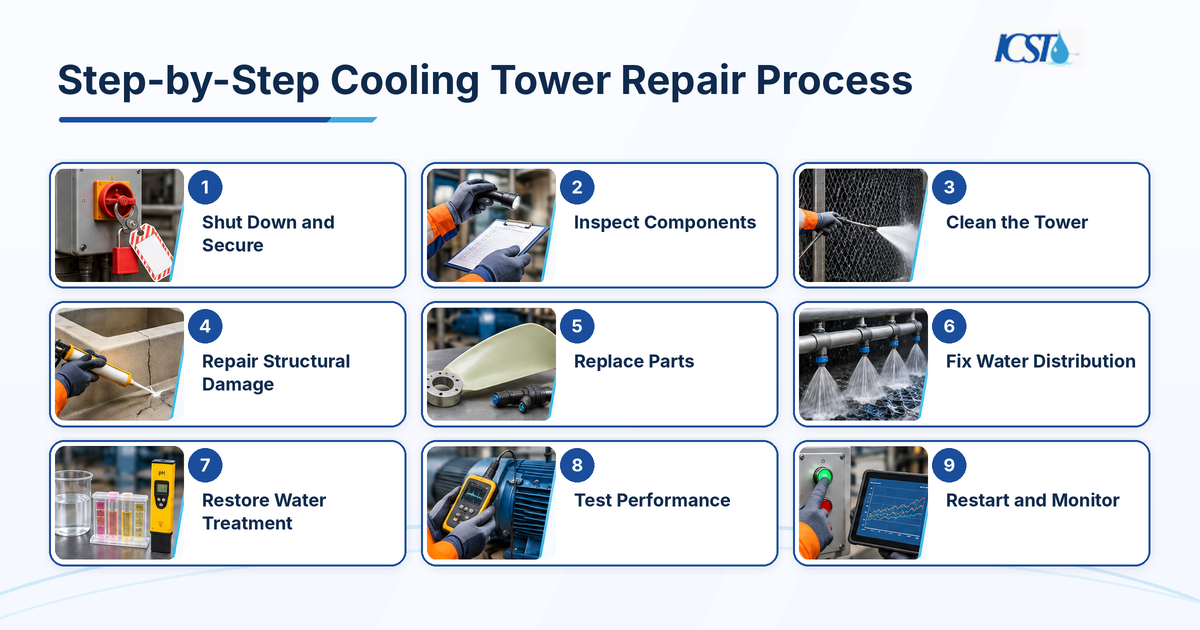
A structured repair process improves safety, reduces mistakes and restores performance more reliably.
Step 1: Shut Down and Secure the System
Shut the tower down completely and follow your site’s lockout/tagout procedure to isolate electrical and mechanical energy. Tell the facility team before work starts.
Plan for work at height and confined space entry if the job needs access to the basin or fan deck, and drain the basin when internal access is required. Never work on live or pressurised systems.
Step 2: Inspect All Components
Work through the inspection checklist above before any repair. Photograph and note the condition of each item. This record sets the scope of the repair.
Step 3: Clean the Cooling Tower
Remove sediment, debris and biological growth from tower surfaces, the basin, sump and fill. Use a cleaning method suited to the fill and drift eliminator material, and check the manufacturer’s cleaning guidance first.
Disinfect as your water treatment program requires, then rinse all surfaces.
Step 4: Repair Structural Damage
Seal cracks in the basin and casing with compatible sealants or repair compounds. Treat corroded metal and apply a protective coating.
Replace casing sections or basin lining where the damage is too extensive for surface repair.
Step 5: Replace Damaged Components
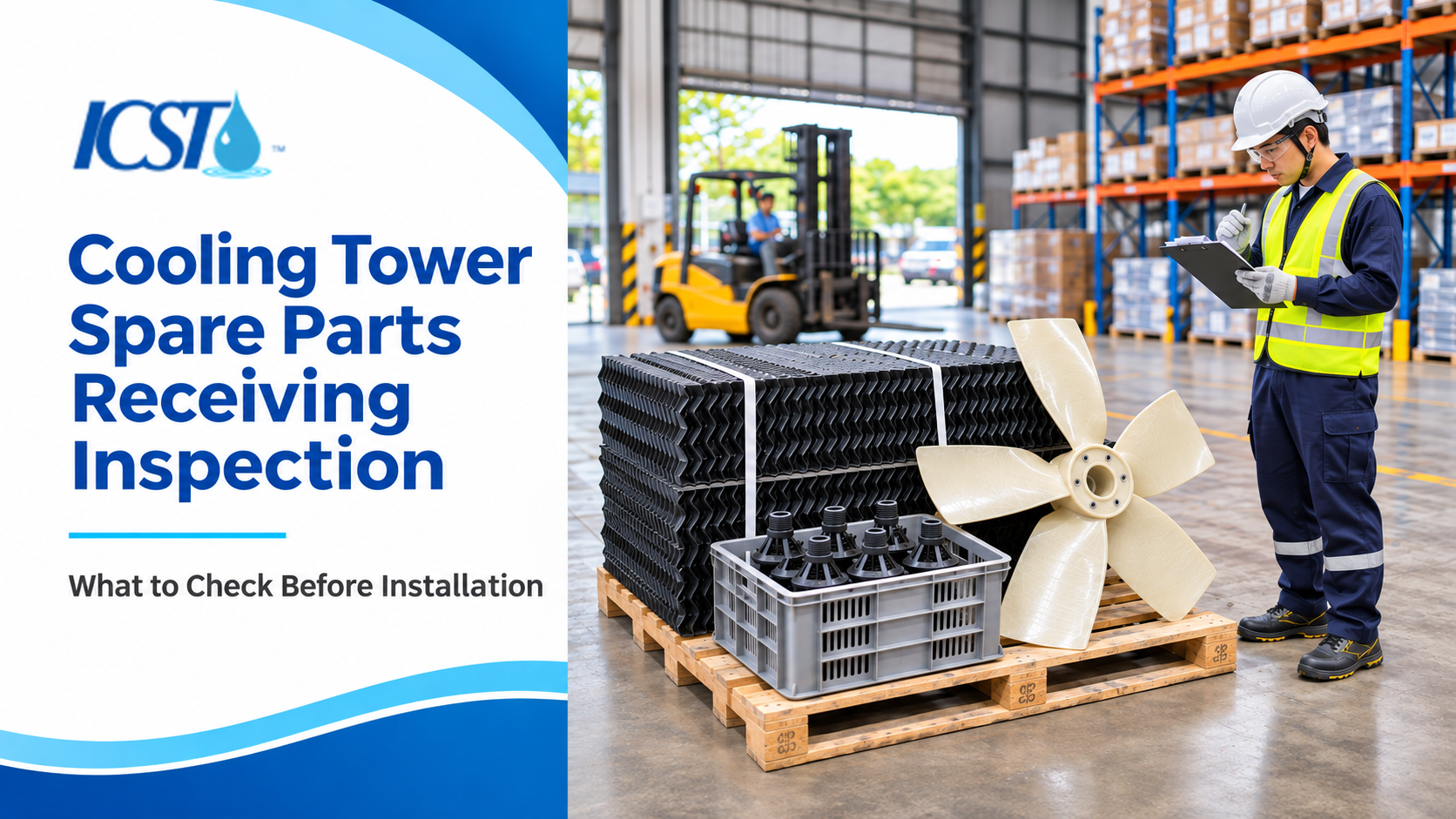
Replace parts that are too worn to repair, such as fill media, drift eliminators, spray nozzles, fan blades, bearings or motors. Use parts specified by the tower manufacturer where possible so performance ratings and warranty stay valid.
ICST supplies cooling tower parts for large industrial towers. Before you request a quote, use our cooling tower parts RFQ checklist.
Step 6: Repair the Water Distribution System
Clean or replace clogged nozzles and inspect the distribution headers for blockages or damage. Confirm that water spreads evenly across all fill cells.
Step 7: Restore Water Treatment
Refill the basin and restore the water treatment program. Test pH, conductivity and chemical levels before restart and confirm they are within the limits set by your water treatment provider. Our guide to cooling water chemistry explains pH balance and control.
Step 8: Test System Performance
Run a dry test first to check fan rotation, motor alignment and gearbox function. Then run with water circulating and monitor temperature, vibration, noise and water distribution against the design specification.
Step 9: Restart and Monitor
Return the tower to full operation and watch it closely for the first day or two. Look for leaks, unusual sounds, vibration or a performance shortfall, and record all work, replaced parts and test results.
Cooling Tower Preventive Maintenance Program
A scheduled program keeps the tower efficient, can extend equipment lifespan and lowers the risk of failure. The tasks below are a general starting point. Manufacturers set different intervals for different towers, so follow your tower’s manual and your water treatment provider’s plan.
| Frequency | Typical tasks |
| Daily | Walk around the tower, check basin level, confirm the fan runs normally, look for leaks |
| Weekly | Test and record water chemistry, clean strainers, clear debris from the basin; check gearbox oil level if your manual specifies weekly checks |
| Monthly | Check fan blades and hardware, remove basin sludge, review water treatment logs; check gearbox oil level if your manual specifies monthly checks |
| Quarterly | Inspect structure, louvers and strainers, lubricate fan motor bearings and fan shafts as the manufacturer specifies, run a fuller water analysis |
| Semi-annual | Inspect and clean drift eliminators, check piping, valves and fittings; inspect or change gearbox oil as the manual requires |
| Annual | Full mechanical and electrical audit, fill media condition check, thermal performance check, basin and sump cleaning |
Intervals for gearbox oil checks, oil changes and bearing lubrication differ between manufacturers and oil types. Disinfection is set by your water treatment program. Always take the exact interval from the manual that came with your tower.
Industrial Cooling Tower Maintenance Best Practices
Large industrial cooling towers benefit from predictive maintenance and condition monitoring in addition to scheduled work. Predictive maintenance uses monitoring data to schedule work before a component fails.
- Condition monitoring: track temperatures, flow, pressure and electrical readings so changes from the baseline are noticed early.
- Vibration analysis: regular vibration measurement on fans, motors and gearboxes shows bearing wear, imbalance and alignment problems before they become audible.
- Thermal imaging: a thermal camera can show hot spots in electrical connections and motors without shutting the tower down.
- Maintenance records: keep dates, findings, water test results, dosing records, replaced parts with part numbers, and incident reports. Good records support warranty claims and future budgeting.
When to Call a Qualified Specialist
Some jobs should not be handled by the plant team alone. Call a qualified cooling tower specialist when:
- Vibration or noise continues after the fan is stopped and you have checked for loose parts or blade contact.
- The gearbox leaks, runs hot, shows metal particles in the oil or makes unusual gear noise.
- Fan blades, the hub or the drive shaft show cracks or damage.
- Corrosion or cracking affects structural steel, frames, basin walls or anchor points.
- The motor overheats, trips breakers or shows damaged insulation.
- The work needs confined space entry, work at height or a shutdown that your team has no procedure for.
- Water tests show persistent high bacteria counts, or Legionella is suspected. Contact your water treatment provider and follow your water management program.
- Repairs keep returning, or performance does not recover after cleaning.
A qualified provider follows lockout/tagout, confined space and chemical handling procedures. ICST provides cooling tower repair services in Thailand and structural inspection for large industrial towers.
Repair vs. Replacement: How to Decide
Not every problem needs a new tower. Compare repair cost, structural condition, performance and the cost of downtime, and look at lifecycle cost instead of age alone.
When Repair Is the Better Option
- Damage is limited to specific components such as a motor, gearbox or fill.
- The structural frame is sound.
- Targeted repairs can fully restore performance.
- The repair estimate is clearly lower than the cost of replacement.
When Replacement Makes More Sense
- Structural corrosion compromises the structural integrity of the frame.
- The tower no longer delivers the cooling capacity the process needs. A thermal upgrade or a new unit may address this.
- Frequent breakdowns keep interrupting operations.
- Replacement parts are obsolete or hard to source.
- Repair estimates approach the cost of a new unit. Many engineers treat roughly half of that cost as a point to review the decision, but this is a rule of thumb and not a standard.
If replacement is the better route, see our cooling tower replacement page or the options for new cooling towers. A new tower also removes the recurring cost of repeated breakdowns.
Choosing Professional Cooling Tower Repair Services
The right repair partner affects performance, safety and long-term cost. Professional cooling tower repair starts with an accurate diagnosis, and expert cooling tower repair teams can handle structural, mechanical and water treatment work. When you compare providers, ask about:
- Experience: a documented record on several tower types and industries.
- Inspection tools: vibration analysers, thermal cameras and water testing.
- Qualified technicians: people who can handle structural, mechanical and water treatment work.
- Safety procedures: lockout/tagout, confined space entry and chemical handling.
- Emergency response: how fast they can send a field team when a tower fails and emergency repairs are needed.
- Maintenance programs: structured annual programs, not only one-off repairs.
Cooling Tower Repair Cost Factors
Repair costs vary with the type of damage, the size of the tower and the work involved. Planned maintenance helps keep maintenance costs and repair costs under control. The main drivers are:
- Labor: usually the largest share, especially for work in confined spaces, at height or needing specialist skills such as gearbox rebuilds or structural welding.
- Parts: motors, gearboxes and fill media are major material costs. Manufacturer-approved parts help keep ratings and warranty coverage.
- Tower size: more cells and components mean more hours to inspect, clean and repair.
- Complexity: replacing a nozzle or sealing a basin costs far less than a mechanical overhaul or structural rebuild.
- Downtime: every hour without cooling can cost production, so shorter repairs lower the total cost.
Mistakes to Avoid During Cooling Tower Repair and Maintenance
- Ignoring water treatment: skipped or inconsistent treatment lets scale, corrosion and biological growth develop. Treatment is a basic operating requirement.
- Delaying inspections: small problems turn into expensive repairs.
- Using incompatible materials: wrong parts or repair materials can speed up corrosion, void warranties and reduce performance. Check compatibility first.
- Skipping lubrication: bearings, fan shafts and motors need lubrication at the manufacturer’s intervals.
- Neglecting vibration: small imbalances and misalignment grow into major failures.
- Keeping poor records: without records you cannot track deterioration, show compliance or plan budgets.
Conclusion
Cooling tower repair and maintenance is a planned operating task, not a reaction to failure. A structured program, regular inspections and the right response to warning signs reduce downtime, protect equipment, improve system reliability and keep the site safer.
Scale, corrosion and wear continue between inspections, and each missed interval narrows the margin before an expensive repair. For large industrial towers in Thailand, International Cooling Solutions Thailand (ICST) provides cooling tower repair and cooling tower maintenance. Contact ICST to schedule an inspection or discuss a maintenance program for your facility.
Frequently Asked Questions
What is cooling tower repair and maintenance?
Cooling tower repair and maintenance is the inspection, cleaning, servicing and restoration of cooling tower components to keep the system running efficiently. It includes water treatment, fan and motor checks, fill media cleaning, basin repair and performance testing. Regular maintenance helps prevent breakdowns, extend equipment life and keep the system running efficiently.
How often should a cooling tower be inspected?
Daily visual checks are common, with more detailed mechanical and water quality checks at weekly, monthly, quarterly and annual intervals. The exact schedule depends on the manufacturer’s manual, operating conditions, water quality and load. Routine inspection catches corrosion, scaling, leaks, vibration and biological growth early.
What are the most common cooling tower problems?
Common problems include scale buildup, corrosion, biological growth, clogged spray nozzles, water leaks, fan imbalance, and motor or gearbox failure. They reduce heat transfer, raise energy use and shorten tower life. Early detection through inspection and water treatment helps avoid costly repairs and downtime.
When should a cooling tower be repaired instead of replaced?
Repair usually makes sense when the damage is limited, the structure is sound and the repair cost is clearly lower than replacement. Replacement is the better option with severe structural damage, repeated failures, poor performance or obsolete parts. Weigh operating cost, downtime risk and long-term performance.
When do I need a qualified specialist for cooling tower repair?
Call a specialist for continuing vibration or noise, gearbox or drive shaft damage, structural corrosion or cracking, motor faults, confined space or work at height, or a suspected Legionella problem. The section above lists the full set of triggers.
Why is water treatment important in cooling tower maintenance?
Water treatment controls scale, corrosion, algae, biofilm and harmful bacteria such as Legionella. Without it, cooling performance drops and component damage increases. A strong water treatment program supports heat transfer, lowers maintenance costs and improves safety.