Explore ICST’s blog for expert insights and latest trends in industrial cooling solutions. Stay updated and optimize your plant’s performance today.
The definition of Industrial Cooling System ROI has changed fundamentally. In previous years, facility managers looked strictly at the electricity bill. In 2026, a truly comprehensive financial strategy must look beyond simple utility costs. To calculate the true value of your cooling infrastructure, you must now factor in Tax Incentives (BOI), Carbon Credits, and Water…
Selecting the right cooling tower is not a simple task. Industrial operations depend on consistent temperature control to maintain efficiency and prevent costly equipment failures. A poorly chosen system can lead to energy waste, frequent breakdowns, and operational delays that impact your bottom line. Cooling tower selection requires careful evaluation of multiple technical and operational…
Choosing the right solution in the Air-Cooled vs. Water-Cooled Chillers debate in 2026 is no longer just an operational decision; it is a strategic financial move. New regulations and rising ambient temperatures in Thailand are forcing manufacturers to rethink their cooling strategies. The choice between an air-cooled and a water-cooled system now directly impacts your…
Industrial cooling systems are essential for manufacturing plants, data centers, and power generation facilities, where reliable heat rejection is critical. Without them, equipment overheats, production halts, and operational costs skyrocket. However, determining the true industrial cooling system cost goes beyond initial equipment quotes. The total project cost includes installation, infrastructure, energy consumption, and maintenance expenses…
Managing industrial assets in Thailand presents a unique challenge known as the “Tropical Premium.” When considering cooling tower installation cost Thailand, it is essential to factor in the local climate, which features humidity levels exceeding 90 percent throughout the year. Standard equipment often fails prematurely under these conditions. Consequently, industrial cooling towers in Thailand require…
Industrial cooling system construction is a complex, high-stakes endeavor that demands precision, coordination, and rigorous adherence to standards. Whether you are building a new cooling tower installation, retrofitting a chiller system, or managing a large-scale thermal management project, understanding the best practices that govern cooling system construction is essential for long-term performance and operational reliability.…
Industrial cooling systems are the hardworking heart of many operations, yet they are often overlooked until a crisis occurs. With 2026 bringing new efficiency standards and refrigerant phase-downs, a proactive approach to upgrading your system is no longer just good practice; it is a competitive necessity. A modernized system ceases to be a simple utility…
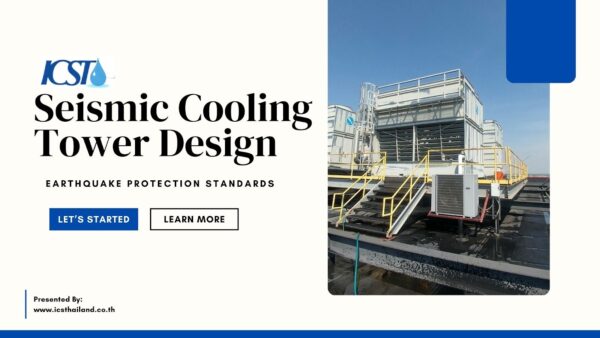
Designing industrial structures requires more than just managing operational loads; it demands preparation for the unpredictable forces of nature. Seismic cooling tower design is a specialized engineering discipline focused on ensuring these critical heat rejection systems withstand earthquake events without catastrophic failure. Unlike standard buildings, cooling towers present unique challenges due to their height, slender…
The engineering environment has shifted. In 2026, relying on manual spreadsheets for cooling tower sizing is no longer sufficient. Cooling tower design software has become essential for meeting new compliance standards, specifically the Ecodesign Regulation 2024/1834 and local environmental mandates, which demand precision that manual calculations cannot provide. Modern facility managers and engineers must move…
Industrial cooling system innovations are undergoing a radical transformation. The era of passive, energy-intensive systems is ending, driven by new regulations and the demand for higher performance. Regulatory shifts across the European Union and Asia are phasing out high-GWP refrigerants and inefficient legacy towers. Simultaneously, industries like high-density computing and heavy manufacturing now view cooling…