Explore ICST’s blog for expert insights and latest trends in industrial cooling solutions. Stay updated and optimize your plant’s performance today.
An IoT cooling tower monitoring architecture connects field-level sensors to edge gateways and cloud SCADA platforms, creating a continuous, end-to-end data pipeline. Industrial sensors measure temperature, conductivity, biocide residual, pH, and vibration in real time. Edge gateways translate Modbus and LoRaWAN signals into encrypted data streams for cloud delivery. Cloud SCADA platforms apply smart alert…
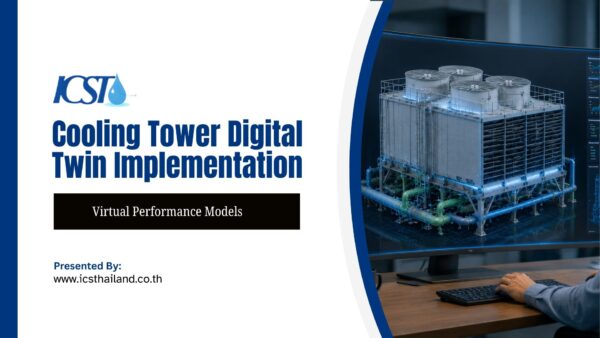
Cooling tower digital twin implementation helps industrial facilities in Thailand create a live virtual model of their industrial cooling towers. Teams compare real operating data against a validated performance curve to ensure continuous efficiency. This setup allows engineers to execute early fouling detection for scaling, airflow loss, or equipment wear. By using smart sensors, analytics,…
Cooling tower registration requirements in Thailand do not always follow one single national “cooling tower registry” system. Instead, Thai facilities usually manage cooling tower compliance through factory licensing, environmental controls, wastewater discharge rules, health and safety programs, industrial estate requirements, and local authority filings. Building owners and plant managers should confirm whether their site needs…
Effective cooling tower chemical safety management requires integrating strict OSHA compliance with mechanical fluid dynamics. Facilities must transition from passive paper records to active digital SDS management using point-of-use QR codes. To eliminate catastrophic chemical incompatibility risks such as toxic chlorine gas releases from side-stream co-feeding, engineering teams must isolate injection points using high-velocity dilution…
An effective ASHRAE 188 implementation cooling tower strategy requires a comprehensive water management plan to reduce Legionella risk within centralized building water systems. Facility managers must establish a multi-disciplinary team, draft precise fluid flow diagrams, and isolate critical control points prone to hazardous conditions. Compliance mandates continuous monitoring of disinfectant levels, strict pH regulation, and…
Obtaining the correct cooling tower environmental permits guarantees legal operation and regulatory compliance for your facility. Depending on your location and system size, you will likely need an air permit to control drift emissions and an NPDES permit to manage wastewater discharge. Some sites also require a stormwater permit, alongside strict adherence to a local…
A cooling tower OSHA compliance guide explains how facilities can protect workers and meet core safety regulations during cooling tower maintenance and operation. It focuses on fall protection for elevated platforms and fixed ladders, lockout tagout procedures for hazardous energy, confined space controls for basins and internal sections, and emergency eyewash access near chemical treatment…
A textile dyeing cooling tower helps dye houses control process heat, protect dye bath stability, and maintain repeatable fabric color. Textile dyeing depends on consistent water quality because pH, hardness, turbidity, suspended solids, sediment, iron, copper, zinc, chlorine, dissolved minerals, and process-water color can affect dyeing results and final fabric appearance. Strong process isolation, stainless…
Optimizing data center cooling tower PUE involves reducing energy consumption while maintaining high reliability. Key strategies include implementing N+2 redundancy to ensure efficient load distribution and leveraging free cooling hours to minimize chiller dependency. Tight approach temperatures, between 1.5°C and 2.5°C, enhance thermal efficiency, while advanced hydronic balancing eliminates pressure imbalances. Incorporating water-side economizers and…
An injection molding cooling tower removes excess process heat so manufacturers can maintain stable mold temperature, shorter cycle times, better part quality, and higher machine output. Cooling often takes the largest share of the molding cycle, so poor heat removal quickly increases scrap, warpage, dimensional variation, and production cost. Modern plastic molding plants use cooling…