Explore ICST’s blog for expert insights and latest trends in industrial cooling solutions. Stay updated and optimize your plant’s performance today.
Industrial cooling systems are essential for managing heat loads and ensuring operational safety. However, without a consistent strategy, even the most robust equipment eventually fails, leading to costly downtime and emergency repairs. A structured approach, built around a reliable cooling maintenance schedule template, transforms maintenance from a reactive scramble into a predictable routine. Implementing a…
Industrial cooling systems are complex beasts. They consist of pumps, heat exchangers, fans, and intricate control loops, all working in unison to dissipate heat. When one component fails, the entire system can grind to a halt, leading to costly downtime and potential equipment damage. Traditional troubleshooting often relies on ad-hoc checklists or the intuition of…
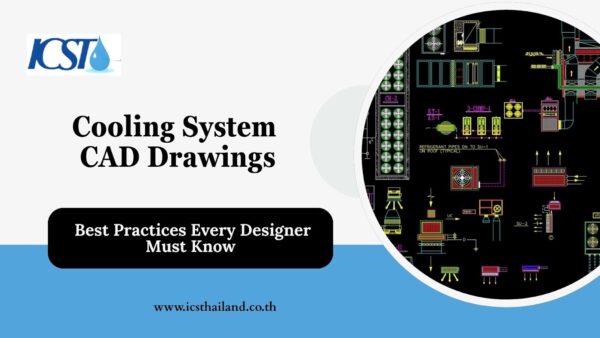
Thermal management is a critical component of modern infrastructure, yet the complexity of designing these systems requires more than just calculation. It demands precise, standardized documentation to ensure that what is designed can be built and maintained effectively. At the center of this process are cooling system CAD drawings, which serve as the visual language…
Cooling towers serve as the lungs of many industrial facilities, expelling waste heat to keep systems running smoothly. Yet, without precise data, operators essentially fly blind, risking inefficiency and equipment failure. Understanding how well your system operates is not just about keeping the water running; it is about optimizing energy use, conserving water, and extending…
Engineers and designers facing complex industrial or commercial projects necessitate absolute precision. Relying on manual spreadsheets or outdated estimation methods leaves too much room for costly errors and inefficiencies. This is where cooling system design software becomes critical for modern HVAC and industrial planning. This guide explores the essential tools, workflows, and selection strategies required…
Global temperatures are approaching the critical 1.5°C threshold. “Business as usual” cooling designs are reaching their breaking point. As we move into 2026, static equipment can no longer handle the aggressive thermal shifts we see today. Meeting climate change cooling requirements is now essential as the climate crisis demands a new approach. We must shift…
Rapid urbanization and industrial expansion act as primary catalysts for rising global temperatures in developed zones. Planners and engineers often attribute rising heat solely to climate change, yet they frequently overlook the massive heat loads generated by the built environment itself. We must analyze the specific infrastructure impact on cooling demand to understand future energy…
The regulatory landscape for industrial operations in Thailand is undergoing a significant transformation, with Thailand’s industrial cooling policies driving new compliance standards and business opportunities. As the country moves towards a future defined by sustainability and energy efficiency, the government is shifting from voluntary energy-saving programs to mandatory compliance. For businesses with industrial cooling needs,…
The Association of Southeast Asian Nations (ASEAN) is rapidly evolving into a global focal point for industrial and commercial cooling solutions. The ASEAN cooling equipment trade encompasses a diverse range of machinery, including industrial cooling systems, large-scale HVAC units, chillers, and specialized refrigeration equipment. This region has transitioned from a simple manufacturing base into a…
Thailand stands on the brink of a major industrial evolution. With leading Thailand cooling providers stepping up to meet the demand, the “Thailand 4.0” initiative drives rapid urbanization, while a surge in “NVIDIA-ready” data centers transforms the nation. Thailand is becoming the premier ASEAN cooling hub. This landscape demands more than simple equipment sales. It…