cooling tower heat recovery

Cooling Tower Heat Recovery: Capturing Waste Heat

Cooling tower heat recovery involves intercepting thermal energy before it leaves your facility. Industrial processes generate massive thermal loads continuously. Standard cooling systems dump this energy directly into the atmosphere. Capturing this resource transforms wasted energy into useful process heat. Engineers achieve waste heat capture using a dedicated heat exchanger, a secondary thermal loop, or…

VFD cooling tower fan application

Engineering Excellence: VFD Cooling Tower Fan Application

A VFD cooling tower fan application optimizes energy efficiency and system reliability by precisely controlling fan speed in response to cooling demand. Utilizing the cubic law, VFDs significantly reduce power consumption, with a 20% speed reduction saving up to 50% energy.  They also minimize mechanical stress through soft-start capabilities, extend equipment life, and ensure precise…

zero liquid discharge for cooling tower

Zero Liquid Discharge for Cooling Towers: Technology Guide

The strategy of zero liquid discharge for cooling tower operations eliminates all liquid waste by recovering and reusing water internally. Instead of draining blowdown water, industrial plants route it through reverse osmosis and thermal processing. Engineers achieve complete wastewater elimination by converting residual salts into solid waste. You extract pure water for reuse during this…

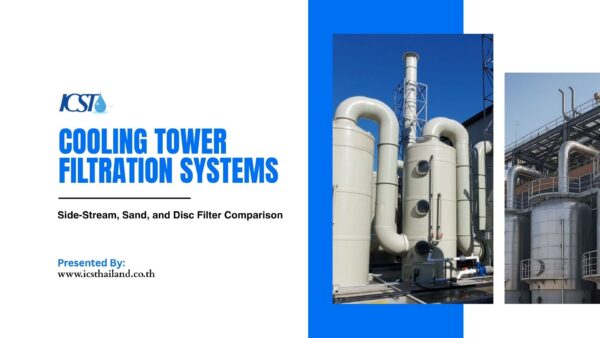
Cooling Tower Filtration Systems: Side-Stream, Sand, and Disc Filter Comparison

Cooling Tower Filtration Systems: Side-Stream, Sand, and Disc Filter Comparison

Cooling tower filtration systems remove suspended solids from circulating water to protect equipment, maintain thermal efficiency, and reduce operational risks. These systems target physical contaminants such as dust, sand, corrosion particles, and biological debris, but they do not remove dissolved solids like salts. In industrial environments, poor filtration is one of the leading causes of…

cooling tower chemical dosing design

Cooling tower chemical dosing design Guide (2026)

Automated chemical dosing systems in cooling towers optimize water treatment by ensuring precise chemical delivery to prevent scale, corrosion, and microbial growth. These systems use real-time sensors, such as conductivity and ORP controllers, to dynamically adjust dosing rates based on water conditions.  This approach reduces chemical waste, extends equipment life, and ensures compliance with environmental…

Cooling Tower Legionella Risk Management

Cooling Tower Legionella Risk Management 2026

Effective cooling tower Legionella risk management requires continuous automated monitoring and targeted dual-biocide treatments to stop dangerous bacterial outbreaks. In high-humidity environments, traditional manual checks fail to prevent rapid biofilm buildup.  You must implement a data-driven water management plan that actively tracks pH, temperature, and chemical levels in real time. By eliminating stagnant pipe zones…

Learn how a cooling tower biocide program uses oxidizing and non-oxidizing treatments to control microbial growth, prevent biofilm, and reduce Legionella risk.

Cooling Tower Biocide Program: Treatment Strategies

A cooling tower biocide program is essential for controlling microbial growth, preventing biofilm formation, and reducing Legionella risk. Oxidizing biocides such as chlorine and bromine provide fast, broad-spectrum disinfection, while non-oxidizing biocides penetrate biofilms and target resistant organisms. The most effective strategy combines both approaches through biocide rotation, controlled dosing, and residual monitoring. By balancing…

cooling tower corrosion control

Cooling Tower Corrosion Control Strategies

 Cooling tower corrosion control focuses on preventing metal degradation in industrial cooling systems through precise electrochemical management and inhibitor programs. In tropical climates like Southeast Asia, high humidity and temperatures accelerate corrosion, making standard methods inadequate.  Effective strategies include using molybdate inhibitors for anodic protection, azoles for copper alloys, and synergistic chemical blends to combat…

Cooling Tower Scale Prevention

Cooling Tower Scale Prevention: Chemistry, Inhibitors, and Monitoring

Effective cooling tower scale prevention requires controlling the precipitation of minerals such as calcium carbonate and silica, which form when water becomes concentrated during evaporation. These deposits reduce heat transfer efficiency and increase energy consumption. Preventing scale involves managing water chemistry, using chemical inhibitors, and continuous monitoring. A crucial parameter for this is the Langelier…

cooling tower water balance calculation

Cooling Tower Water Balance Calculation Guide

A cooling tower water balance calculation determines the exact amount of fresh water required to keep a cooling system operating efficiently. You complete this formula by ensuring the fresh makeup water added perfectly matches the total water lost through evaporation, controlled blowdown, and accidental drift.  Tracking these specific water loss points allows you to safely…